EduNinja
IB Biology HL/Notes/C4.1 Populations and communities

IB Biology HLC4.1 Populations and communitiesNotes

Define a Population

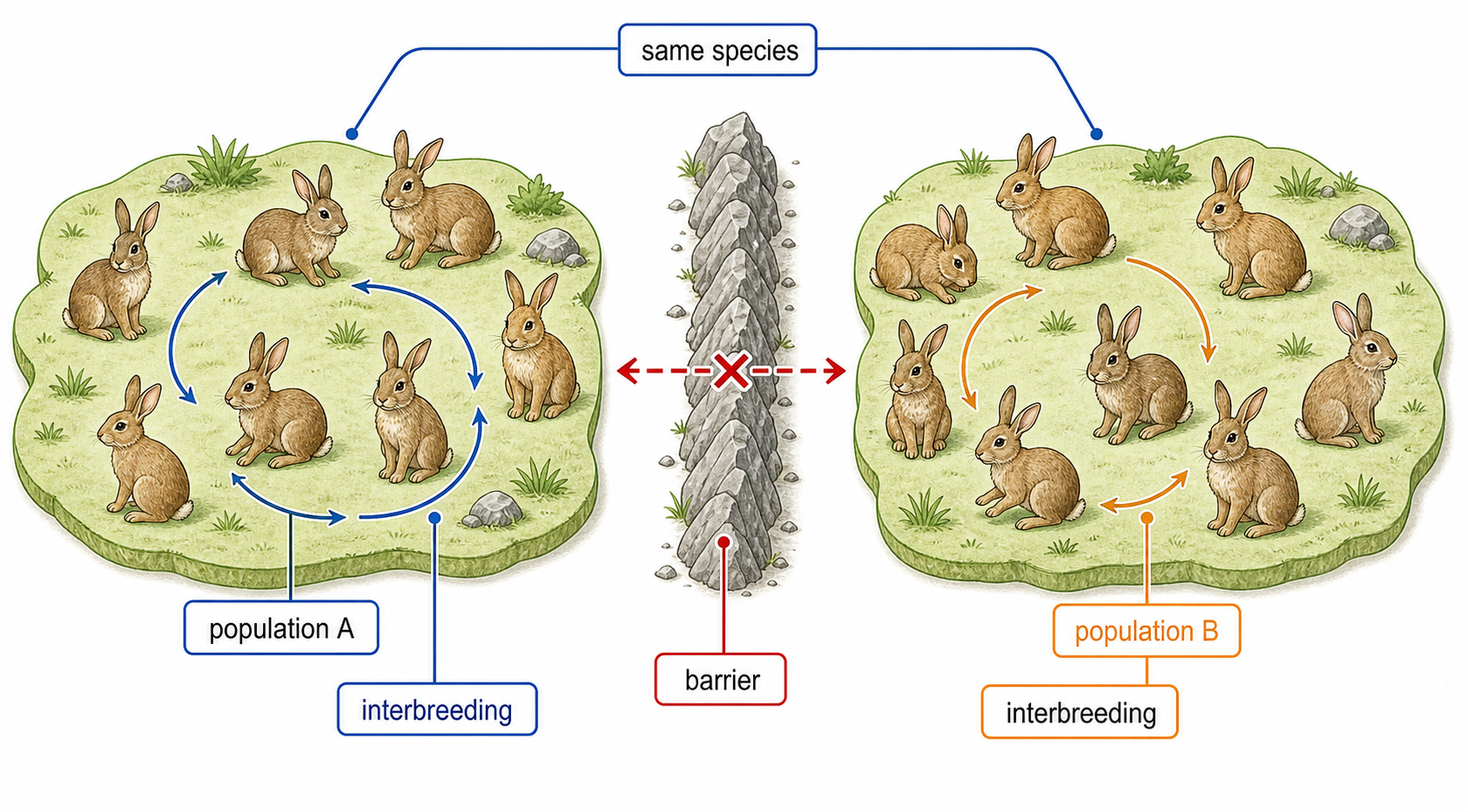
A population is not just a count of organisms. In IB wording, it is interacting organisms of the same species living in one area, where members have opportunities to interbreed and separate populations may be reproductively isolated from one another.

Same species is required.
One area is required.
Interaction and possible interbreeding make it a population rather than a loose list of organisms.

Population means same species plus shared area and interaction.

Match each ecological level to the correct wording.

Match
Reasons
0/3

Match each ecological level to the correct wording.

Choose
Population
Species
Community

Choose a Sampling Method

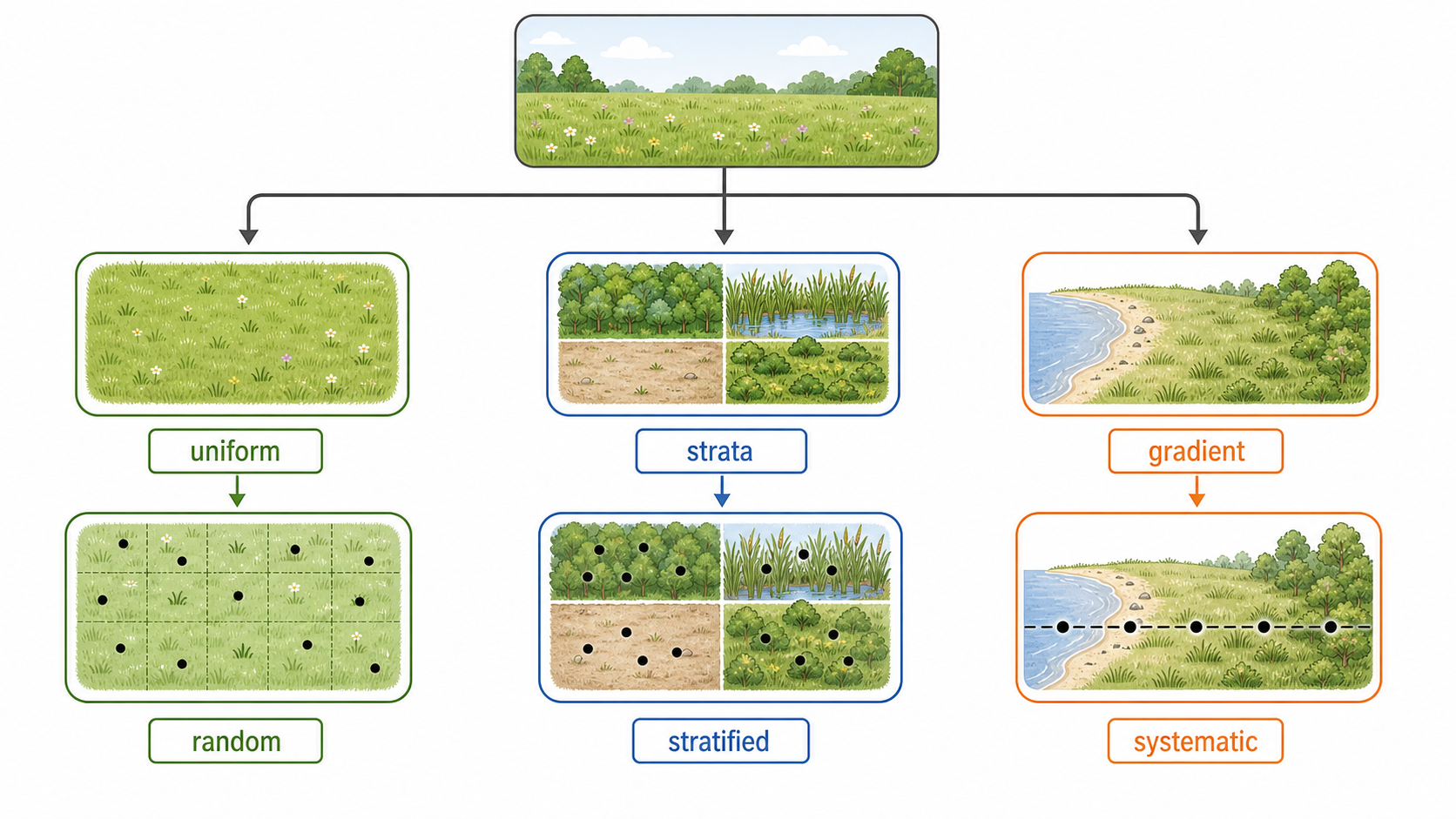
When a full count is impractical, the exam wants you to justify an estimate. Random sampling reduces bias in a fairly uniform habitat, stratified sampling covers known habitat zones, and systematic sampling samples along a gradient or transect.

Use estimation when counting every organism is impractical.
Random sampling reduces bias in uniform habitats.
Stratified sampling represents different zones.
Systematic sampling is useful along gradients.

Good population estimates match the sampling design to the habitat.

Sort each situation by the best sampling design.

Sort
Unsorted
4
random sampling
0
stratified sampling
0
systematic sampling
0

Sort each situation by the best sampling design.

Choose
similar grassland with no obvious zones
rocky shore with upper and lower zones
plants changing along a moisture gradient
large uniform pond edge where exact count is impractical

Place Random Quadrats

Practice

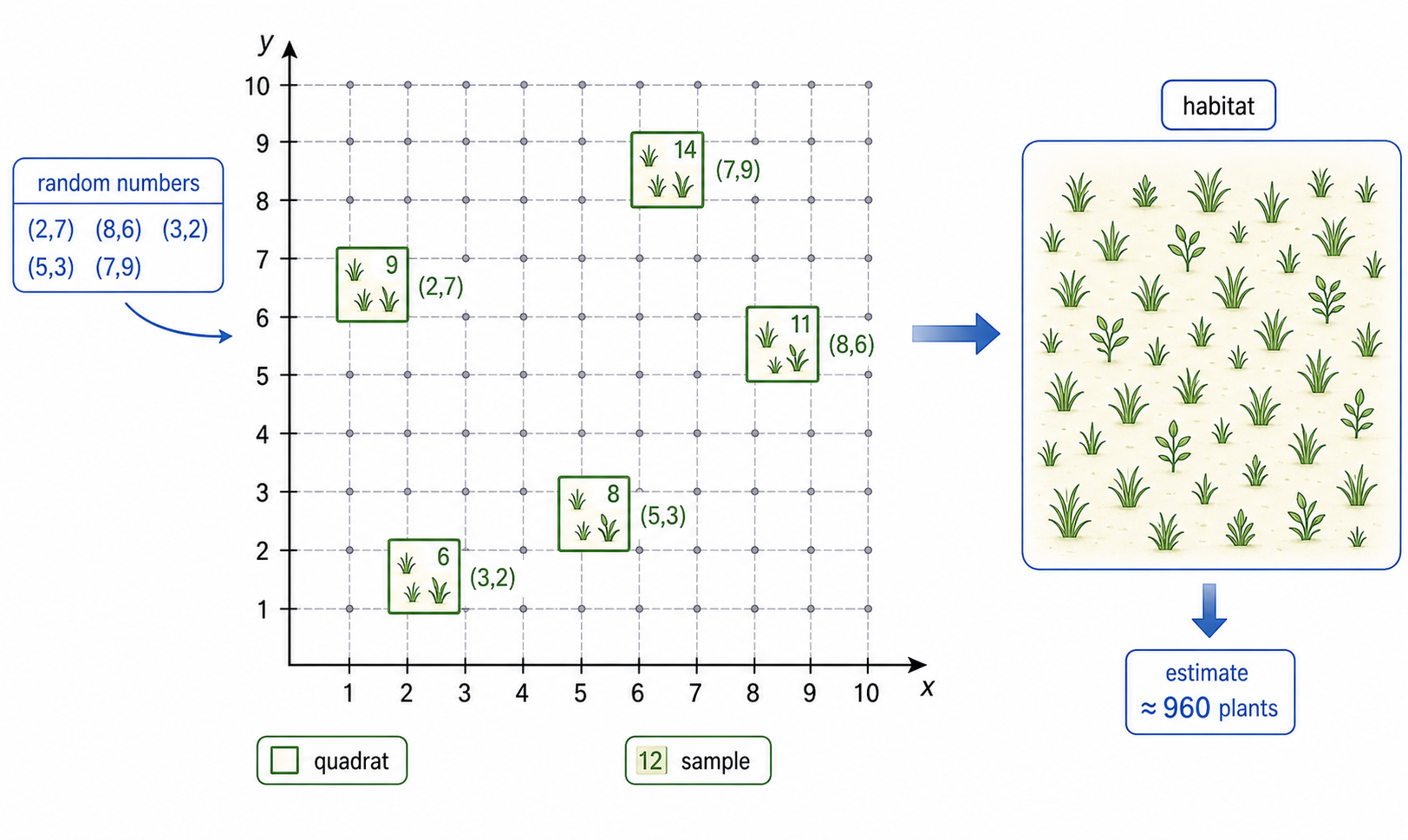
Quadrats work best for sessile organisms because you can sample a known area without the organism moving away. Random coordinates prevent the student from choosing convenient patches, and quadrat area lets density, frequency, cover, or abundance be scaled to the whole habitat.

Quadrats are for sessile organisms.
Random coordinates reduce sampling bias.
Known quadrat area allows density or abundance estimates.
Cover and frequency are often better than exact counts for many plants.

Random placement plus known area makes a quadrat estimate defensible.

Sort the fieldwork choices.

Sort
Unsorted
5
improves estimate
0
weakens estimate
0

Sort the fieldwork choices.

Choose
use random number coordinates
record quadrat area
sample only the densest patches
change quadrat size without recording it
repeat enough quadrats across the habitat

Use Capture-Mark-Recapture

Practice

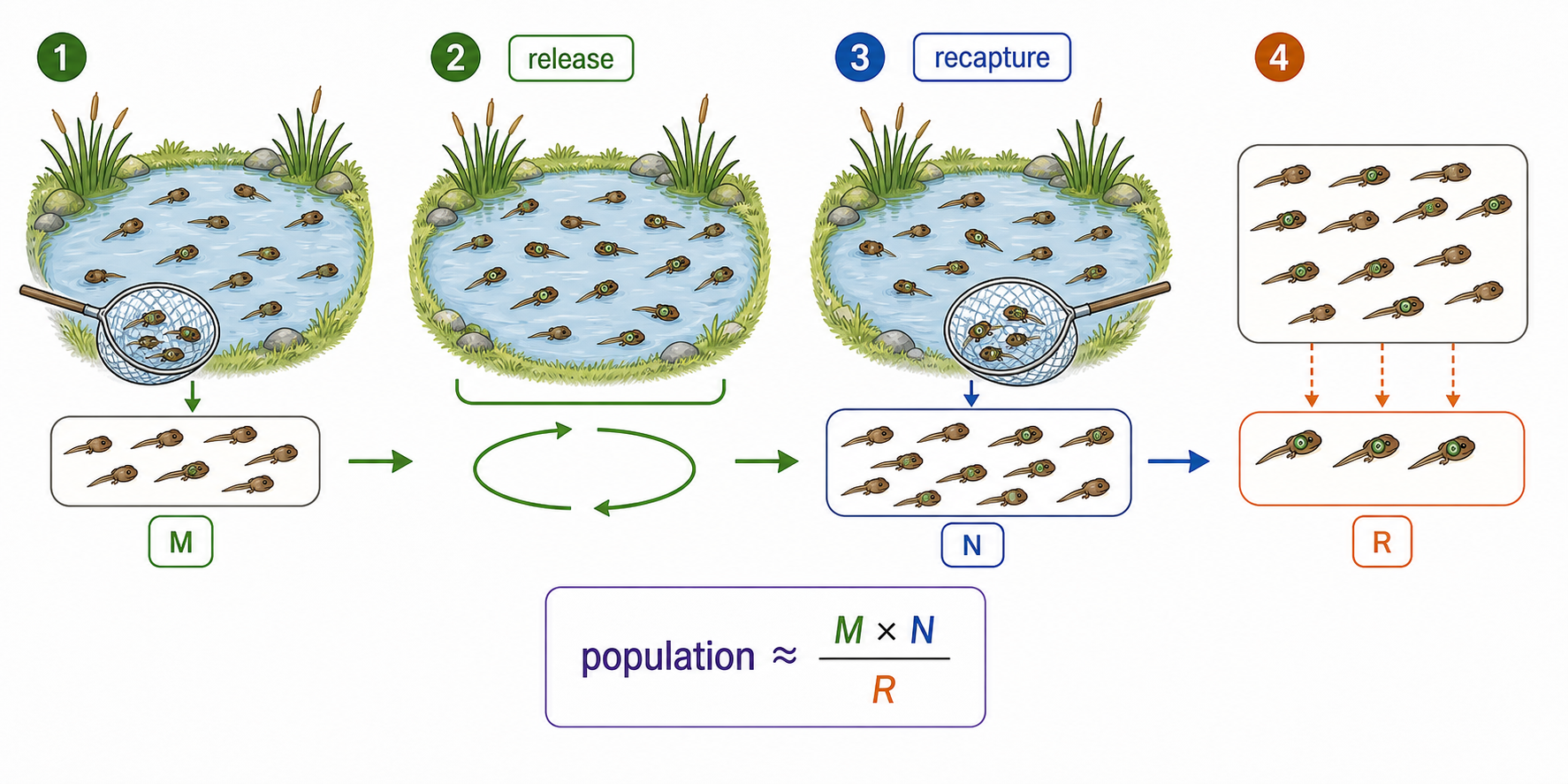
Capture-mark-release-recapture estimates motile animals by asking what fraction of the second sample was already marked. The Lincoln index is population estimate = M x N / R, but exam marks often also require assumptions: marks persist, animals mix, capture chance is similar, and marking does not affect survival.

Use capture-mark-release-recapture for motile animals.
Lincoln index: population estimate = M x N / R.
M is first marked, N is total recaptured, and R is marked recaptured.
The estimate is only as good as the assumptions.

The calculation compares marked animals in the second sample with the first marked group.

40 animals are marked first. Later 50 are recaptured, and 10 are marked. What is the best exam response?

Choose

40 animals are marked first. Later 50 are recaptured, and 10 are marked. What is the best exam response?

Choose

Explain Carrying Capacity

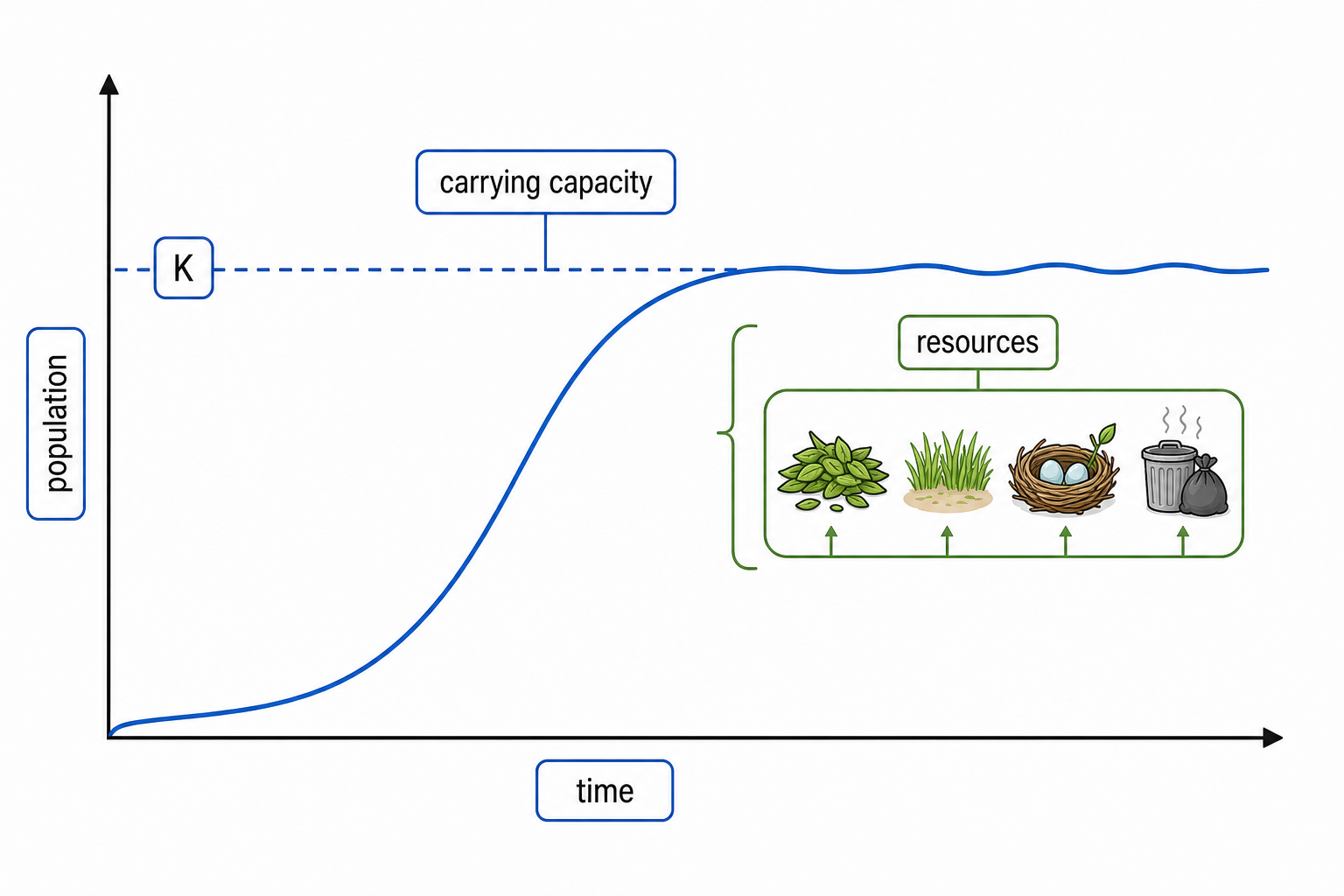
Carrying capacity is the maximum population an environment can sustain over time. The cause is limited resources: as food, space, mates, or light become scarce, competition increases, natality can fall, mortality can rise, and growth slows near the limit.

Carrying capacity is the maximum sustainable population.
It is caused by limiting resources, not by time alone.
Competition increases near capacity.
Growth slows or levels when natality and mortality balance.

The plateau is explained by limiting resources and competition.

A population is near carrying capacity and food supply decreases. Predict the growth-rate change.

Predict

A population is near carrying capacity and food supply decreases. Predict the growth-rate change.

Choose

Trace Negative Feedback

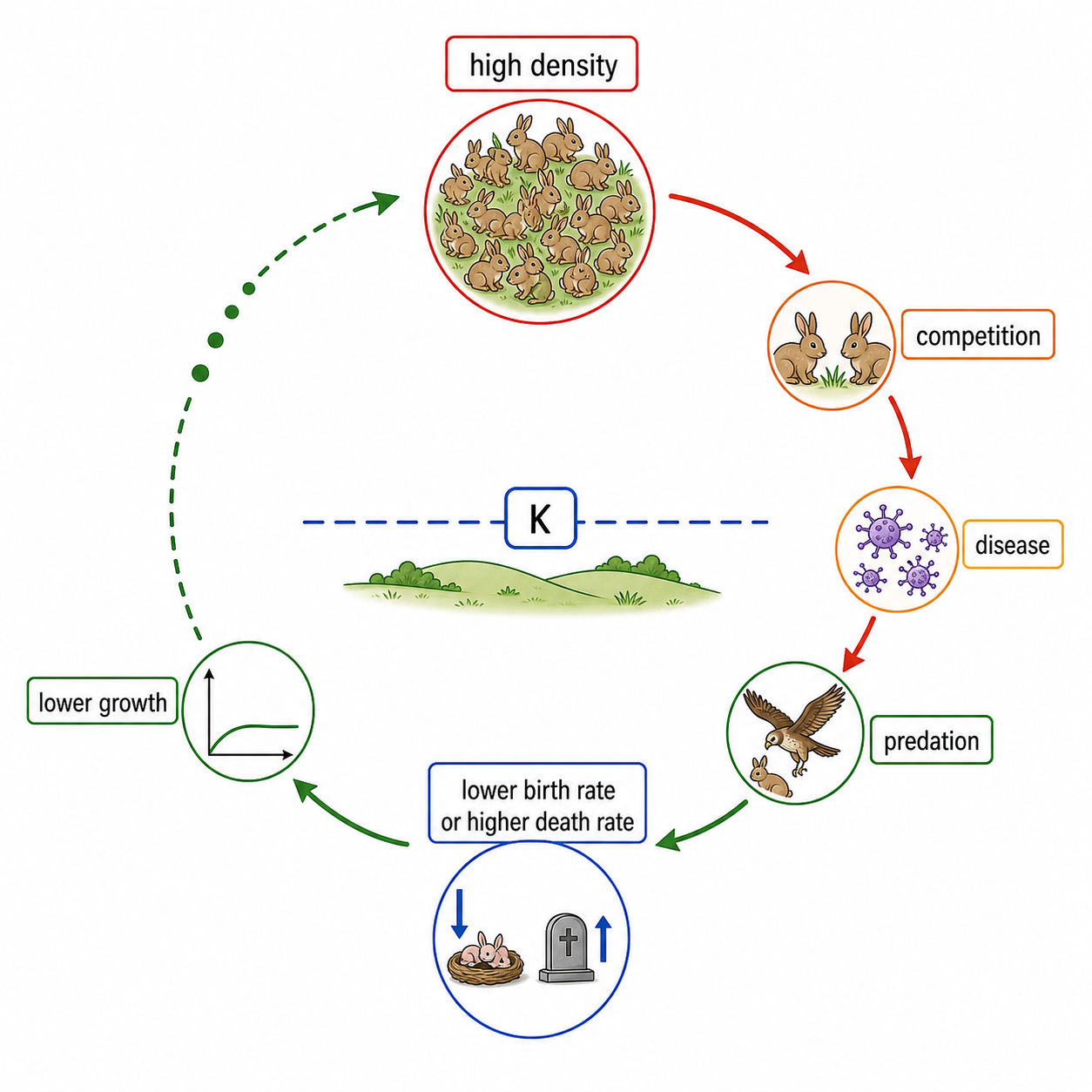
Negative feedback in populations means the control gets stronger as density rises. More crowded populations face stronger competition, predation, waste buildup, and disease, so mortality rises or natality falls and the population is pushed back toward carrying capacity.

Density-dependent factors strengthen as density rises.
Competition, predation, waste, and disease can regulate population size.
Negative feedback reduces deviation from carrying capacity.
Density-independent events may change numbers but do not get stronger because the population is crowded.

Density-dependent regulation is a feedback loop.

Sort each factor.

Sort
Unsorted
5
density-dependent feedback
0
density-independent disturbance
0

Sort each factor.

Choose
disease spreads faster in a crowded population
competition for nesting sites increases
a storm kills individuals regardless of density
predators find prey more easily when prey are abundant
drought affects a sparse and crowded population similarly

Compare Growth Curves

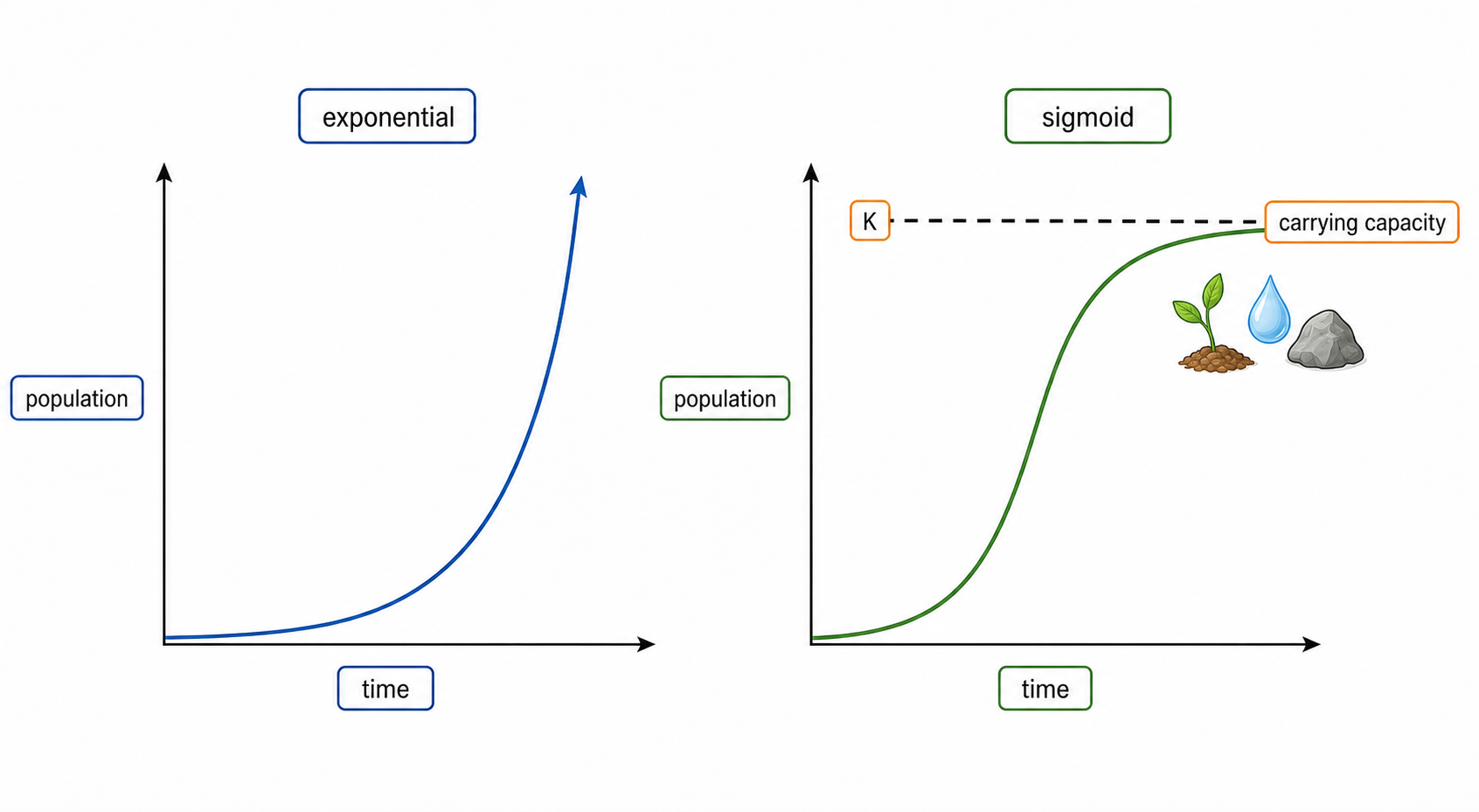
Exponential growth happens when resources are abundant and limiting factors are weak, so the population keeps accelerating. Sigmoid growth may begin with a fast increase, but it slows and levels off as resources become limiting near carrying capacity.

Exponential growth: abundant resources and weak limiting factors.
Sigmoid growth: lag, rapid growth, slowing, then plateau.
The plateau is carrying capacity.
The explanation should connect graph shape to resource limits.

Curve shape shows how limiting factors change.

Compare the two curves and pick the resource explanation.

Compare
A
J-shaped curve that keeps steepening
B
S-shaped curve that levels off at a plateau
Which curve indicates increasing resource limitation and why?

Compare the two curves and pick the resource explanation.

Choose
Models
J-shaped curve that keeps steepeningS-shaped curve that levels off at a plateau

Read a Sigmoid Model

Practice

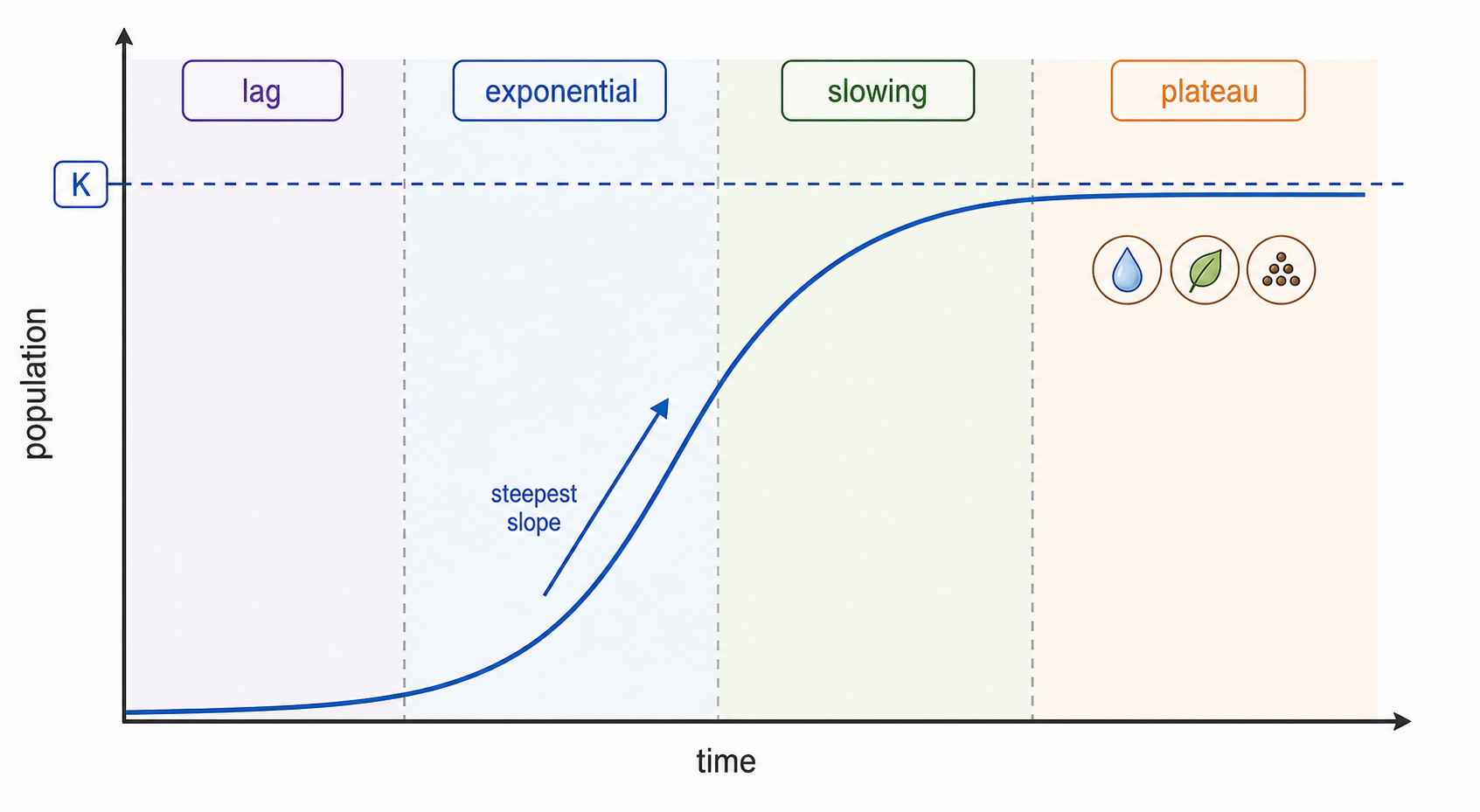
Fast-growing organisms such as yeast or duckweed make sigmoid growth visible in classroom data. Read the curve by slope: lag is slow adaptation, exponential is fastest increase, transition slows as limiting factors appear, and plateau shows little net growth near carrying capacity.

Yeast or duckweed can model sigmoid growth.
Lag, exponential, transition, and plateau phases show changing growth rate.
The steepest slope means the highest growth rate.
The plateau means birth and death rates are roughly balanced.

The slope, not just the height, shows growth rate.

Use the sigmoid graph phases to answer.

Graph

Use the sigmoid graph phases to answer.

Choose

Separate Competition and Cooperation

Practice

Within a population, individuals can compete or cooperate. Intraspecific competition occurs for limited food, mates, space, or light, while cooperation such as social hunting or parental care can increase survival and reproductive success.

Intraspecific means within the same species.
Competition reduces access to limited resources.
Cooperation can improve survival or reproduction.
Exam answers should state the fitness consequence.

Sort the same-species interactions.

Sort
Unsorted
5
intraspecific competition
0
cooperation
0

Define a Community

A community is all the interacting populations in an ecosystem. The key step up from population is that different species are now included, and their interactions make population changes interdependent within the abiotic environment.

A population is one species; a community includes interacting populations of different species.
Communities sit inside ecosystems with abiotic conditions.
Interactions make populations interdependent.
This definition prepares the species-relationship cards that follow.

A community is built from interacting populations.

Match the ecological level to the example.

Match
Reasons
0/3

Match the ecological level to the example.

Choose
Population
Community
Ecosystem

Classify Species Relationships

Practice

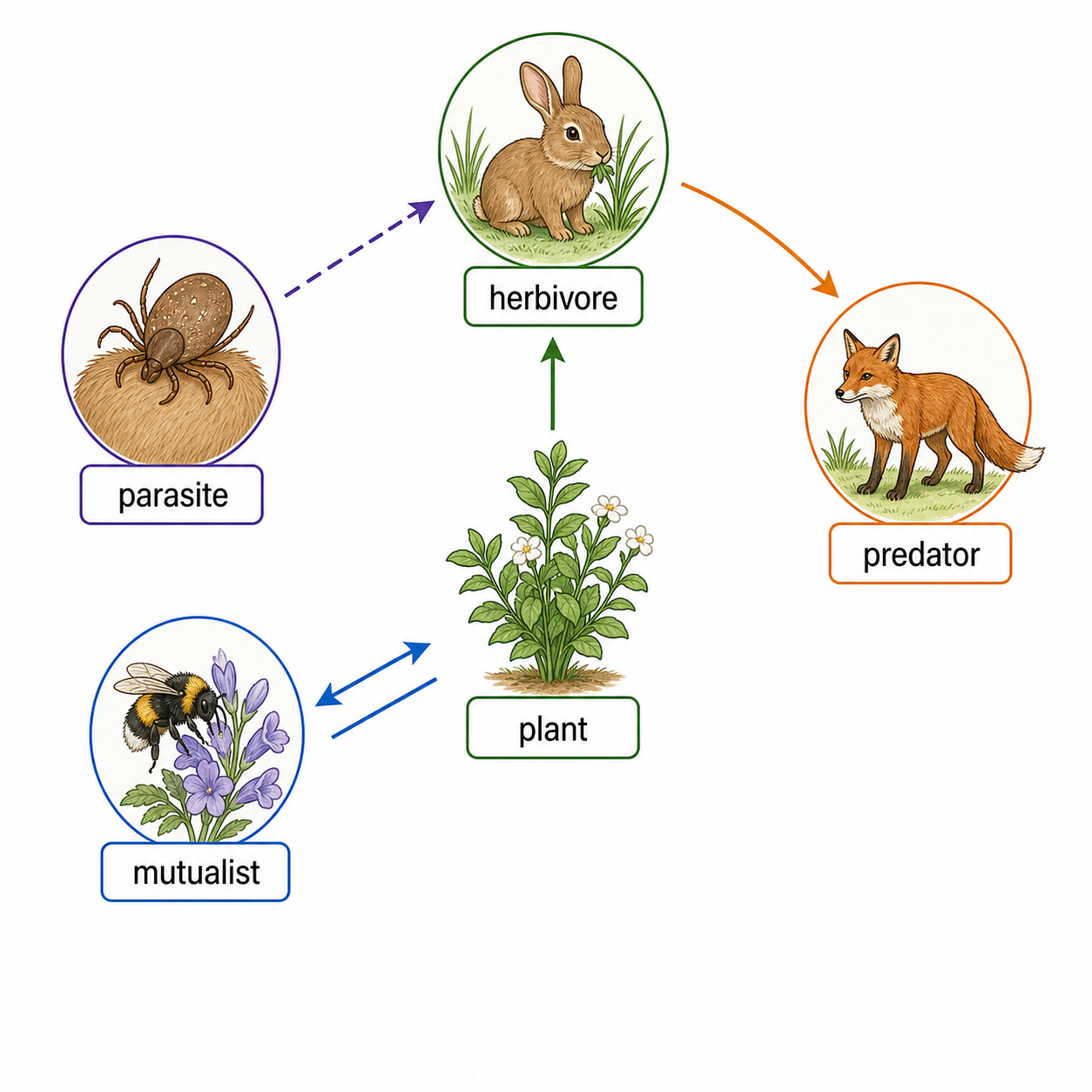
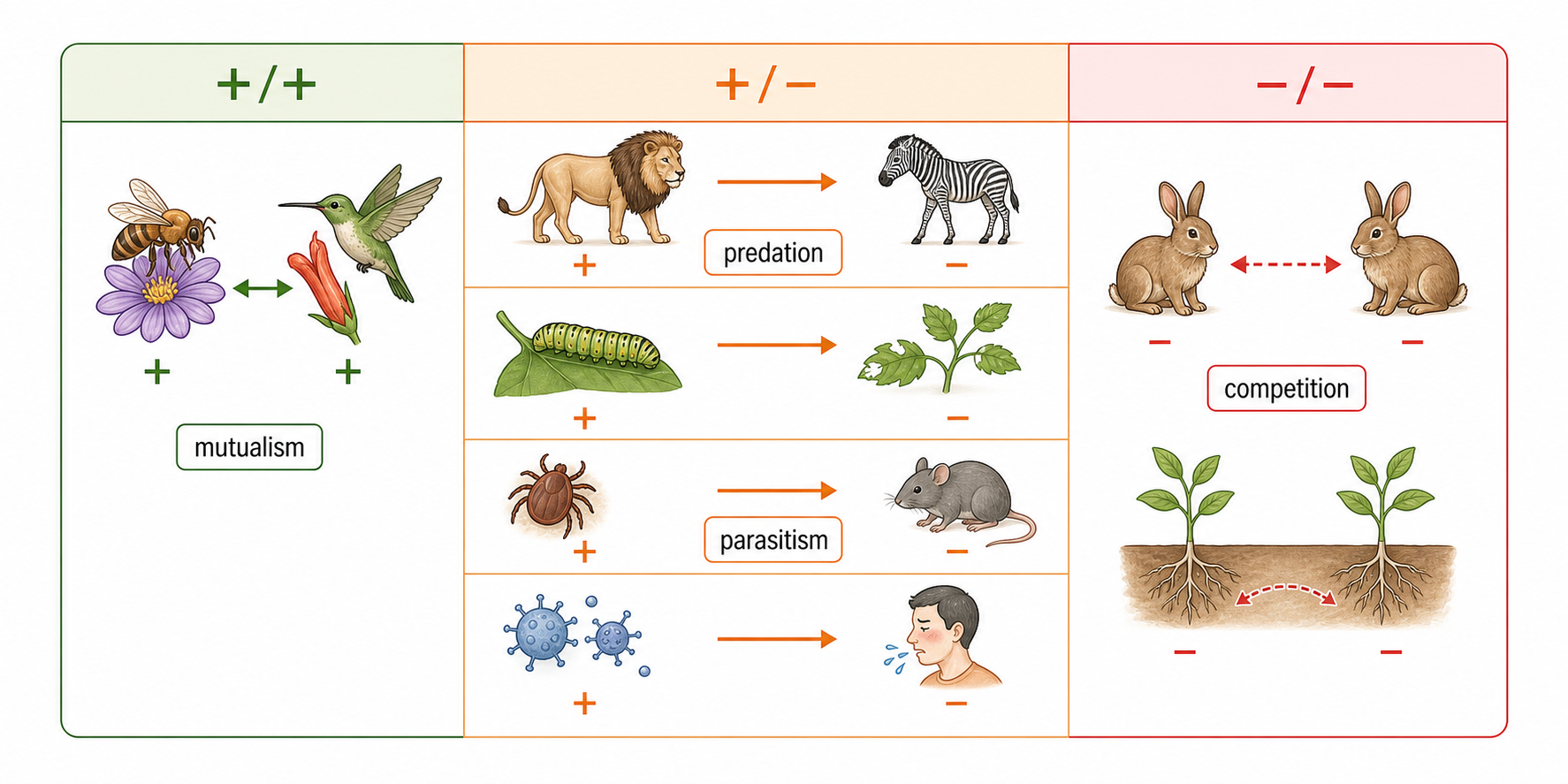
Interspecific relationships are interactions between different species in a community. Classify them by the effect on each species: predation and herbivory involve consumption, competition harms both through shared resource limits, mutualism benefits both, and parasitism or pathogenicity benefits one while harming the host.

Interspecific means between species.
Use benefit/harm logic to classify relationships.
Predation and herbivory involve consumption.
Parasitism and pathogenicity harm a host without the same pattern as immediate predation.

Benefit/harm logic sorts relationship names.

Match each relationship to its effect pattern.

Match
Reasons
0/4

Match each relationship to its effect pattern.

Choose
Mutualism
Competition
Predation
Parasitism/pathogenicity

Recognize Mutualism

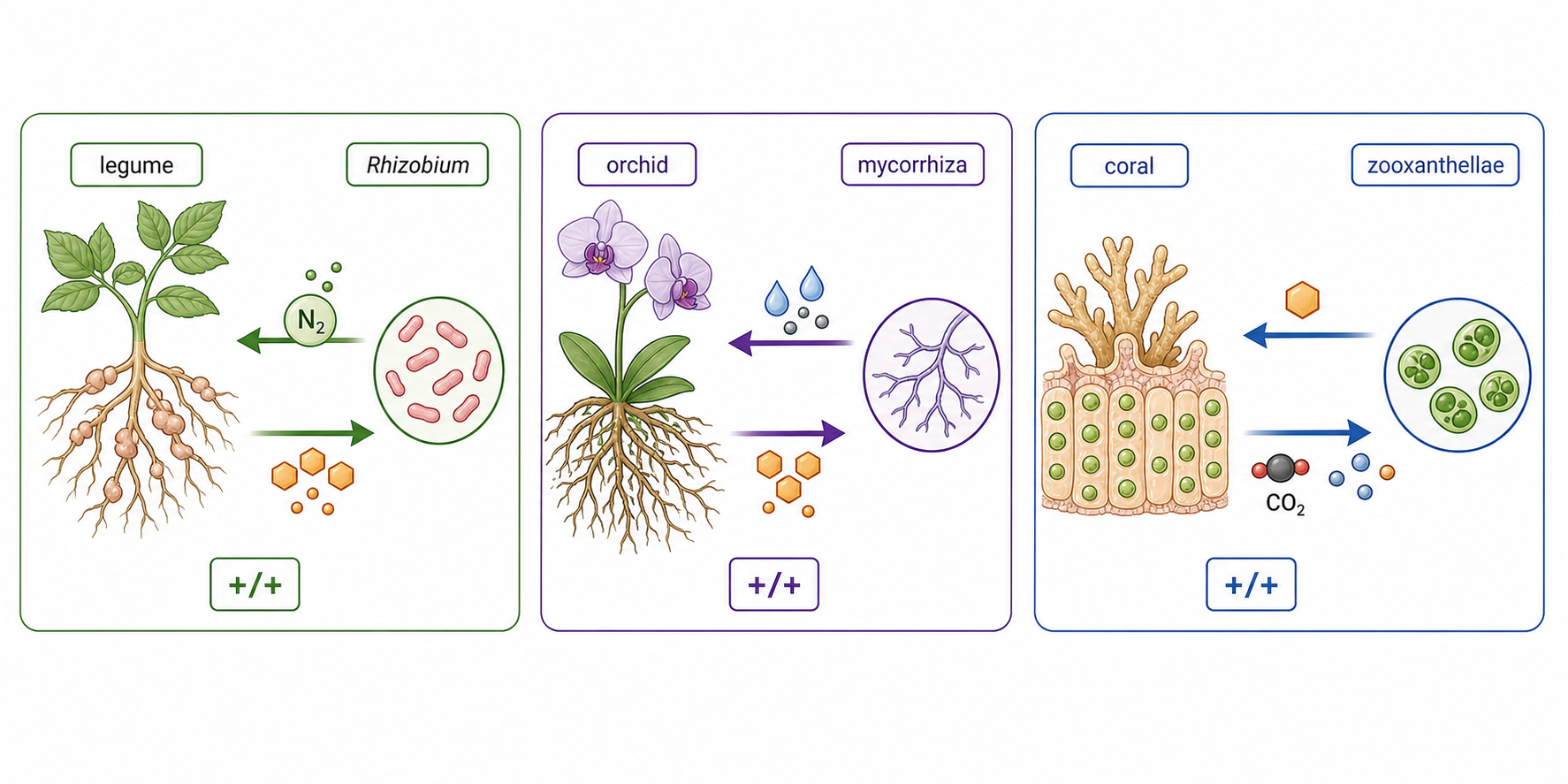
Mutualism means both species benefit, usually through exchanged resources or protection. IB examples worth recognizing are legumes and Rhizobium, orchids and mycorrhizae, and corals with zooxanthellae; in each case, state what each partner gains.

Mutualism benefits both species.
Legumes and Rhizobium exchange sugars and fixed nitrogen compounds.
Orchids and mycorrhizae link plant roots to fungal nutrient uptake.
Corals and zooxanthellae link animal shelter to photosynthetic products.

For mutualism, say what both partners gain.

Match each mutualism pair to the benefit logic.

Match
Reasons
0/3

Match each mutualism pair to the benefit logic.

Choose
Legume + Rhizobium
Orchid + mycorrhizae
Coral + zooxanthellae

Compare Endemic and Invasive Species

Practice
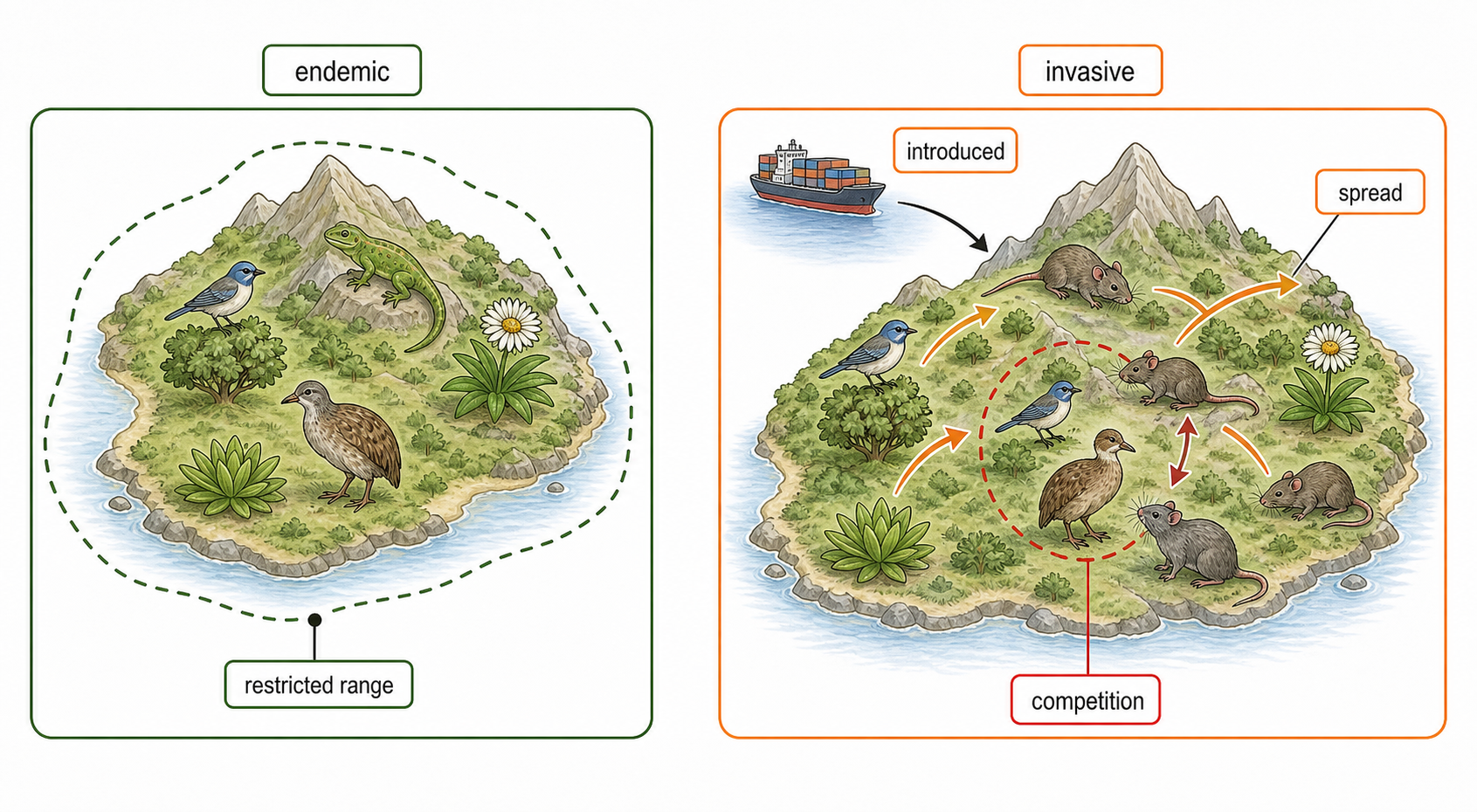
An endemic species is native to a restricted geographic area. An invasive species is introduced or spreading in a way that can escape normal controls and compete with endemic species for niche resources, so the exam often asks for both the definition and the ecological consequence.

Endemic means native to a restricted geographic area.
Invasive species can escape predators, diseases, or competitors that controlled them elsewhere.
Invasive species may compete with endemic species for niche resources.
Do not define invasive only as non-native; ecological impact matters.

Endemic is range; invasive is spread plus impact.

Compare the two species profiles.

Compare
A
A plant native only to one island chain and found nowhere else.
B
A fish introduced to a lake that spreads quickly and reduces native fish food supply.
Which is endemic, which is invasive, and what ecological consequence should be named?

Compare the two species profiles.

Choose
Models
A plant native only to one island chain and found nowhere else.A fish introduced to a lake that spreads quickly and reduces native fish food supply.

Test for Competition

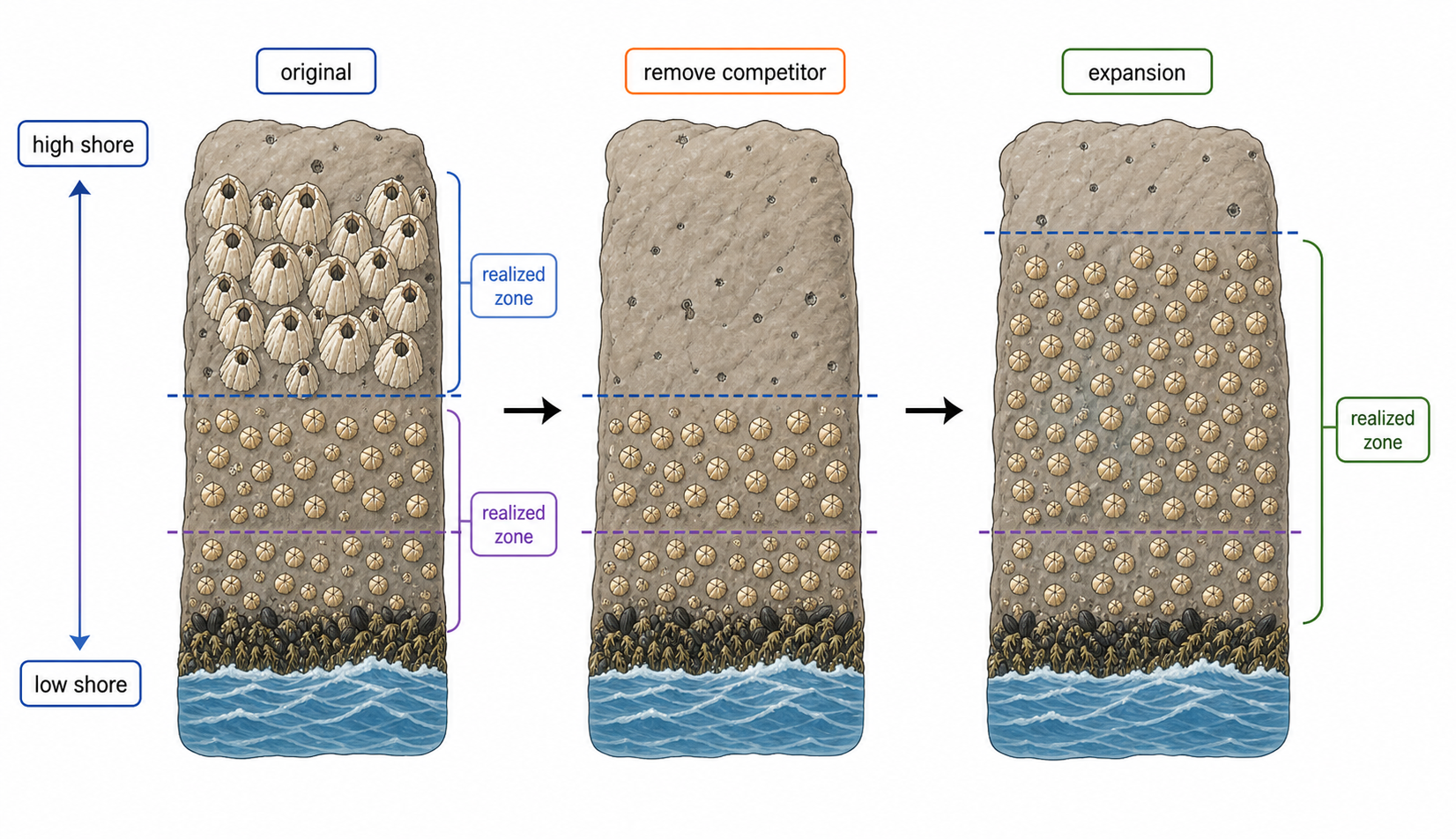
Competition is not proven just because two species occur in a pattern. Stronger evidence comes from lab experiments, field observations, or removal studies; Connell's barnacle study is the classic example because removing one species showed that the other could occupy a wider fundamental niche than its usual realized niche.

Competition can be tested by experiments, observations, or removal studies.
Removal studies are powerful because they manipulate the competitor.
Connell barnacles show fundamental versus realized niche.
A pattern alone is weaker than manipulated evidence.

Removal studies test whether competition limits realized niche.

A barnacle expands lower down the shore only after a competitor is removed. What does this show?

Predict

A barnacle expands lower down the shore only after a competitor is removed. What does this show?

Choose

Use the Chi-Squared Test

Practice

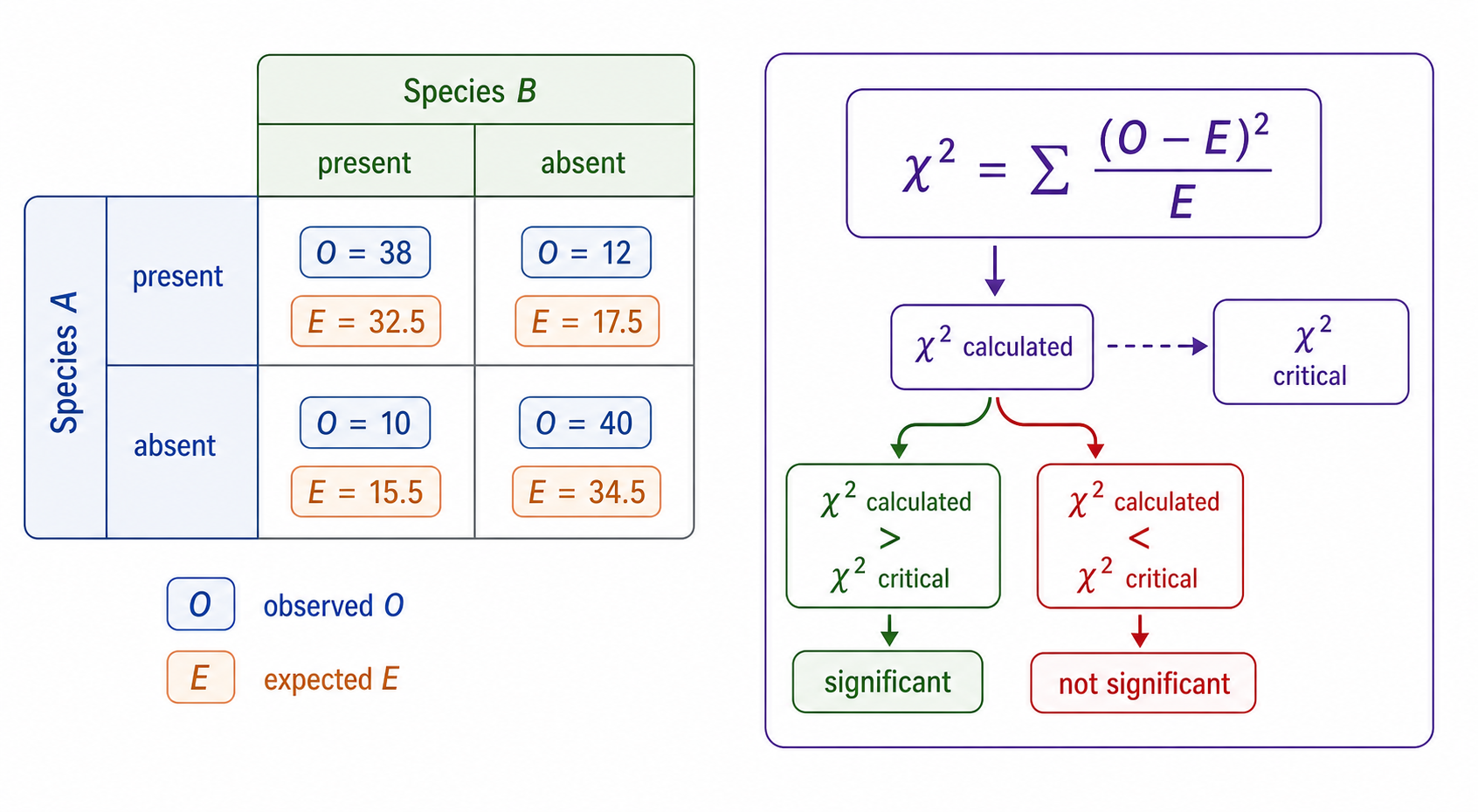
A chi-squared test checks whether the presence or absence of two species is associated in quadrat data. The exam route is: make a 2 x 2 table, calculate expected counts from row total x column total / grand total, calculate chi-squared, use degrees of freedom, compare with the critical value, then interpret association cautiously.

Chi-squared tests association between two species from presence/absence data.
Expected count = row total x column total / grand total.
For a 2 x 2 table, degrees of freedom = 1.
A significant association can support competition, but does not prove the mechanism alone.

Statistics tests association; biology explains mechanism.

Read the chi-squared workflow.

Graph

Read the chi-squared workflow.

Choose

Track Predator-Prey Cycles

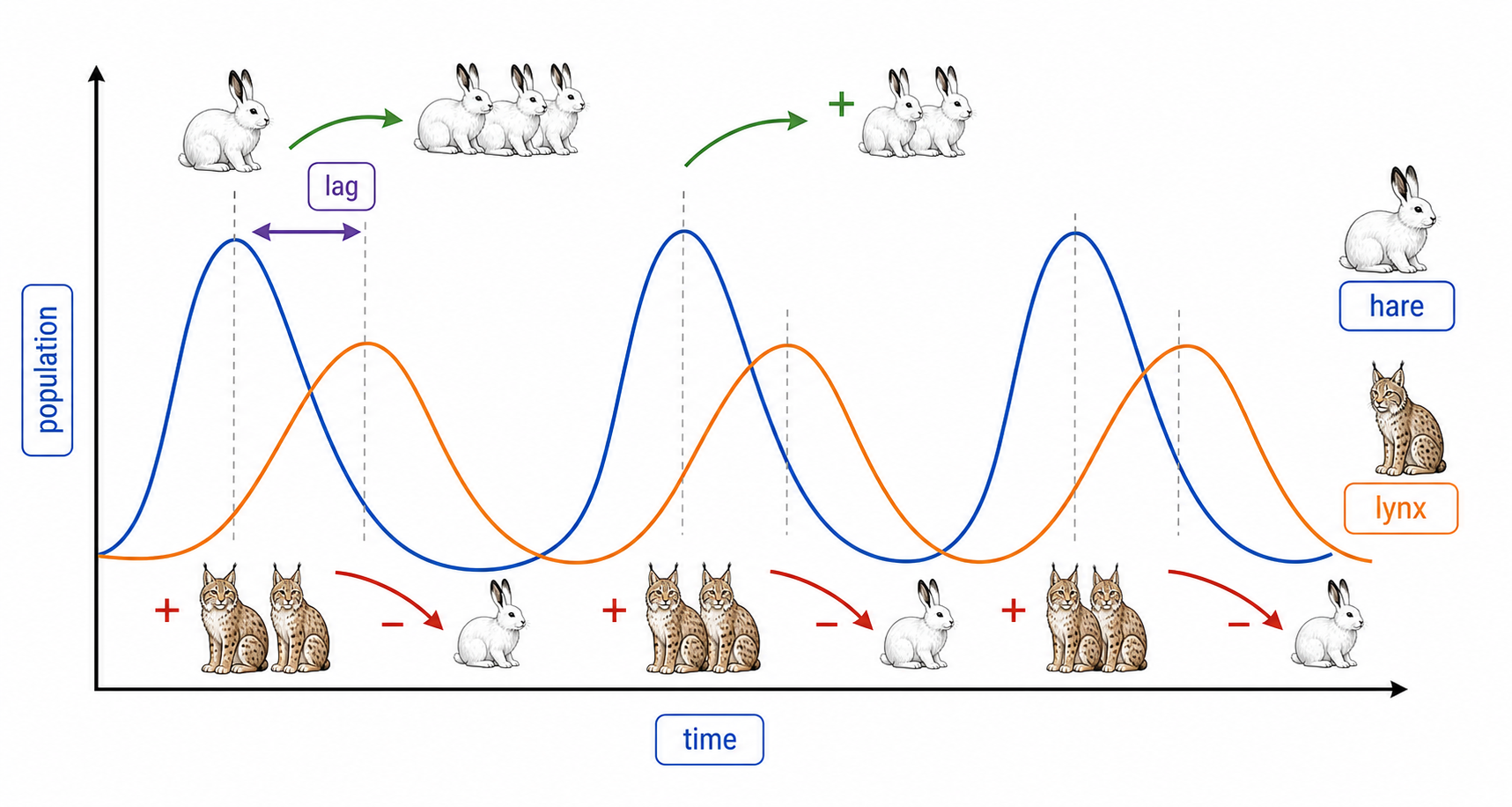
Predator-prey relationships regulate populations through density-dependent feedback. In the snowshoe hare and lynx cycle, hare numbers rise first, lynx numbers rise after a time lag, higher predation pushes hare numbers down, and the lynx population later falls because food is reduced.

Prey usually peak before predators.
Predator peaks lag because reproduction and survival respond after prey abundance changes.
Predation can regulate prey density.
The cycle is feedback, not two unrelated waves.

Prey change first; predator response lags.

Interpret the predator-prey cycle.

Graph

Interpret the predator-prey cycle.

Choose

Compare Top-Down and Bottom-Up Control

Practice
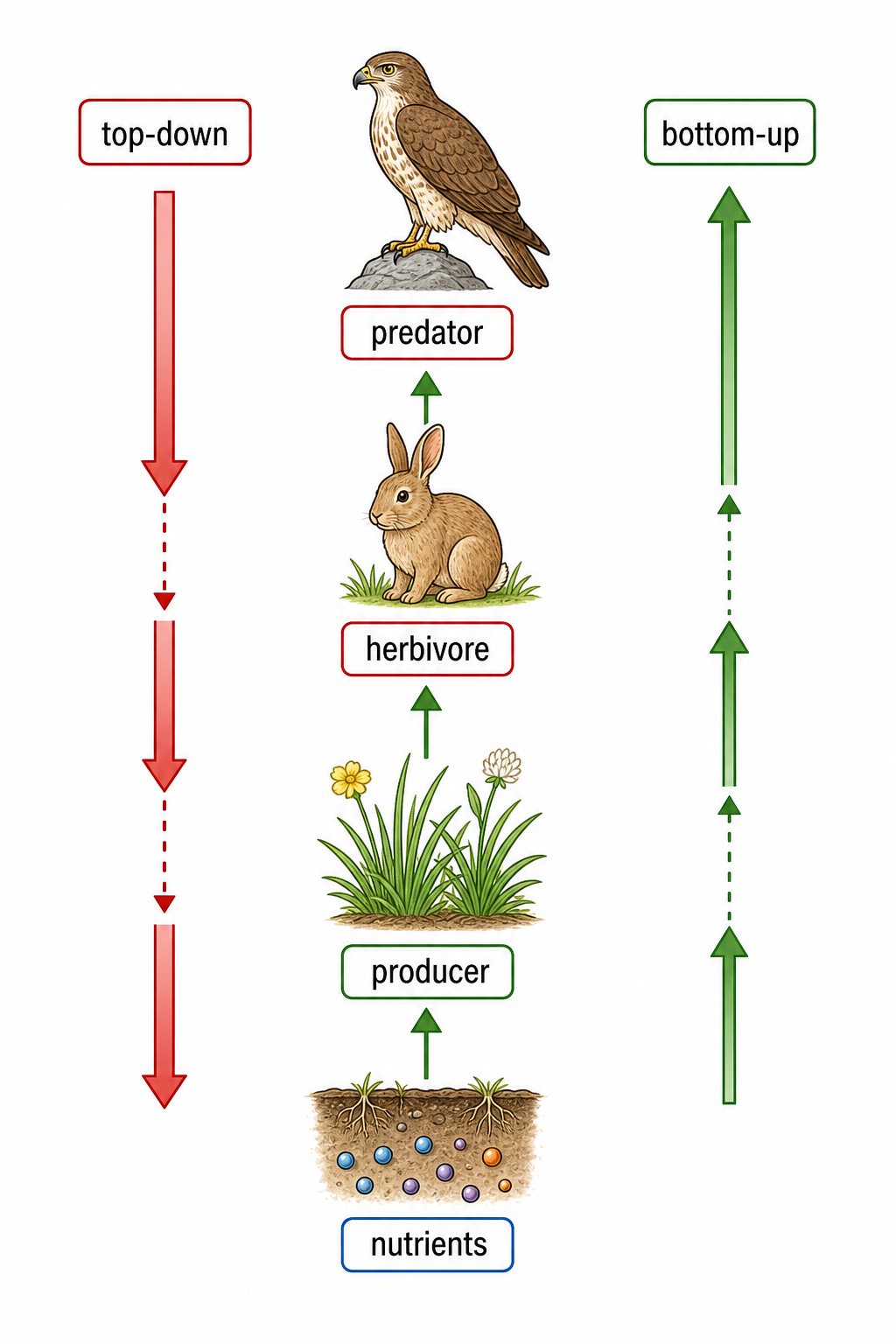
Top-down control starts with predators or consumers and cascades to lower trophic levels. Bottom-up control starts with producers, nutrients, or resource supply and then affects organisms higher in the food web; the key is the starting point of the causal change.

Top-down begins with predators or consumers.
Bottom-up begins with producers or resources.
Classify by direction of causation, not by increase/decrease.
Both can change community structure.

Control type depends on where the causal change starts.

Sort each scenario by control direction.

Sort
Unsorted
4
top-down control
0
bottom-up control
0

Sort each scenario by control direction.

Choose
predator removal releases herbivore populations
nutrient increase raises producer biomass and later herbivores
consumer increase reduces prey and changes plant biomass
producer biomass drops and higher trophic levels later shrink

Link Allelopathy and Antibiotics

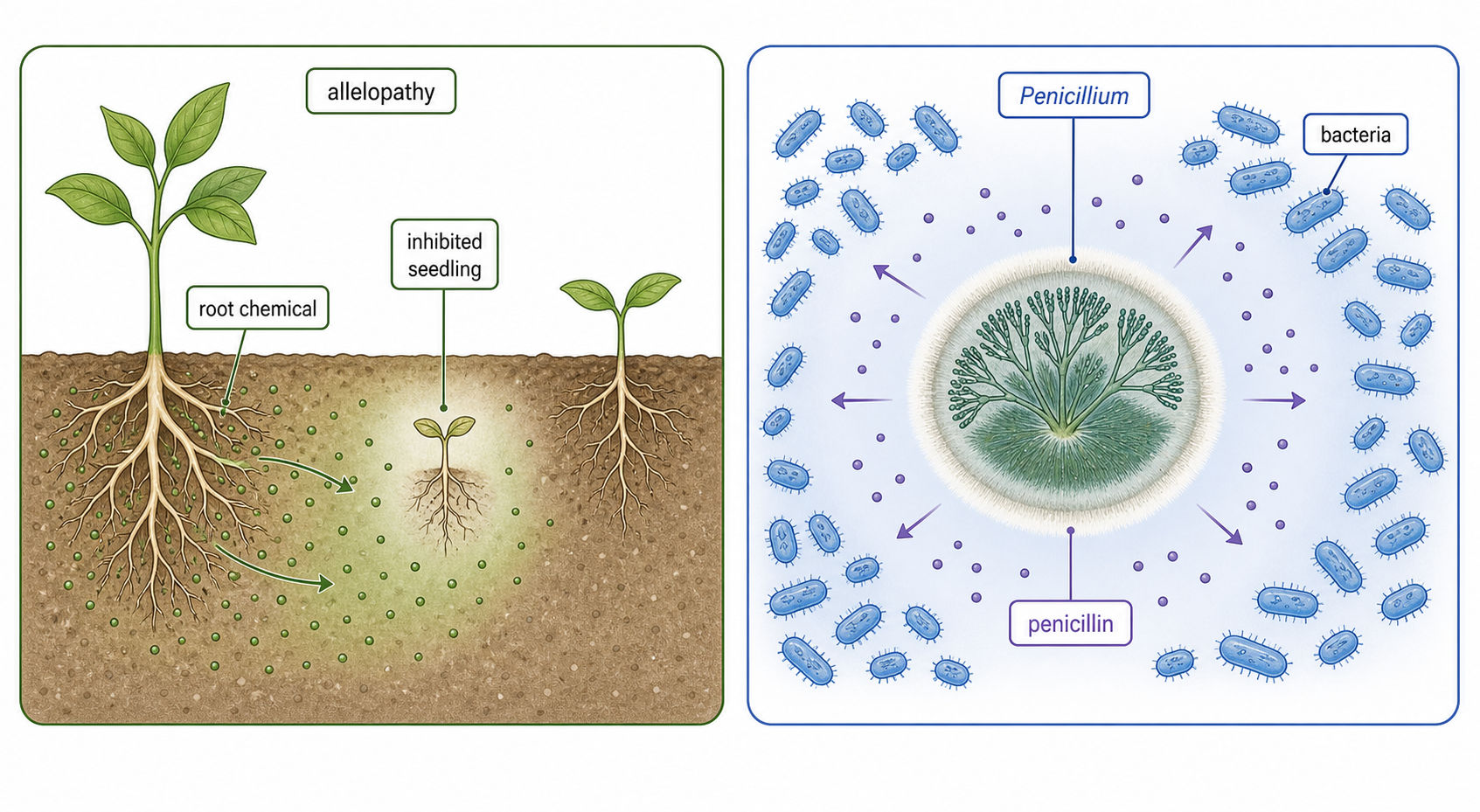
Allelopathy is chemical competition: one organism releases chemicals that inhibit the germination or growth of competitors. Antibiotics are microbial allelochemicals, so penicillin from Penicillium is a clear example of a chemical released by one organism that inhibits another.

Allelopathy releases chemicals into the environment.
The chemicals inhibit competitor germination or growth.
Antibiotics are microbial allelochemicals.
Penicillin from Penicillium is the named example to remember.

Allelopathy and antibiotics both show chemical competition.

Match the chemical interaction to its consequence.

Match
Reasons
0/3

Match the chemical interaction to its consequence.

Choose
Allelopathic plant
Penicillium
Antibiotic

Transfer: Explain Populations and Communities

Exam Practice

C4.1 can be organized as a connected answer chain. Population: interacting organisms of the same species in one area, with possible interbreeding and possible reproductive isolation from other populations. Sampling: use estimates when full counts are impractical; choose random, stratified, or systematic sampling to reduce bias for the habitat pattern. Quadrats: estimate density, frequency, cover, or abundance of sessile organisms using random coordinates and known quadrat area. Capture-mark-release-recapture: estimate motile animal populations with Lincoln index M x N / R and check marks, mixing, capture chance, and survival assumptions. Carrying capacity: maximum population an environment can sustain because food, space, mates, light, or other resources become limiting. Negative feedback: density-dependent factors such as competition, predation, waste, and disease strengthen as density rises and push populations back toward carrying capacity. Growth curves: exponential growth occurs with abundant resources and weak limiting factors; sigmoid growth slows near carrying capacity. Sigmoid modelling: yeast or duckweed can show lag, exponential, transition, and plateau phases; slope shows growth rate. Intraspecific interactions: competition reduces access to food, mates, space, or light; cooperation such as social hunting or parental care can increase survival and reproduction. Community: all interacting populations in an ecosystem, with species interdependent inside the abiotic environment. Interspecific relationships: classify herbivory, predation, competition, mutualism, parasitism, and pathogenicity by benefit, harm, consumption, or infection. Mutualism: both species benefit; examples include legumes and Rhizobium, orchids and mycorrhizae, and corals with zooxanthellae. Endemic versus invasive: endemic species are native to a restricted geographic area; invasive species can escape controls and compete with endemic species for niche resources. Testing competition: lab experiments, field observations, and removal studies such as Connell barnacles provide evidence; removal can reveal fundamental versus realized niche. Chi-squared: test association between two species using quadrat presence/absence data, observed and expected counts, degrees of freedom, and critical values. Predator-prey: predator and prey populations regulate each other by density-dependent feedback; snowshoe hare and lynx cycles show prey peaks followed by predator peaks after a time lag. Top-down versus bottom-up: top-down starts with predators or consumers and cascades downward; bottom-up starts with producers or resources and affects higher trophic levels. Allelopathy and antibiotics: allelopathy releases chemicals that inhibit competitor germination or growth; antibiotics such as penicillin from Penicillium are microbial allelochemicals.

Population: interacting organisms of the same species in one area, with possible interbreeding and possible reproductive isolation from other populations.
Sampling: use estimates when full counts are impractical; choose random, stratified, or systematic sampling to reduce bias for the habitat pattern.
Quadrats: estimate density, frequency, cover, or abundance of sessile organisms using random coordinates and known quadrat area.
Capture-mark-release-recapture: estimate motile animal populations with Lincoln index M x N / R and check marks, mixing, capture chance, and survival assumptions.
Carrying capacity: maximum population an environment can sustain because food, space, mates, light, or other resources become limiting.
Negative feedback: density-dependent factors such as competition, predation, waste, and disease strengthen as density rises and push populations back toward carrying capacity.
Growth curves: exponential growth occurs with abundant resources and weak limiting factors; sigmoid growth slows near carrying capacity.
Sigmoid modelling: yeast or duckweed can show lag, exponential, transition, and plateau phases; slope shows growth rate.
Intraspecific interactions: competition reduces access to food, mates, space, or light; cooperation such as social hunting or parental care can increase survival and reproduction.
Community: all interacting populations in an ecosystem, with species interdependent inside the abiotic environment.
Interspecific relationships: classify herbivory, predation, competition, mutualism, parasitism, and pathogenicity by benefit, harm, consumption, or infection.
Mutualism: both species benefit; examples include legumes and Rhizobium, orchids and mycorrhizae, and corals with zooxanthellae.
Endemic versus invasive: endemic species are native to a restricted geographic area; invasive species can escape controls and compete with endemic species for niche resources.
Testing competition: lab experiments, field observations, and removal studies such as Connell barnacles provide evidence; removal can reveal fundamental versus realized niche.
Chi-squared: test association between two species using quadrat presence/absence data, observed and expected counts, degrees of freedom, and critical values.
Predator-prey: predator and prey populations regulate each other by density-dependent feedback; snowshoe hare and lynx cycles show prey peaks followed by predator peaks after a time lag.
Top-down versus bottom-up: top-down starts with predators or consumers and cascades downward; bottom-up starts with producers or resources and affects higher trophic levels.
Allelopathy and antibiotics: allelopathy releases chemicals that inhibit competitor germination or growth; antibiotics such as penicillin from Penicillium are microbial allelochemicals.

Put the C4.1 exam answer frame in order.

Order
1
define whether the question is about a population, community, or ecosystem
2
classify species relationships using benefit, harm, consumption, or infection
3
interpret growth using resources, carrying capacity, and density-dependent feedback
4
choose the correct sampling or statistical method and state why it reduces bias or tests association
5
evaluate evidence such as removal studies, predator-prey lag, chi-squared association, or trophic control direction

Use this for exam questions that combine field sampling, population regulation, graph interpretation, interspecific relationships, statistical association, and ecosystem control.

Population: interacting organisms of the same species in one area, with possible interbreeding and possible reproductive isolation from other populations.
Sampling: use estimates when full counts are impractical; choose random, stratified, or systematic sampling to reduce bias for the habitat pattern.
Quadrats: estimate density, frequency, cover, or abundance of sessile organisms using random coordinates and known quadrat area.
Capture-mark-release-recapture: estimate motile animal populations with Lincoln index M x N / R and check marks, mixing, capture chance, and survival assumptions.
Carrying capacity: maximum population an environment can sustain because food, space, mates, light, or other resources become limiting.
Negative feedback: density-dependent factors such as competition, predation, waste, and disease strengthen as density rises and push populations back toward carrying capacity.
Growth curves: exponential growth occurs with abundant resources and weak limiting factors; sigmoid growth slows near carrying capacity.
Sigmoid modelling: yeast or duckweed can show lag, exponential, transition, and plateau phases; slope shows growth rate.
Intraspecific interactions: competition reduces access to food, mates, space, or light; cooperation such as social hunting or parental care can increase survival and reproduction.
Community: all interacting populations in an ecosystem, with species interdependent inside the abiotic environment.
Interspecific relationships: classify herbivory, predation, competition, mutualism, parasitism, and pathogenicity by benefit, harm, consumption, or infection.
Mutualism: both species benefit; examples include legumes and Rhizobium, orchids and mycorrhizae, and corals with zooxanthellae.
Endemic versus invasive: endemic species are native to a restricted geographic area; invasive species can escape controls and compete with endemic species for niche resources.
Testing competition: lab experiments, field observations, and removal studies such as Connell barnacles provide evidence; removal can reveal fundamental versus realized niche.
Chi-squared: test association between two species using quadrat presence/absence data, observed and expected counts, degrees of freedom, and critical values.
Predator-prey: predator and prey populations regulate each other by density-dependent feedback; snowshoe hare and lynx cycles show prey peaks followed by predator peaks after a time lag.
Top-down versus bottom-up: top-down starts with predators or consumers and cascades downward; bottom-up starts with producers or resources and affects higher trophic levels.
Allelopathy and antibiotics: allelopathy releases chemicals that inhibit competitor germination or growth; antibiotics such as penicillin from Penicillium are microbial allelochemicals.

Use this for exam questions that combine field sampling, population regulation, graph interpretation, interspecific relationships, statistical association, and ecosystem control.

Common loss: naming a method, graph phase, or relationship without explaining the evidence, assumption, or biological consequence.