EduNinja
IB Biology HL/Notes/C2.1 Chemical signalling [HL only]

IB Biology HLC2.1 Chemical signalling [HL only]Notes

Bind The Right Ligand
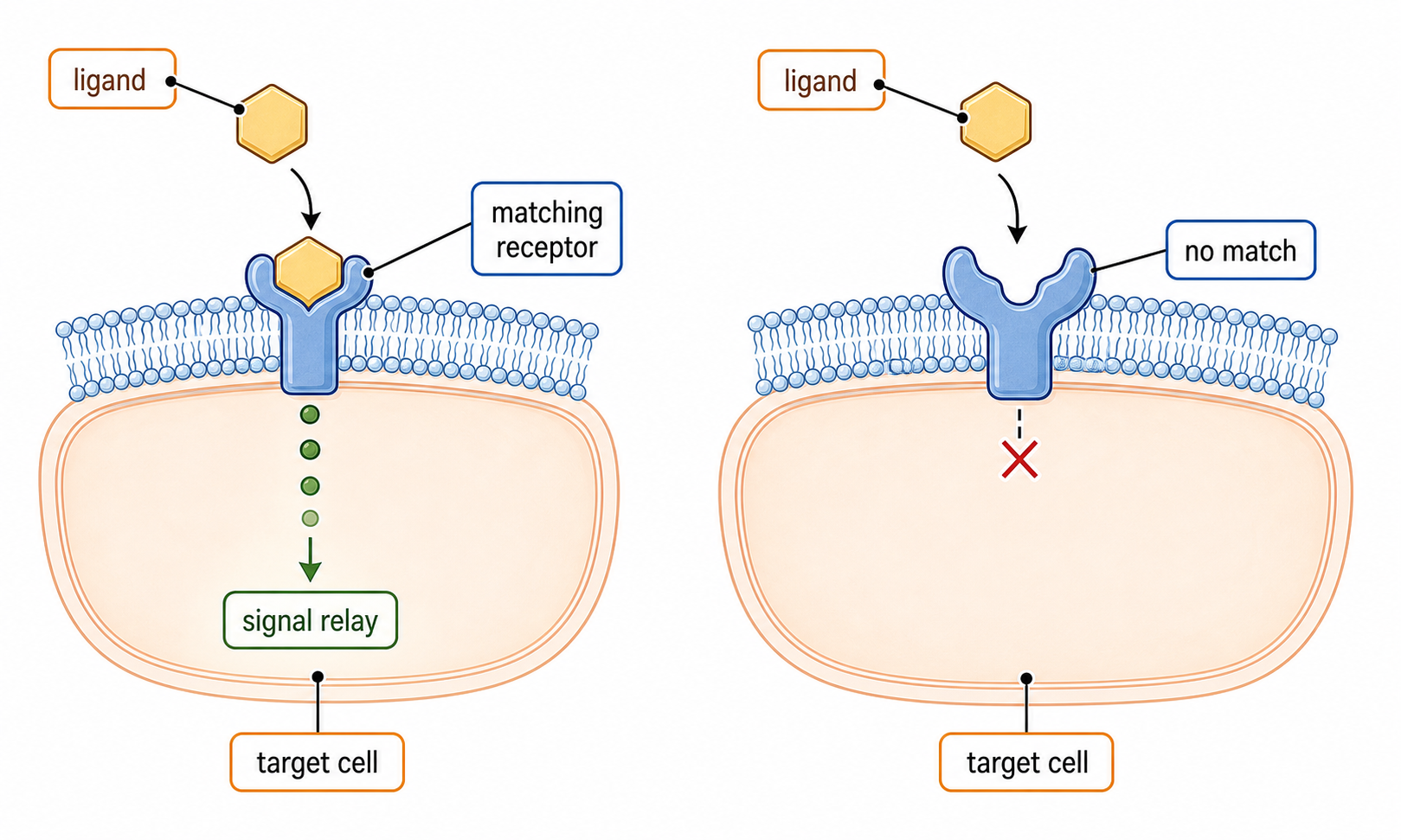
Receptor proteins act as gatekeepers for chemical signalling. They have binding sites specific to signalling ligands. Only target cells with the matching receptor respond, because ligand binding changes the receptor and starts signal transduction inside the cell.

Receptor proteins have binding sites specific to signalling ligands.
Ligand binding starts signal transduction in target cells.
Specificity explains why a chemical signal affects only target cells, not every cell nearby.

Match each phrase to receptor matching or downstream response.

Match
Reasons
0/4

Sense A Quorum Threshold

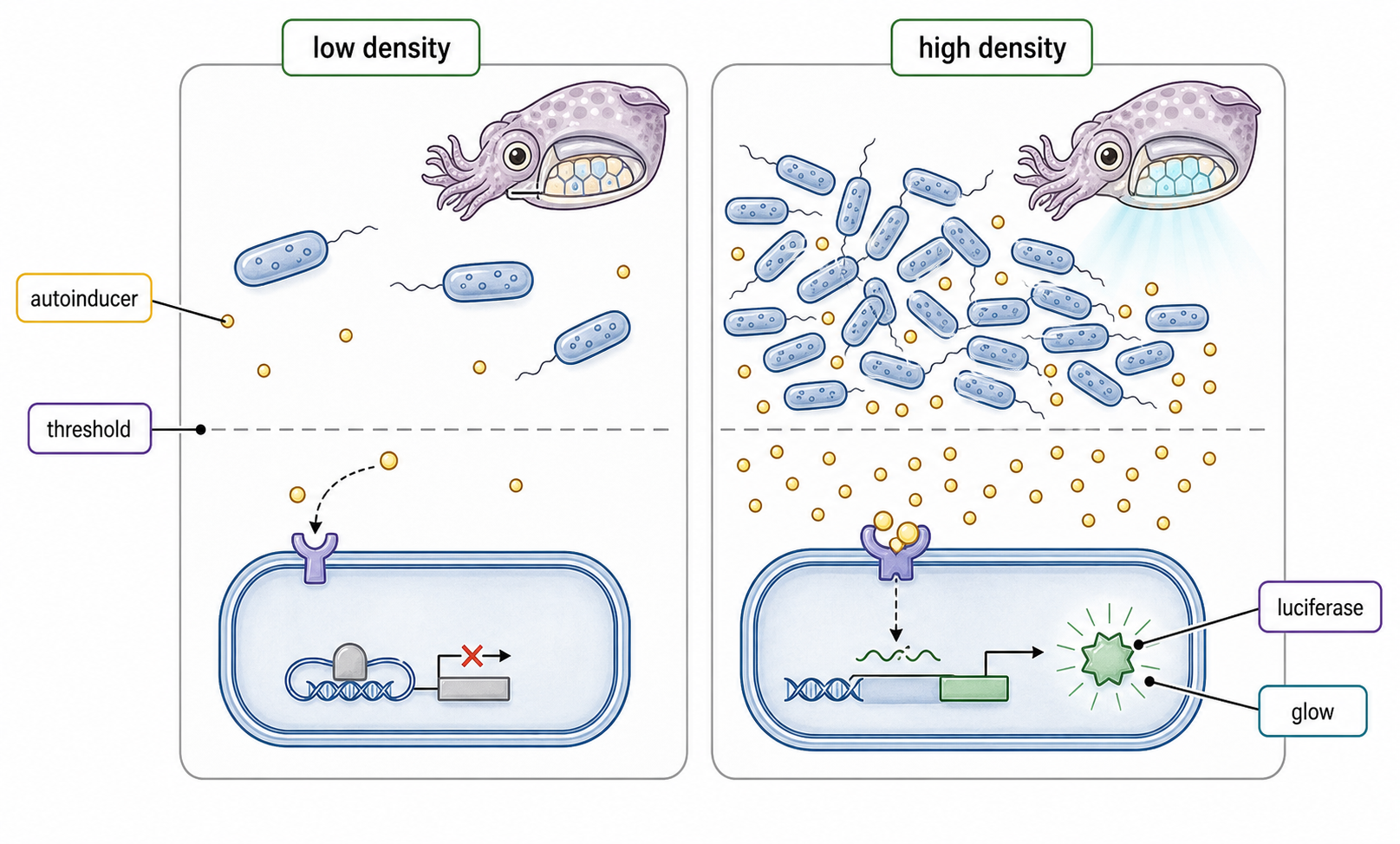
Quorum sensing is a threshold story. Autoinducers allow bacteria to detect population density thresholds. As density rises, autoinducers accumulate; once the threshold is reached, many cells change gene expression together. Vibrio fischeri bioluminescence and biofilm formation are key examples.

Autoinducers allow bacteria to detect population density thresholds.
Vibrio fischeri bioluminescence and biofilm formation are key examples.
The response depends on group density, not one isolated bacterium.

Predict which bacterial culture switches on quorum-sensing genes.

Predict

Compare Signal Types

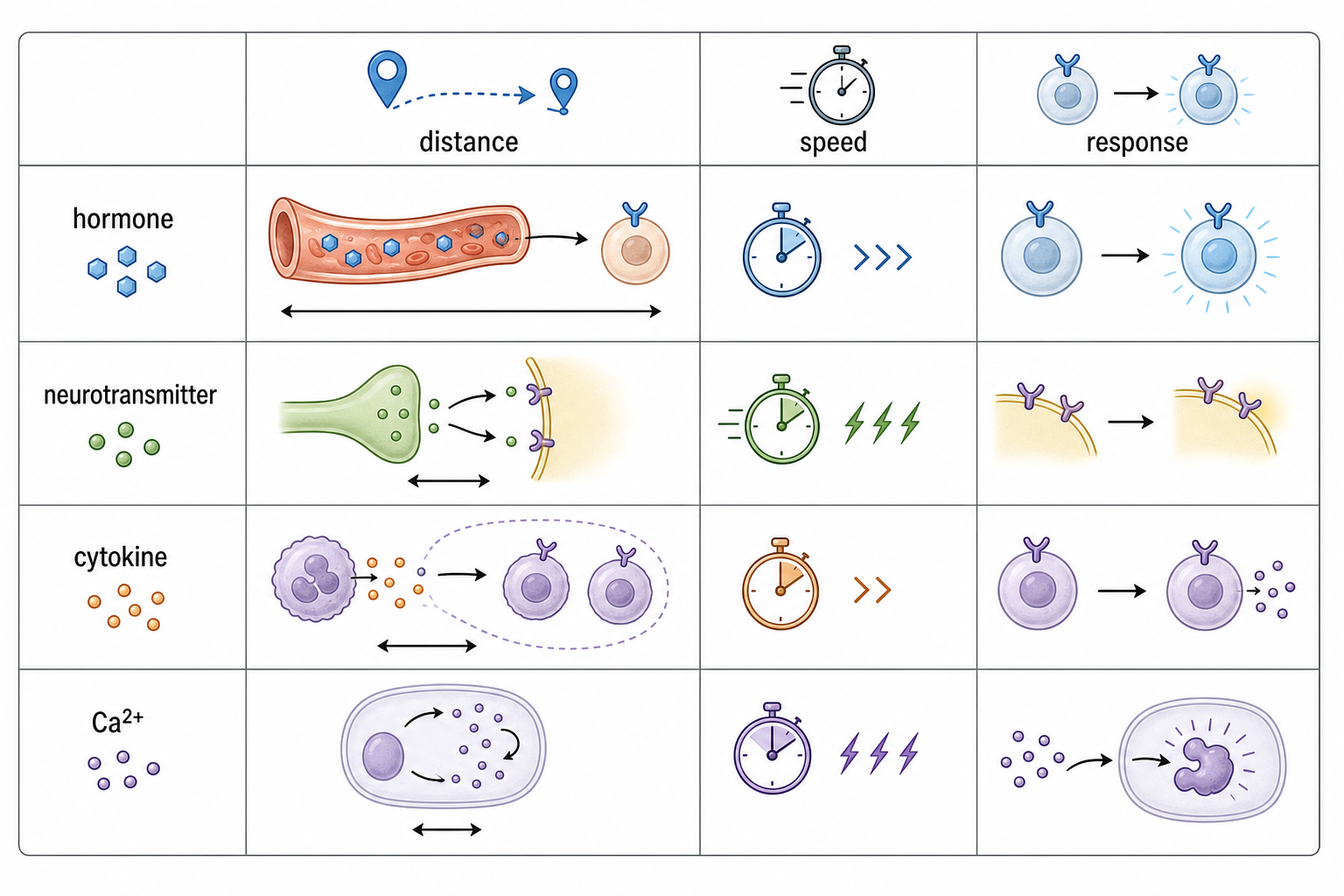
Animal chemical signals are not all the same kind of message. Animal signals include hormones, neurotransmitters, cytokines, and Ca2+ ions. They differ in source, distance, speed, and target-cell response. Hormones include protein/peptide, steroid, and amine classes; neurotransmitters include acetylcholine, amino acids, peptides, amines, and nitric oxide.

Animal signals include hormones, neurotransmitters, cytokines, and Ca2+ ions.
They differ in source, distance, speed, and target-cell response.
Hormones include protein/peptide, steroid, and amine classes; neurotransmitters include acetylcholine, amino acids, peptides, amines, and nitric oxide.

Sort each feature into the most likely signal category.

Sort

Local Vs Long-Distance Signals

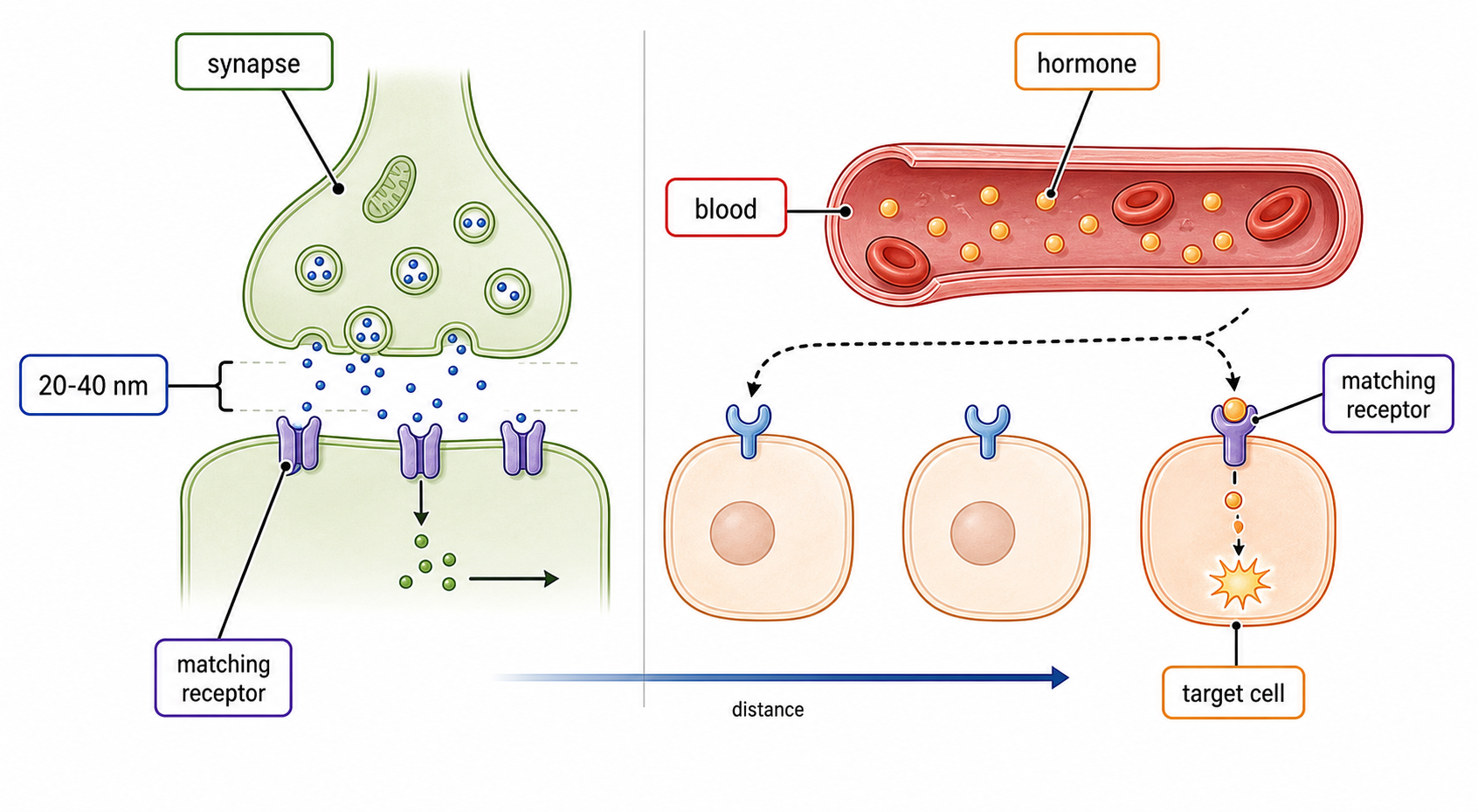
Distance is part of the signal logic. Neurotransmitters act locally across narrow synaptic clefts. Hormones travel through blood to distant cells with matching receptors. A hormone can circulate widely, but only cells with the right receptor respond.

Neurotransmitters act locally across narrow synaptic clefts.
Hormones travel through blood to distant cells with matching receptors.
Receptor specificity still decides which cells respond.

Match each route feature to neurotransmitter or hormone signalling.

Match
Reasons
0/4

Choose The Right Receptor

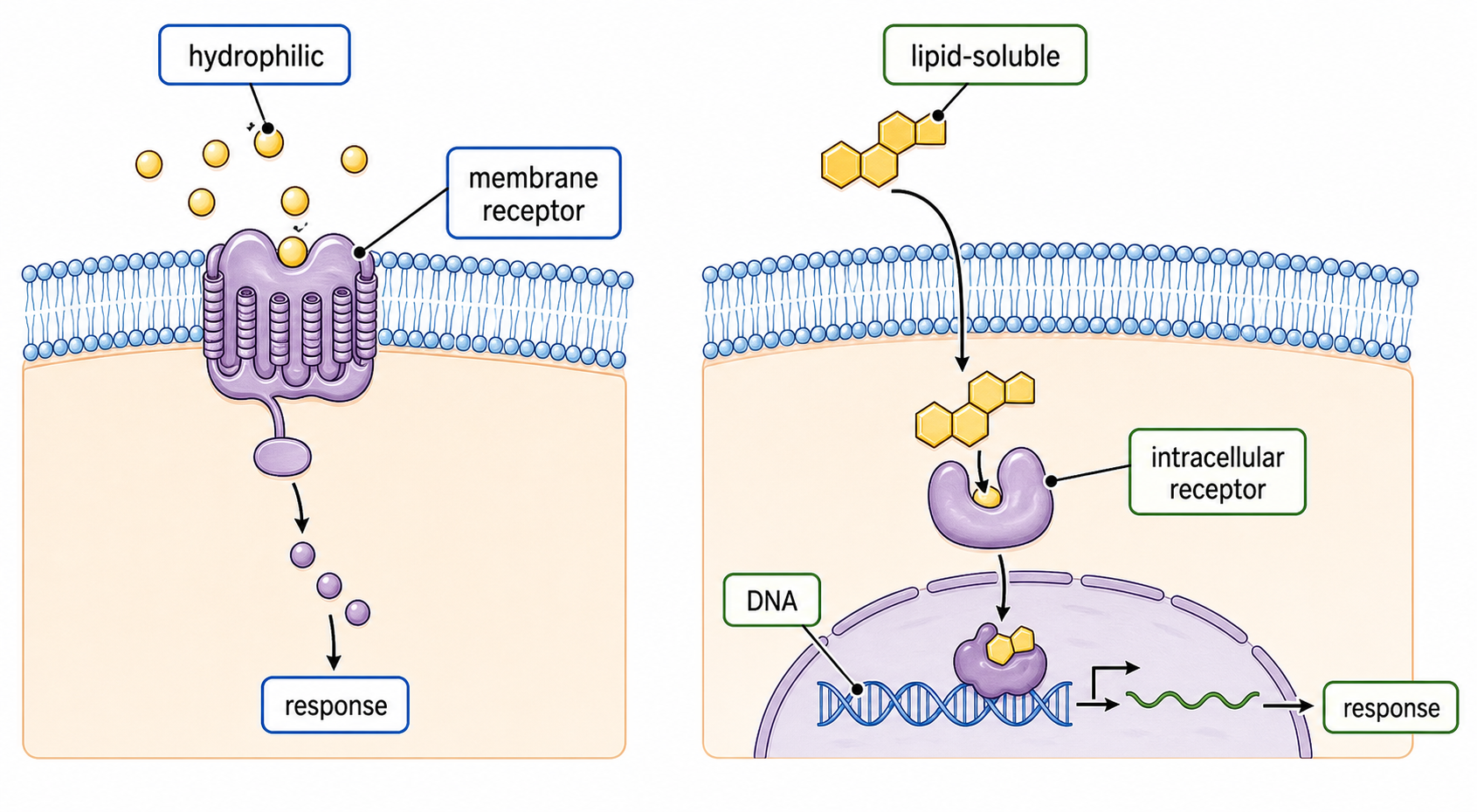
Receptor location follows ligand chemistry. Hydrophilic ligands bind transmembrane receptors and use intracellular relays. Steroid and thyroid hormones cross membranes and bind cytoplasmic or nuclear receptors. Hormone-receptor complexes enter or act in the nucleus as transcription factors.

Hydrophilic ligands bind transmembrane receptors and use intracellular relays.
Steroid and thyroid hormones cross membranes and bind cytoplasmic or nuclear receptors.
Hormone-receptor complexes enter or act in the nucleus as transcription factors.

Sort each ligand or response route.

Sort

Trace A Signal Cascade

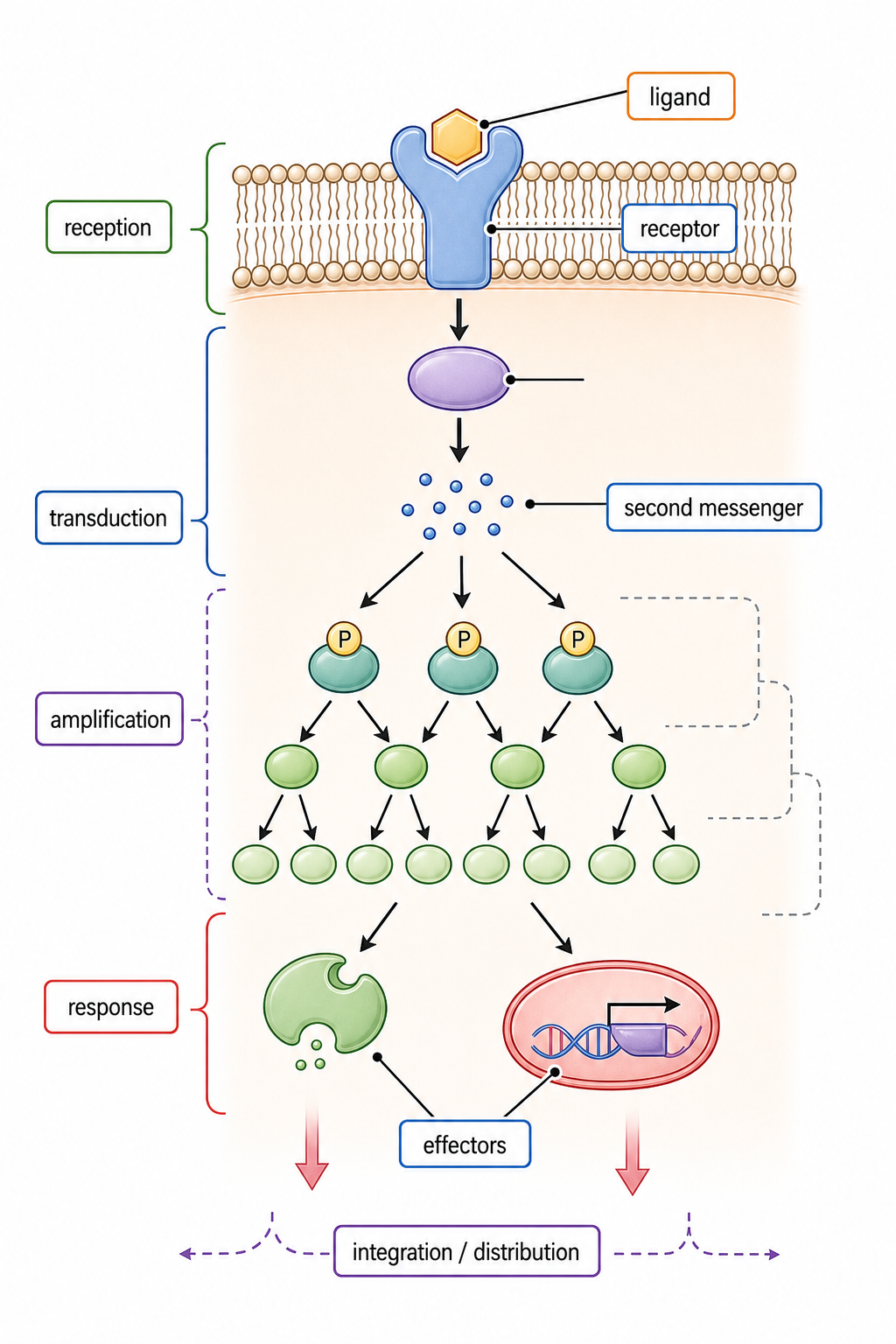
Signal transduction is the relay between receptor binding and response. Signal transduction relays, amplifies, integrates, and distributes ligand signals. Pathways use relay proteins, second messengers, phosphorylation cascades, and effectors, so one ligand can produce a coordinated cell response.

Signal transduction relays, amplifies, integrates, and distributes ligand signals.
Pathways use relay proteins, second messengers, phosphorylation cascades, and effectors.
The pathway is the bridge between ligand binding and the final response.

Put the generic signal cascade in order.

Order
1
ligand binds receptor
2
receptor changes activity
3
effector produces cellular response
4
phosphorylation cascade amplifies signal
5
relay proteins or second messengers activate

Open A Sodium Channel

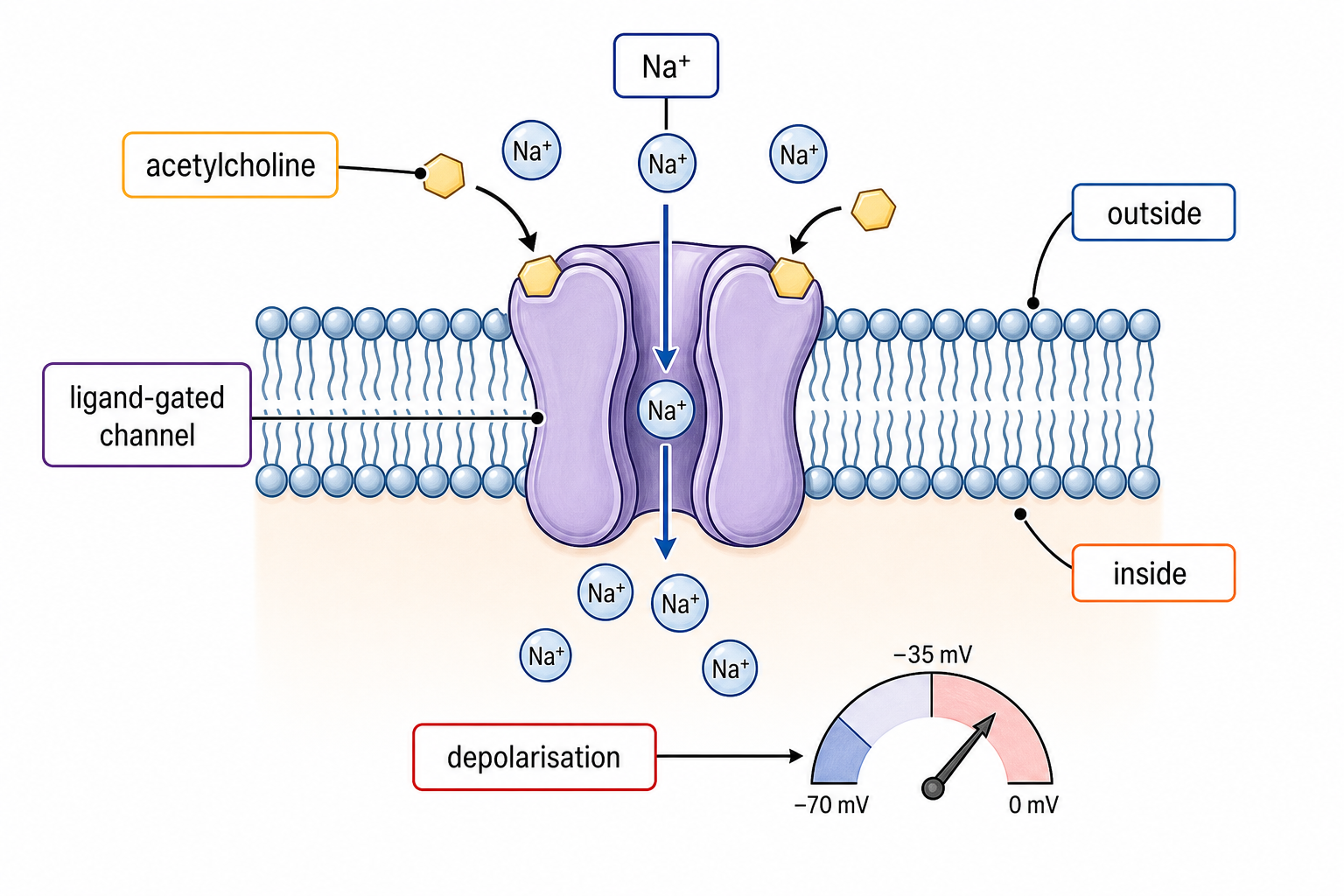
Acetylcholine provides a local signalling example. It can bind ligand-gated sodium channels. When the channel opens, sodium influx changes membrane potential and can depolarize the postsynaptic membrane.

Acetylcholine can bind ligand-gated sodium channels.
Sodium influx changes membrane potential.
The postsynaptic membrane can depolarize.

Order acetylcholine signalling at a postsynaptic membrane.

Order
1
sodium channel opens
2
Na+ enters postsynaptic cell
3
postsynaptic membrane depolarizes
4
acetylcholine diffuses across synaptic cleft
5
acetylcholine binds ligand-gated sodium channel

Read A GPCR Switch

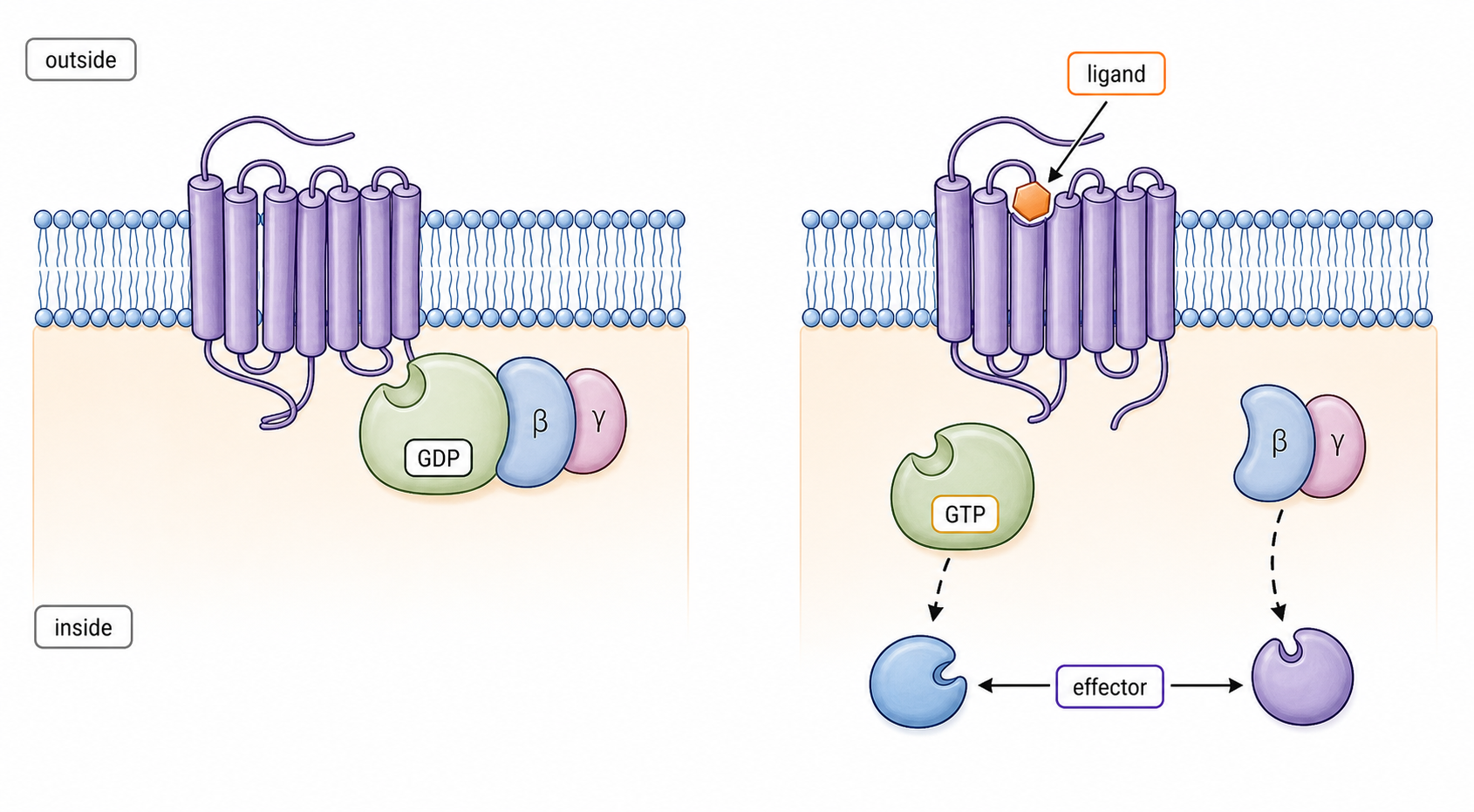
GPCRs are seven-helix transmembrane receptors linked to G proteins. Ligand binding causes GDP-GTP exchange and activation of effector proteins. The G protein is the switch: GDP means off, GTP means active.

GPCRs are seven-helix transmembrane receptors linked to G proteins.
Ligand binding causes GDP-GTP exchange.
Activated G proteins activate effector proteins.

Put the GPCR switch in order.

Order
1
ligand binds GPCR
2
GPCR changes shape
3
G protein exchanges GDP for GTP
4
second messenger or enzyme response follows
5
G protein subunit activates effector protein

Follow Epinephrine To cAMP

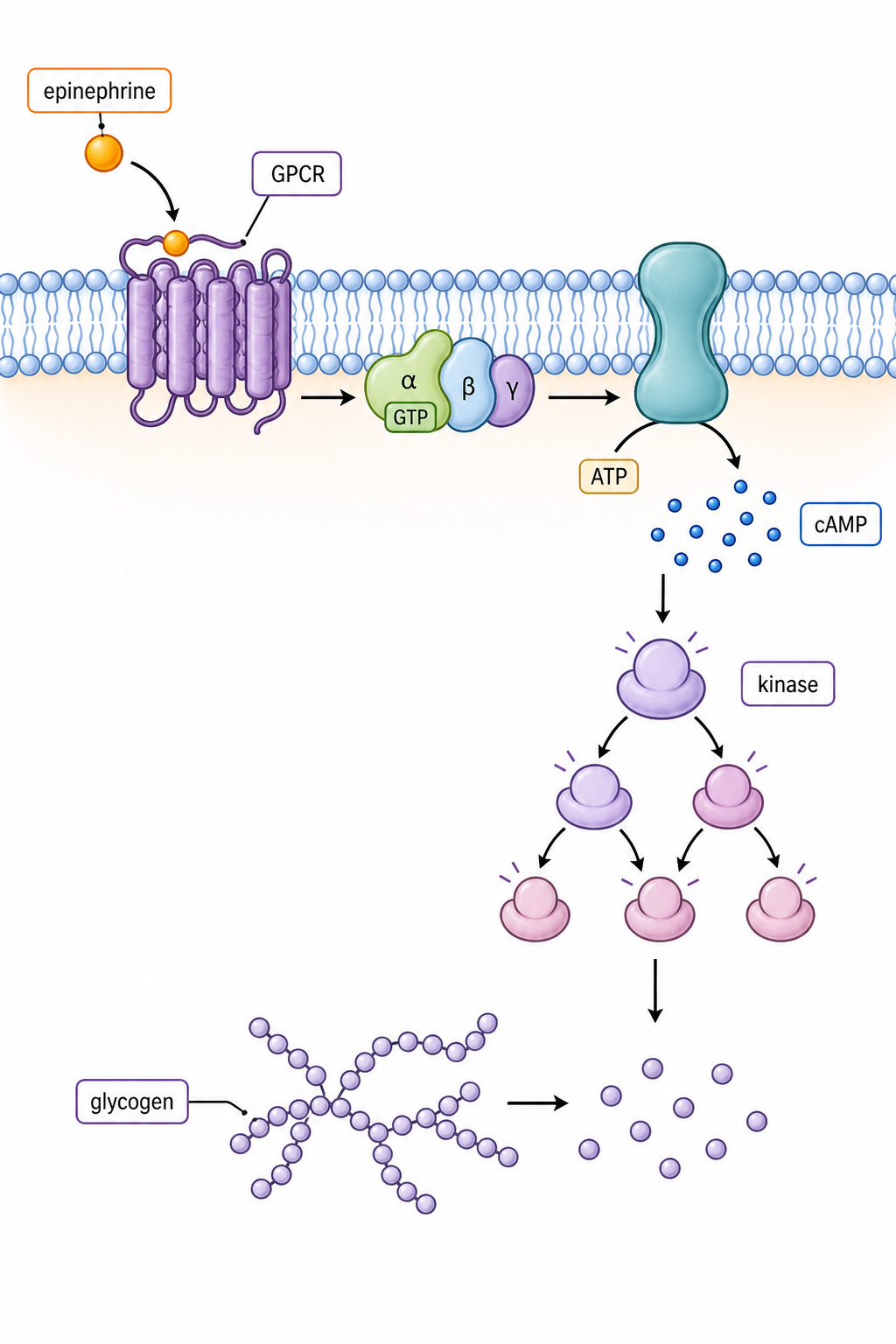
Epinephrine, also called adrenaline, is the named GPCR example. Epinephrine binds adrenergic GPCRs and activates G protein signalling. Adenylyl cyclase forms cAMP, activating kinase cascades for glycogen breakdown.

Epinephrine binds adrenergic GPCRs and activates G protein signalling.
Adenylyl cyclase forms cAMP.
cAMP activates kinase cascades for glycogen breakdown.

Put epinephrine signalling in order.

Order
1
cAMP is formed
2
G protein is activated
3
glycogen breakdown increases
4
adenylyl cyclase is activated
5
epinephrine binds adrenergic GPCR
6
protein kinase cascade activates

Track Insulin Through RTKs

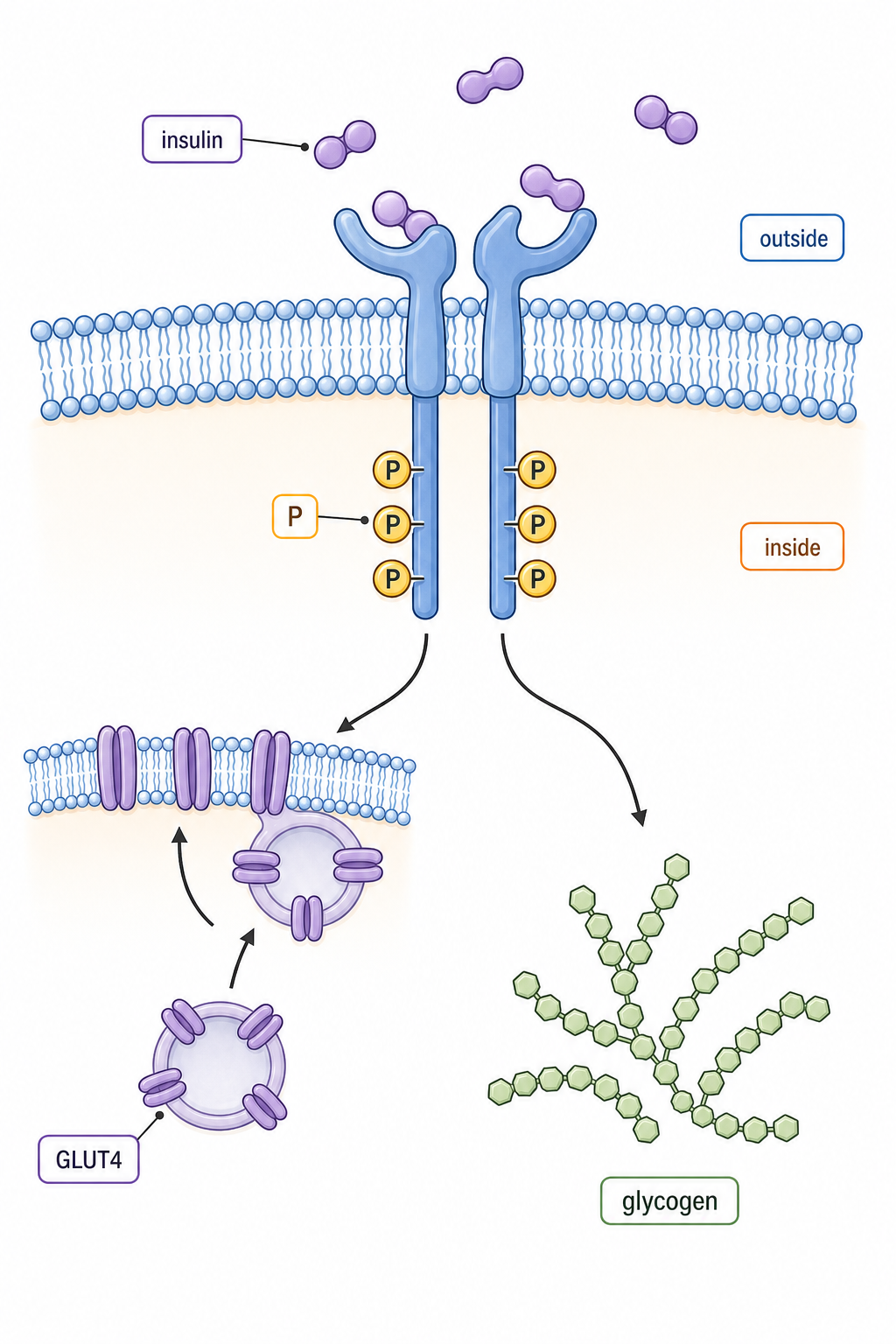
Insulin is the named RTK example. RTK ligand binding causes dimerisation and autophosphorylation. Insulin signalling moves GLUT4 vesicles to membranes and promotes glycogenesis, so cells take up glucose and store it as glycogen.

RTK ligand binding causes dimerisation and autophosphorylation.
Insulin signalling moves GLUT4 vesicles to membranes.
Insulin promotes glycogenesis and helps lower blood glucose.

Put insulin RTK signalling in order.

Order
1
insulin binds RTK
2
receptors dimerise
3
glycogenesis is promoted
4
autophosphorylation occurs
5
GLUT4 vesicles move to membrane
6
downstream signalling is activated

Use Oestradiol And Progesterone

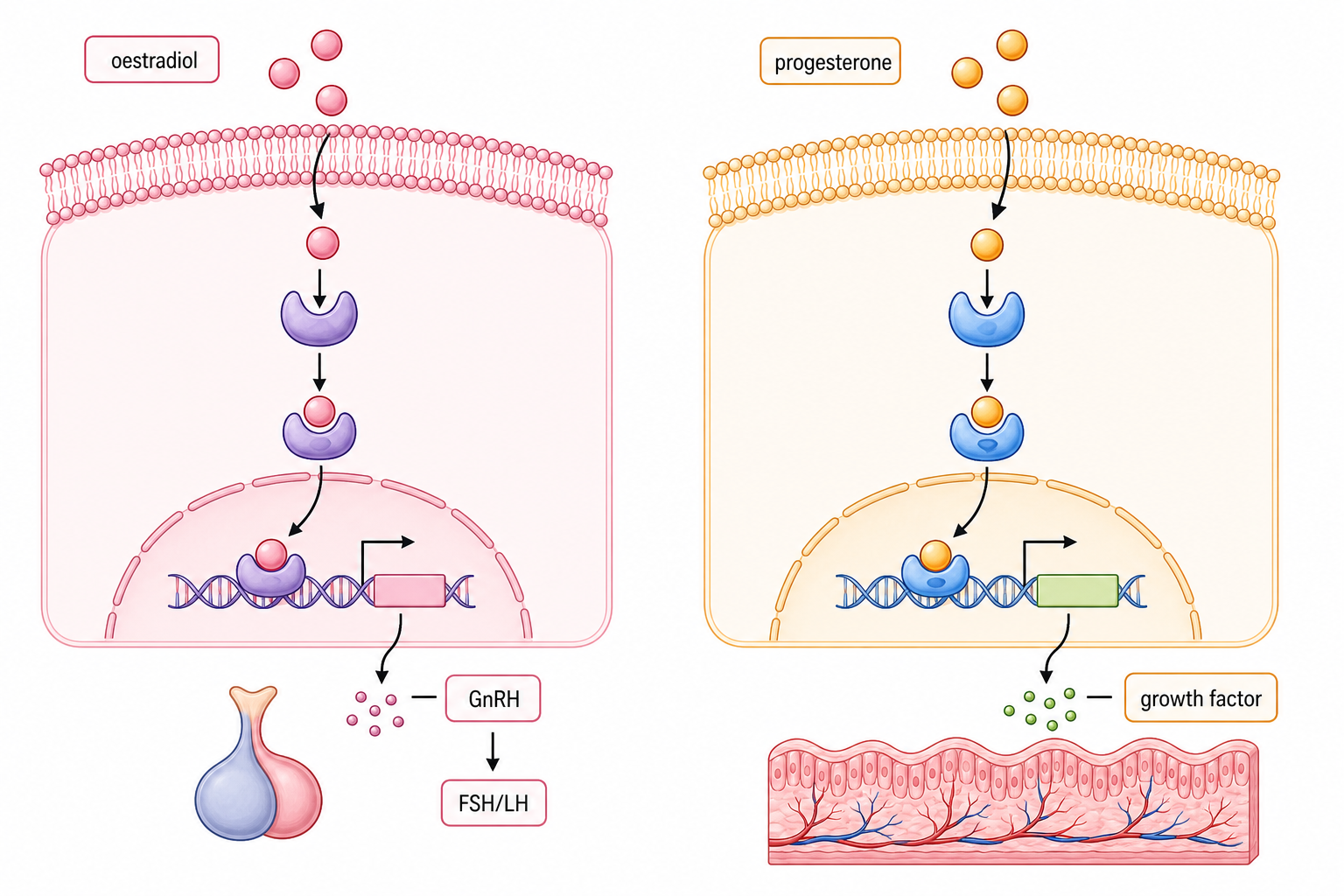
Oestradiol and progesterone are named intracellular-receptor examples. Oestradiol regulates female sex characteristics and hypothalamus-pituitary targets. Progesterone from corpus luteum or placenta maintains endometrium and pregnancy. Both work through intracellular receptor proteins that affect transcription in target cells.

Oestradiol regulates female sex characteristics and hypothalamus-pituitary targets.
Progesterone from corpus luteum or placenta maintains endometrium and pregnancy.
Steroid hormone receptors affect transcription in target cells.

Match each hormone to the target effect.

Match
Reasons
0/4

Compare Positive And Negative Feedback

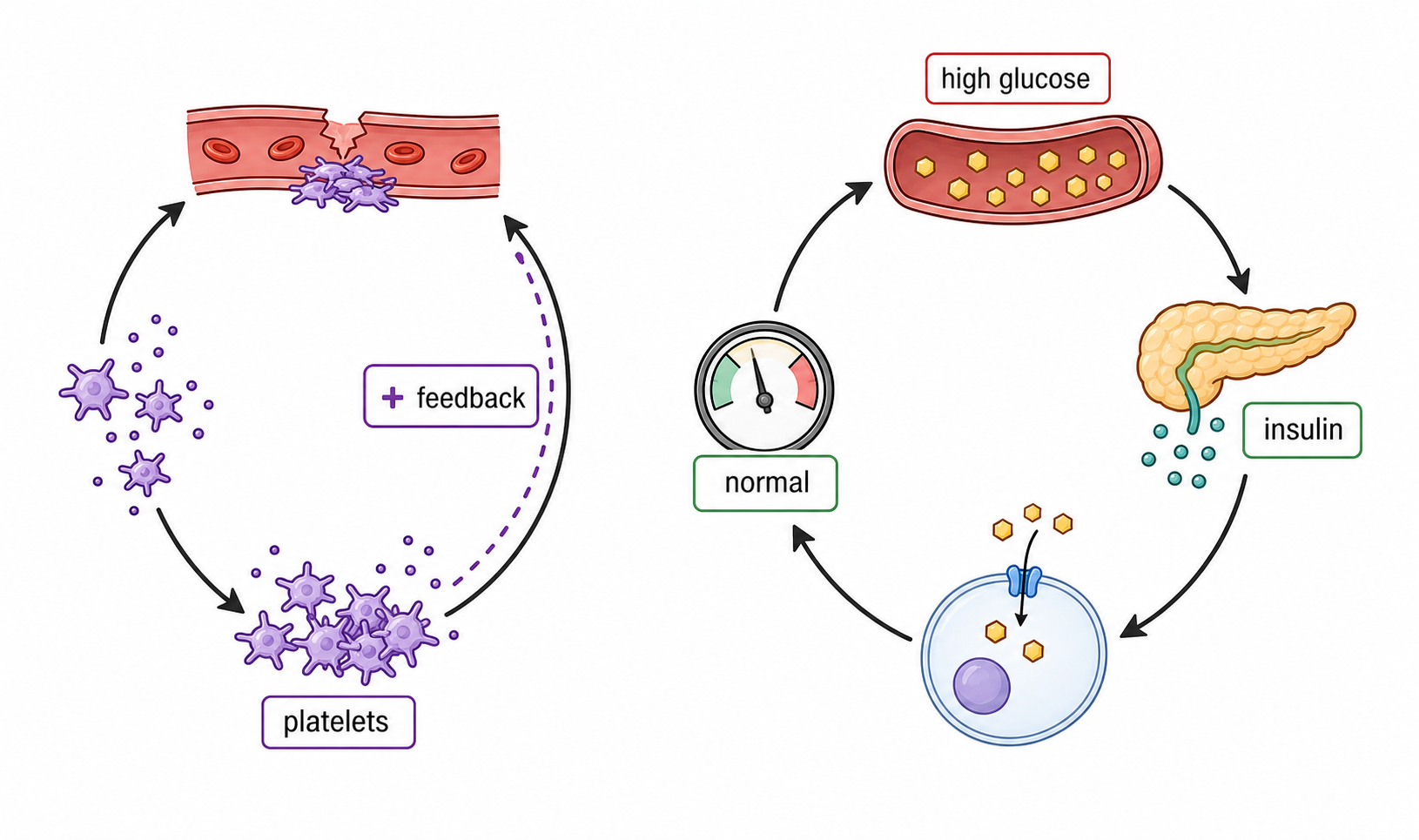
Feedback is about what the response does to the original change. Positive feedback amplifies responses, such as ethylene in fruit ripening. Negative feedback restores stability, such as insulin lowering blood glucose. The exam trap is calling every control loop negative feedback.

Positive feedback amplifies responses, such as ethylene in fruit ripening.
Negative feedback restores stability, such as insulin lowering blood glucose.
The key contrast is amplification versus stabilisation.

Spot the error: “Insulin is positive feedback because it responds to high blood glucose.”

Spot Errors

HL Transfer: Explain Chemical Signalling

Exam Practice

A ligand only affects target cells with the matching receptor. Quorum sensing uses autoinducers and thresholds for group behaviour. Animal signals differ by source, distance, speed, target-cell response, and chemical class. Hydrophilic ligands use transmembrane receptors and relays; steroid and thyroid hormones use intracellular receptors that affect transcription. Named pathways then show the logic: acetylcholine opens sodium channels, GPCRs switch G proteins through GDP-GTP exchange, epinephrine uses cAMP and kinase cascades, insulin RTKs use dimerisation/autophosphorylation to move GLUT4 and promote glycogenesis, steroid hormones change gene expression, and feedback either amplifies or restores stability.

Start every signalling answer with ligand specificity and target-cell receptor matching.
Then choose the route: local synapse, blood-borne hormone, transmembrane receptor, or intracellular receptor.
For named mechanisms, give the sequence, not just the pathway name.
Finish feedback comparisons with amplification versus stability.

Put the topic logic in order.

Order
1
transduction relays/amplifies the message
2
feedback amplifies or stabilizes the outcome
3
ligand binds a specific receptor on a target cell
4
signal type and ligand chemistry determine route
5
named GPCR, RTK, ion-channel, or intracellular pathway produces response

Use this for HL structured questions that combine signalling categories, receptor routes, named pathways, and feedback examples.

Receptor proteins have binding sites specific to signalling ligands, and ligand binding starts signal transduction in target cells.
Autoinducers allow bacteria to detect population density thresholds; Vibrio fischeri bioluminescence and biofilm formation are key quorum-sensing examples.
Animal signals include hormones, neurotransmitters, cytokines, and Ca2+ ions, differing in source, distance, speed, and target-cell response.
Hormones include protein/peptide, steroid, and amine classes; neurotransmitters include acetylcholine, amino acids, peptides, amines, and nitric oxide.
Neurotransmitters act locally across narrow synaptic clefts; hormones travel through blood to distant cells with matching receptors.
Hydrophilic ligands bind transmembrane receptors and use intracellular relays; steroid and thyroid hormones cross membranes and bind cytoplasmic or nuclear receptors.
Signal transduction relays, amplifies, integrates, and distributes ligand signals using relay proteins, second messengers, phosphorylation cascades, and effectors.
Acetylcholine can bind ligand-gated sodium channels; sodium influx changes membrane potential and can depolarize the postsynaptic membrane.
GPCRs are seven-helix transmembrane receptors linked to G proteins; ligand binding causes GDP-GTP exchange and activation of effector proteins.
Epinephrine binds adrenergic GPCRs, activates G protein signalling, and adenylyl cyclase forms cAMP to activate kinase cascades for glycogen breakdown.
RTK ligand binding causes dimerisation and autophosphorylation; insulin signalling moves GLUT4 vesicles to membranes and promotes glycogenesis.
Steroid and thyroid hormones bind intracellular receptor proteins; hormone-receptor complexes enter or act in the nucleus as transcription factors.
Oestradiol regulates female sex characteristics and hypothalamus-pituitary targets; progesterone from corpus luteum or placenta maintains endometrium and pregnancy.
Positive feedback amplifies responses, such as ethylene in fruit ripening; negative feedback restores stability, such as insulin lowering blood glucose.

Use this for HL structured questions that combine signalling categories, receptor routes, named pathways, and feedback examples.

Do not give pathway names without receptor type, sequence, and consequence; do not mix up amplification with stability.