
Why Animals Need Locomotion
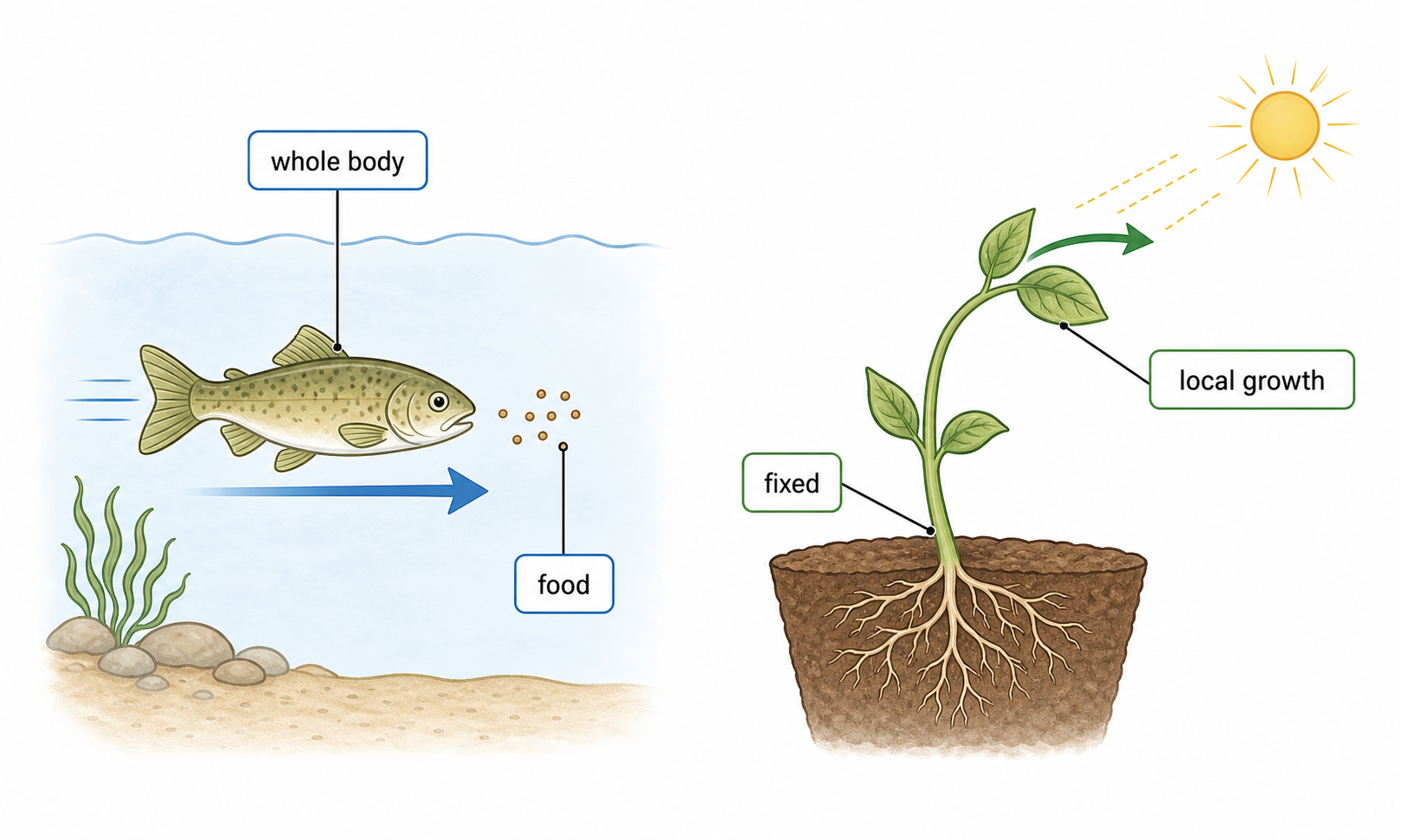
All organisms show movement, but only some show locomotion: whole-organism movement from place to place. Motile animals move to find food, escape predators, find mates, or migrate. Sessile organisms, such as plants or corals in sessile stages, do not move place to place but still move parts or grow toward stimuli. Examples include blackbirds feeding, hares escaping predators, orangutans finding mates, and whales migrating. Locomotion can improve survival and reproductive success.
Notice that locomotion is whole-body movement, but sessile organisms still show movement of parts or growth responses.
Sort each example into movement only or locomotion.
SortSort each example into movement only or locomotion.
ChooseSpot Marine Mammal Adaptations
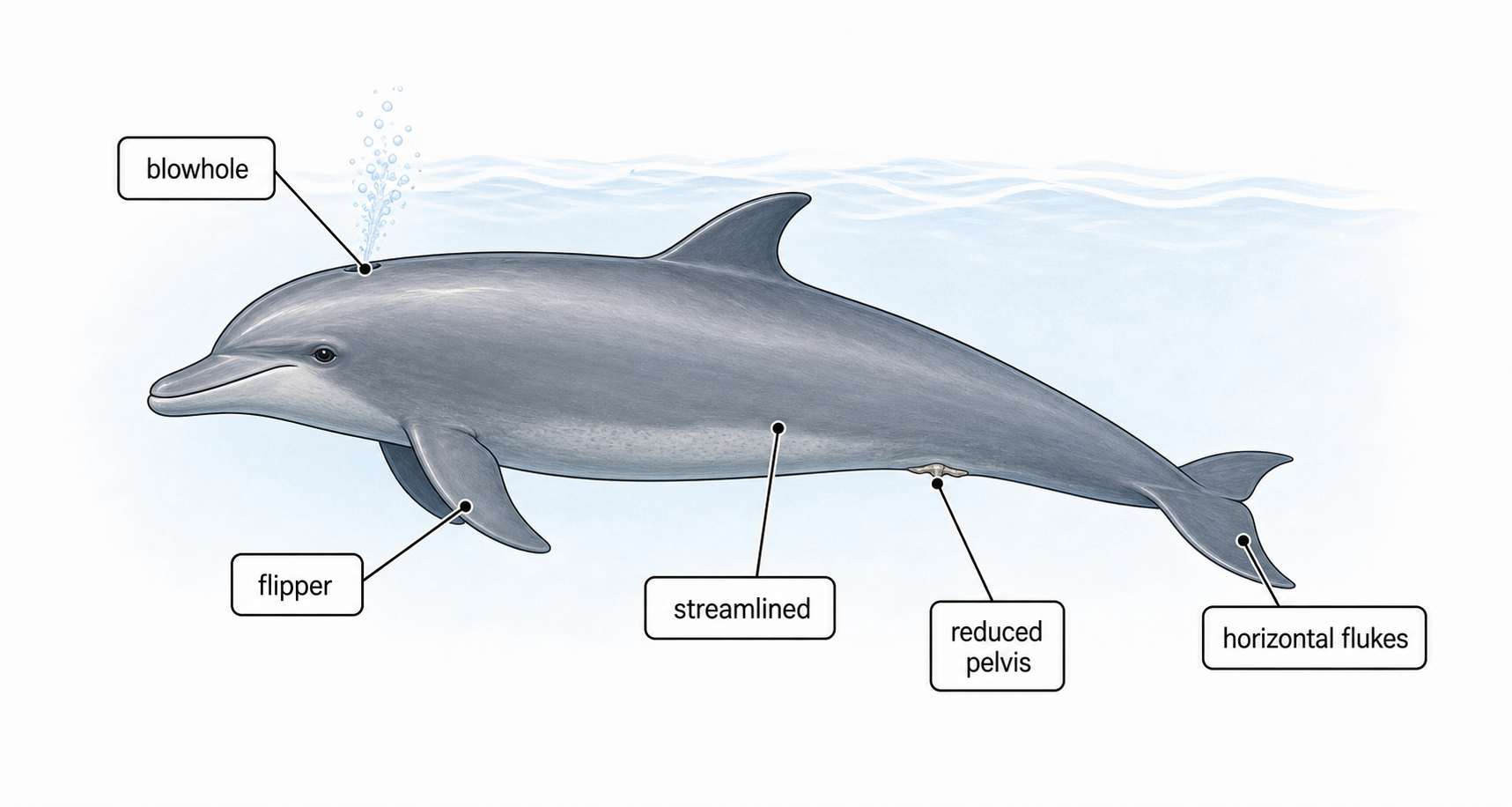
Marine mammals show how body form supports locomotion. Streamlined bodies reduce drag, flippers steer, up-and-down tail flukes provide propulsion, reduced pelvic bones and absent hind limbs reduce resistance, and blowholes allow rapid surface breathing that closes during dives.
Each feature should be read as a structure-to-function adaptation for swimming.
Match each marine mammal feature to its locomotion advantage.
MatchMatch each marine mammal feature to its locomotion advantage.
ChooseRead a Sarcomere
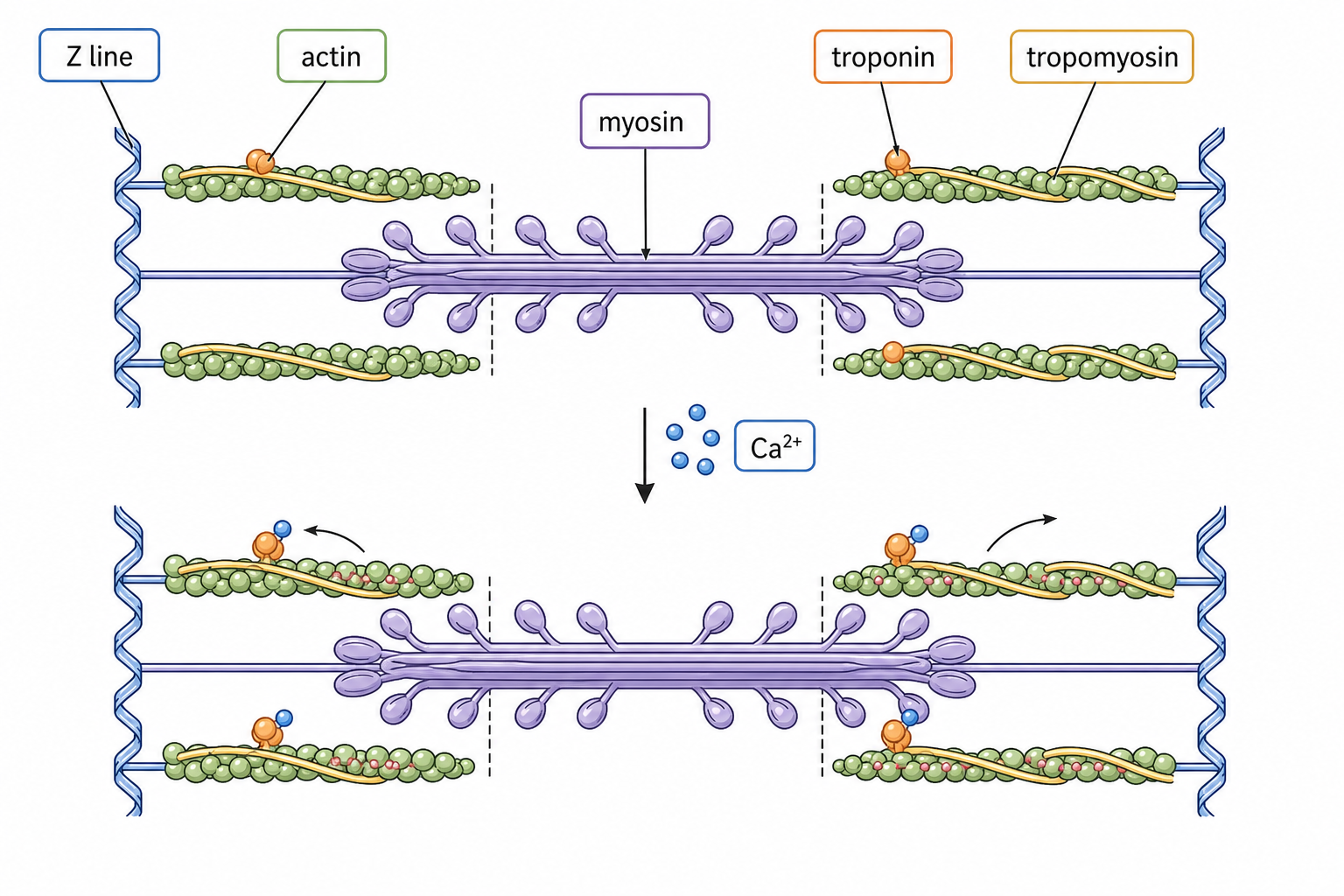
A sarcomere is the repeating contractile unit between Z lines. Thin actin filaments and thick myosin filaments overlap. During contraction, the filaments do not shorten; they slide past each other, so Z lines move closer together and the sarcomere shortens.
Use the model to see why contraction shortens the sarcomere even though the filaments themselves do not shorten.
Which observation best identifies a contracted sarcomere?
ChooseWhich observation best identifies a contracted sarcomere?
ChooseSequence Contraction
Practice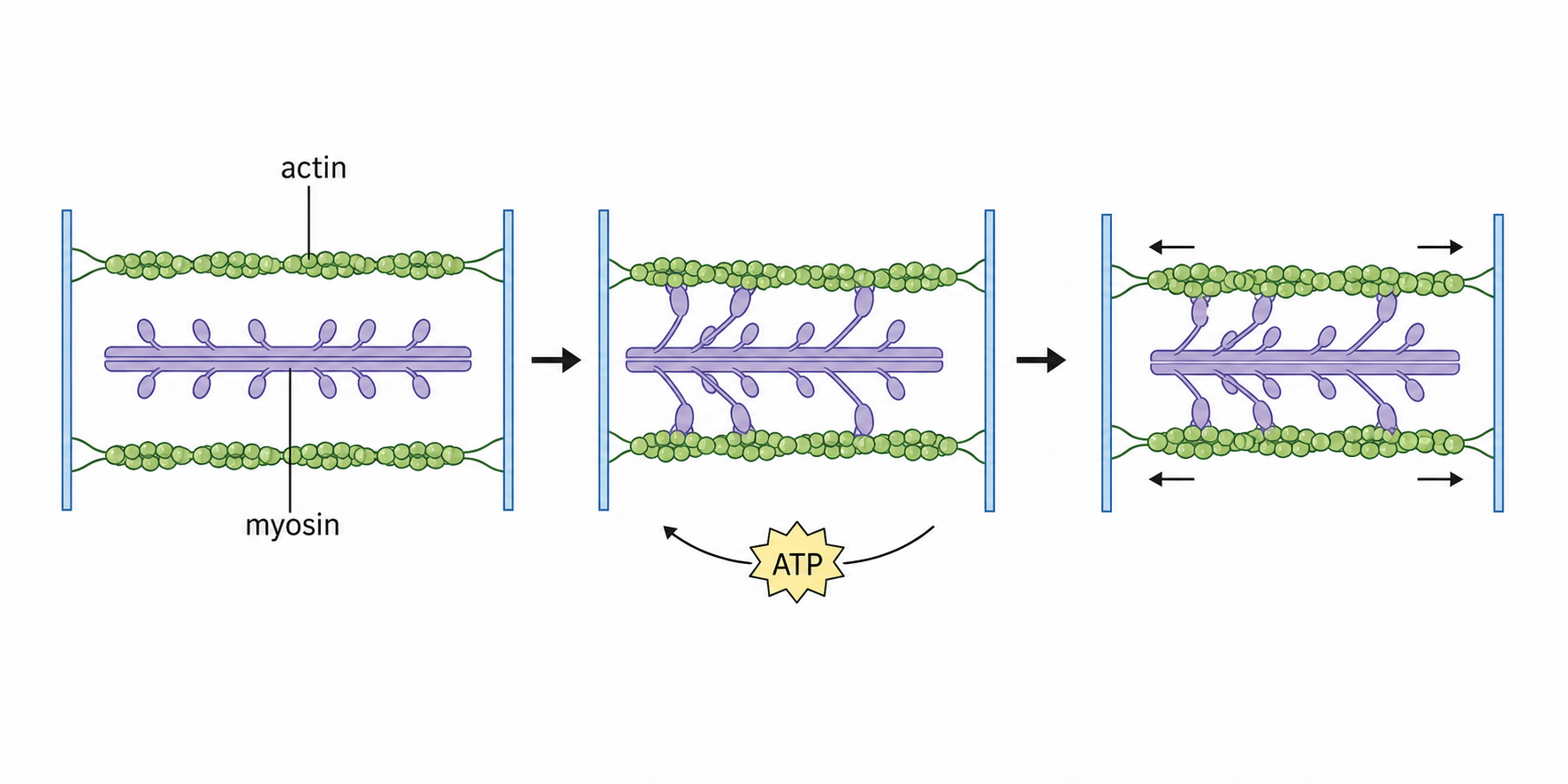
The sliding filament cycle explains how actin moves. Calcium binds troponin, moving tropomyosin away from actin binding sites. Myosin heads form cross-bridges with actin. ATP binding breaks the cross-bridge; ATP hydrolysis re-cocks the myosin head; the head binds again and releases ADP and phosphate during the power stroke, pulling actin toward the centre of the sarcomere.
Order the sliding filament contraction cycle.
OrderTrigger and Reset a Muscle
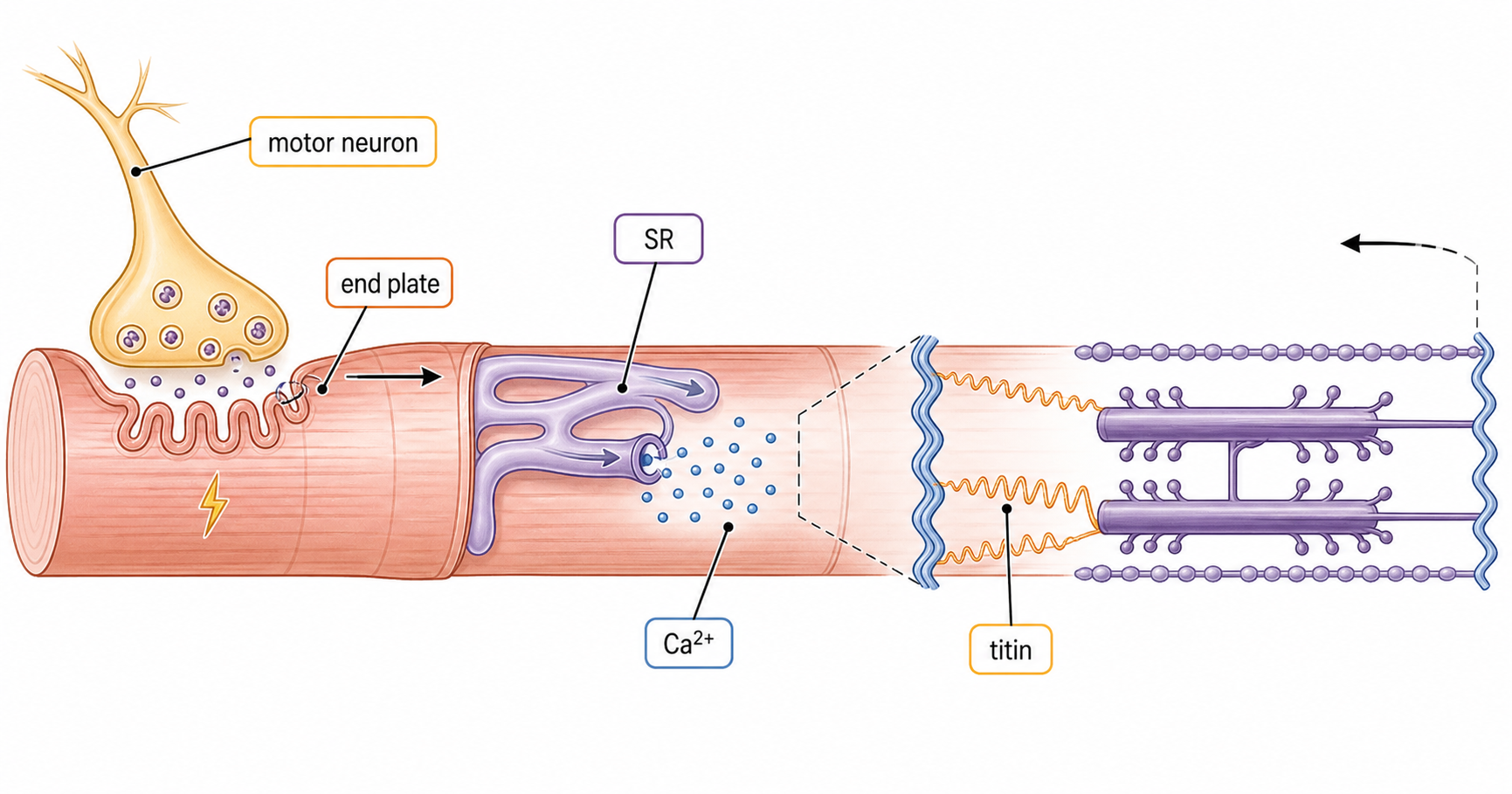
A motor neuron triggers skeletal muscle contraction at the neuromuscular junction. An action potential reaches the motor end plate, acetylcholine is released, the sarcolemma is excited, and calcium is released from the sarcoplasmic reticulum to start contraction. A motor unit is one motor neuron plus all the muscle fibres it controls. Titin acts as a molecular spring in sarcomeres, centres myosin, recoils after stretching, and helps prevent overstretching. Antagonistic muscles are needed because muscles actively contract but do not actively extend.
Follow the path from nerve signal to calcium release, then to recoil and antagonistic control.
Match each muscle-control term to its role.
MatchMatch each muscle-control term to its role.
ChooseUse Skeletons as Levers
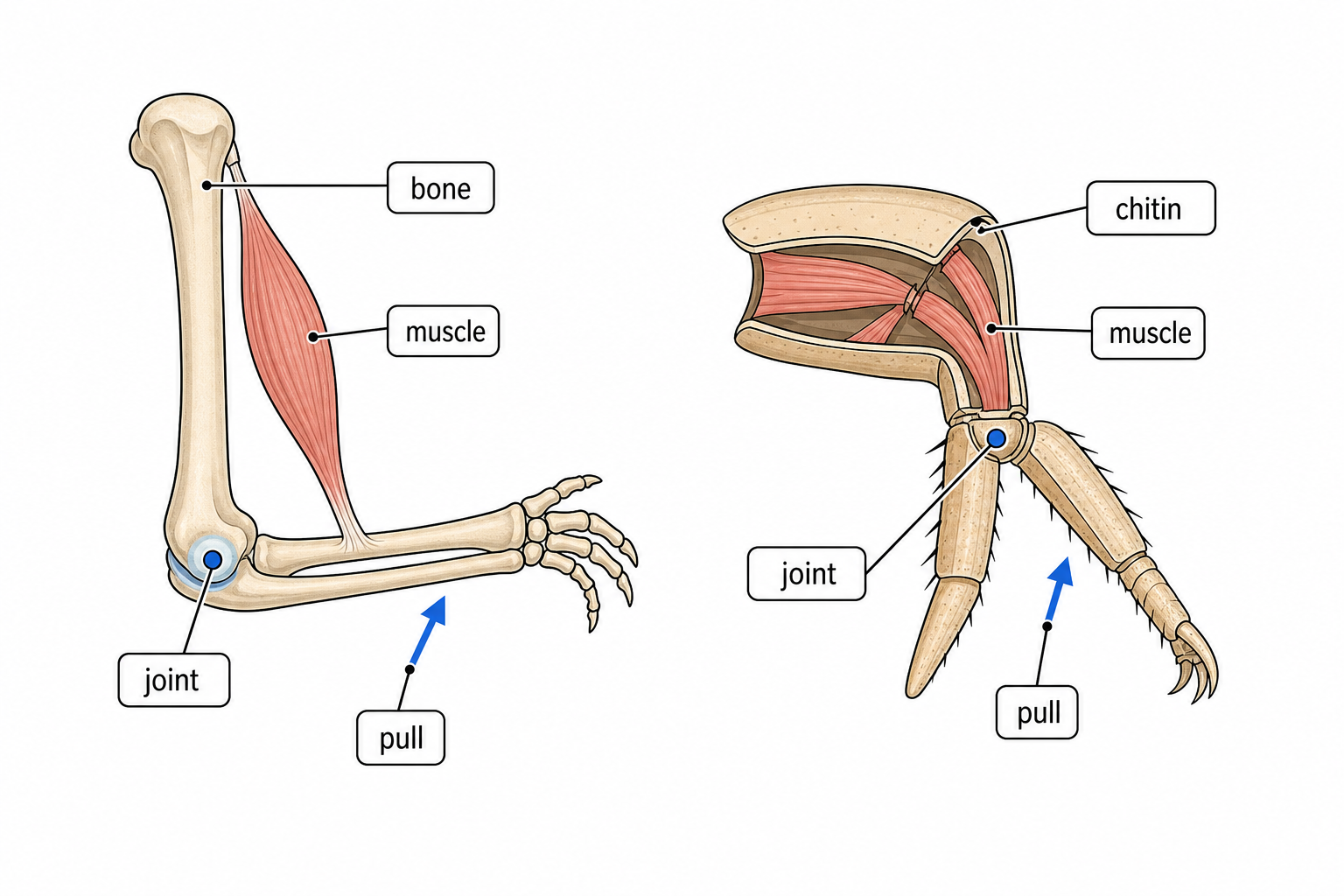
Skeletons turn muscle contraction into movement. They provide support, protection, muscle anchorage, and lever systems. Vertebrate endoskeletons are internal and muscles attach to bones by tendons; arthropod exoskeletons are external, contain chitin, have joints, and muscles attach internally. Antagonistic muscles pull on levers to move joints.
Compare where force is anchored before it can act as a lever.
Sort each structure or feature into the correct role.
SortSort each structure or feature into the correct role.
ChooseCompare Hip and Knee Movement
PracticeSynovial joints allow movement while limiting friction and preventing instability. Synovial fluid lubricates the joint between cartilage-covered bones; tendons attach muscles to bones; ligaments connect bones and stabilise joints. Range of motion depends on joint type, bone surfaces, ligaments, and muscles. Ball-and-socket joints such as the hip and shoulder allow movement in three planes including circumduction; hinge joints such as the knee and elbow mainly allow flexion and extension in one plane.
Sort features into hip, knee, or both synovial joints.
SortUse Intercostals as a Model
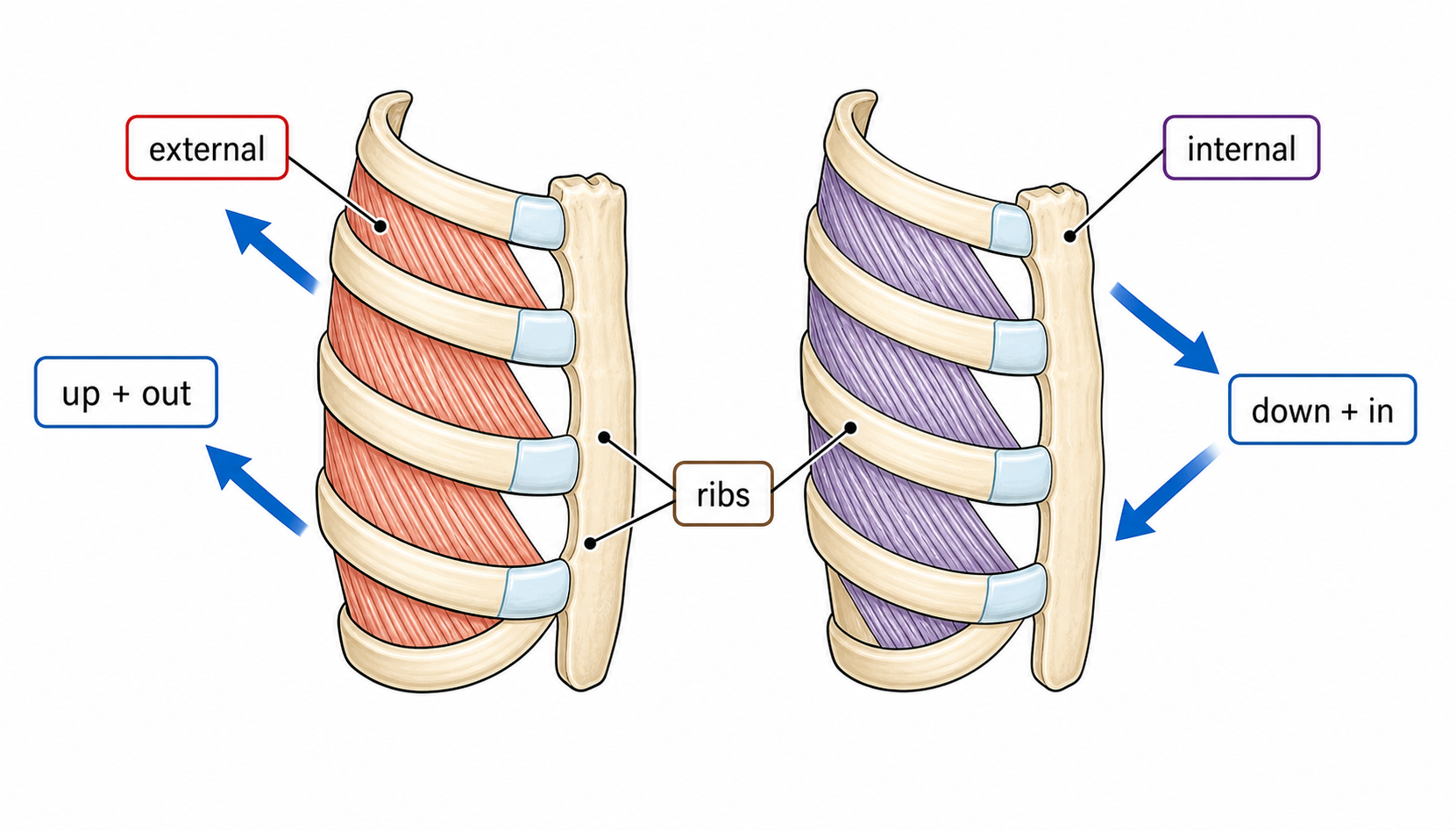
Intercostal muscles are a useful model of antagonistic muscle action during ventilation. External intercostal muscles contract to lift ribs up and out during inspiration. Internal intercostal muscles pull ribs down and in during forced expiration. Like other antagonistic pairs, one set contracts while the other relaxes to produce opposite movements.
Read the opposite arrow directions to remember the antagonistic pair.
Match each intercostal action to the ventilation phase.
MatchMatch each intercostal action to the ventilation phase.
ChooseHL Transfer: Explain Muscle And Motility
Exam PracticeA strong answer links movement benefit, muscle contraction mechanism, force transfer, joint range, and locomotion adaptations. For contraction, use calcium-troponin-tropomyosin and ATP-driven myosin cross-bridge cycling. For movement, use antagonistic muscles, tendons, ligaments, skeletons as levers, and joint type. For locomotion, link body form to survival or swimming advantage. Locomotion can improve survival and reproductive success.
Match each exam clue to the answer link it needs.
MatchUse this for HL questions on locomotion, sliding filament contraction, motor units, titin, skeletons, synovial joints, range of motion, intercostals, and marine mammal adaptations.
Use this for HL questions on locomotion, sliding filament contraction, motor units, titin, skeletons, synovial joints, range of motion, intercostals, and marine mammal adaptations.
Do not write a list of movement terms. For each mark, connect structure or molecule to action and biological advantage.