
Why Capillaries Exchange Fast
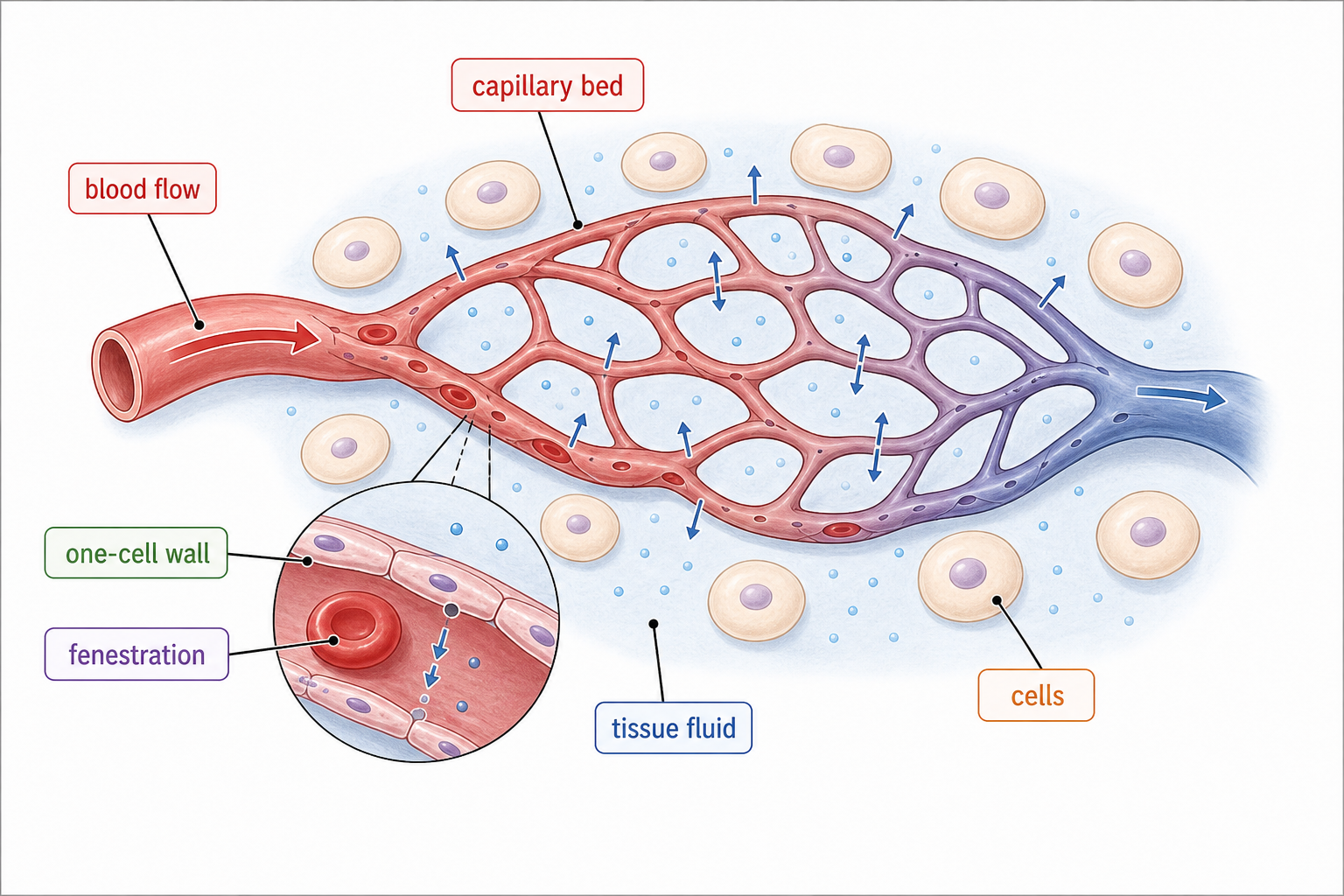
Capillaries are built for exchange, not high-pressure transport. They are narrow, highly branched, and close to body cells, so substances have a short path between blood and tissues. Their one-cell-thick endothelial walls reduce diffusion distance, and fenestrations in some capillaries allow rapid exchange and tissue fluid formation.
Link each structural feature to faster exchange rather than just naming parts.
Match each capillary feature to its exchange advantage.
MatchMatch each capillary feature to its exchange advantage.
ChooseCompare Arteries And Veins
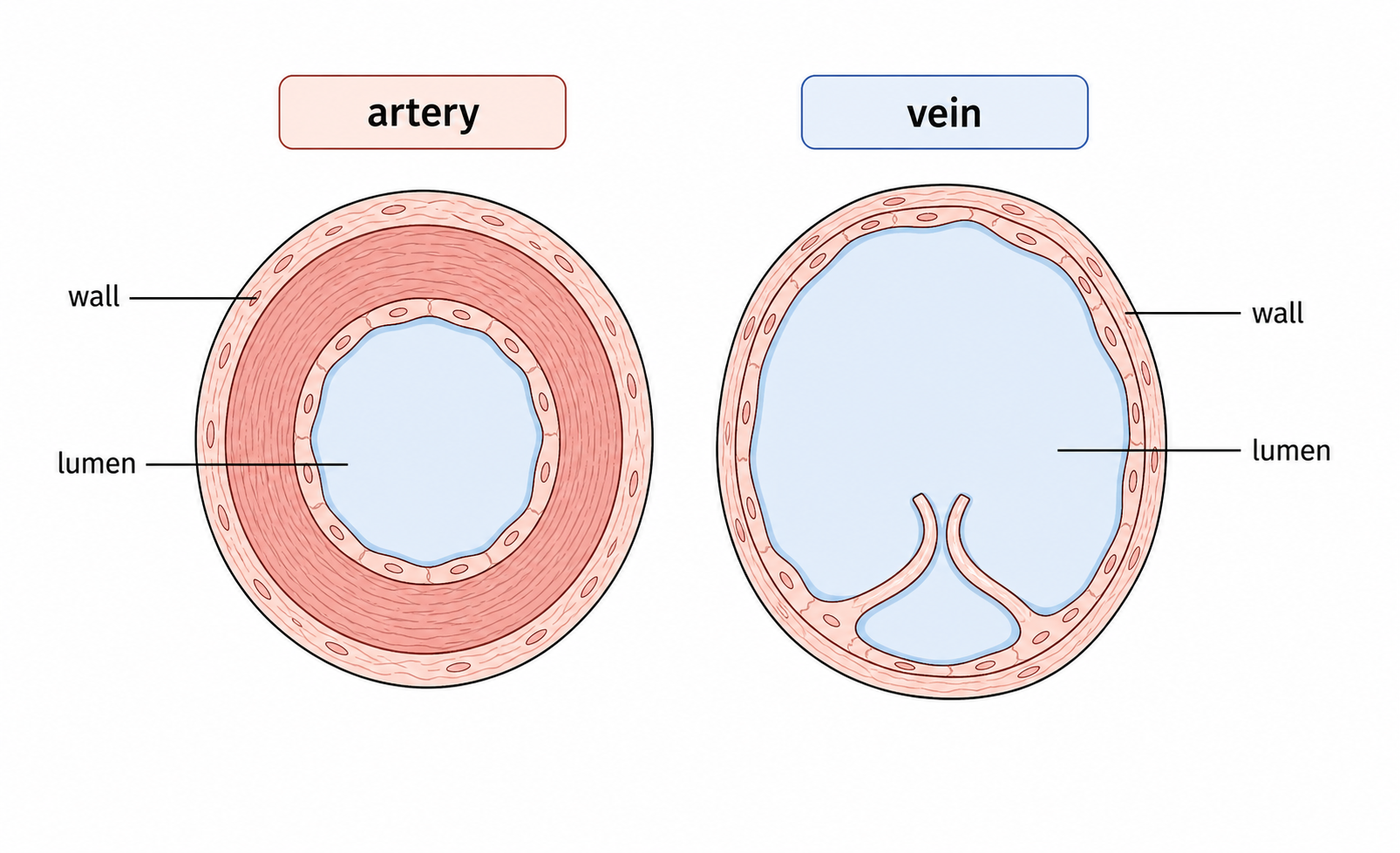
Arteries and veins share basic wall components: endothelium, smooth muscle, elastic tissue, and collagen. Their proportions differ because pressure differs. Arteries have thicker walls and smaller lumens to withstand and maintain high pressure. Veins have thinner walls and wider lumens for low-pressure return.
Sort the features into artery, vein, or both.
SortHow Arteries Keep Pressure
Arteries receive blood at high pressure from ventricles. Thick walls and collagen prevent rupture, elastic fibres stretch during systole and recoil during diastole to even out pulse pressure and maintain flow, and smooth muscle in arteries and arterioles regulates blood distribution to tissues.
Which artery feature directly helps maintain blood flow between heartbeats?
ChooseMeasure A Pulse Correctly
PracticePulse is the pressure wave created by ventricular contraction and felt in arteries such as the radial or carotid artery. Counting for a full minute is most accurate; shorter counts can be scaled, but errors are magnified when the count is multiplied.
Which pulse-rate method is most accurate for a resting student?
ChooseWhy Veins Need Valves
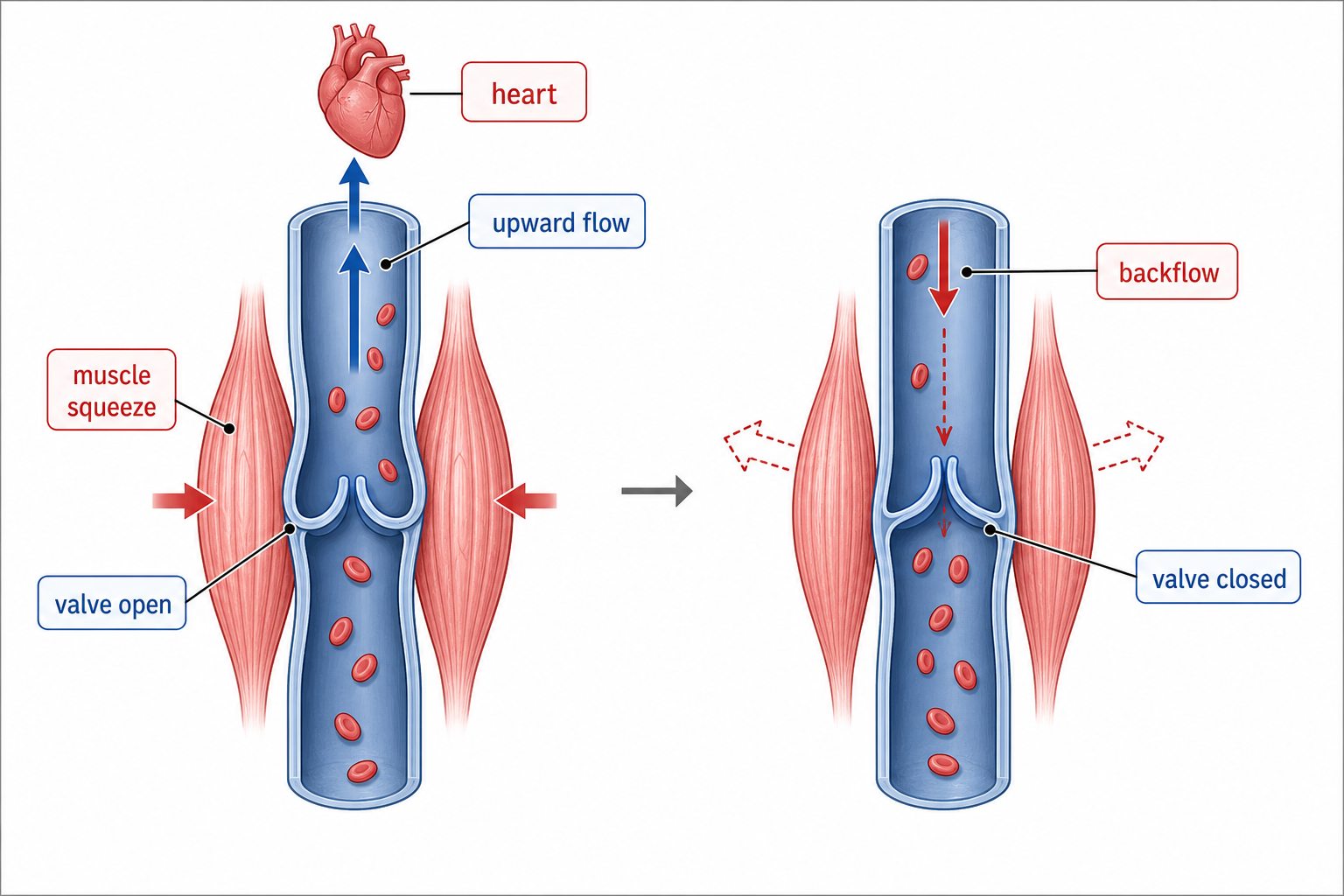
Veins return blood at low pressure. Valves prevent backflow toward capillaries, thin flexible walls allow surrounding skeletal muscles to compress veins, and large lumens reduce friction so low-pressure blood can flow back to the heart.
The muscle pump matters because venous pressure is low.
Order the vein-return mechanism during skeletal muscle contraction.
OrderOrder the vein-return mechanism during skeletal muscle contraction.
ChooseFrom Plaque To Heart Attack
Coronary arteries supply cardiac muscle with oxygen and nutrients. Atherosclerosis can form plaques beneath damaged coronary artery endothelium. If a plaque ruptures, thrombosis can occlude the artery, reducing oxygen delivery; cardiac muscle may die, causing myocardial infarction.
Order the coronary artery occlusion story.
OrderHow Water Rises In Xylem
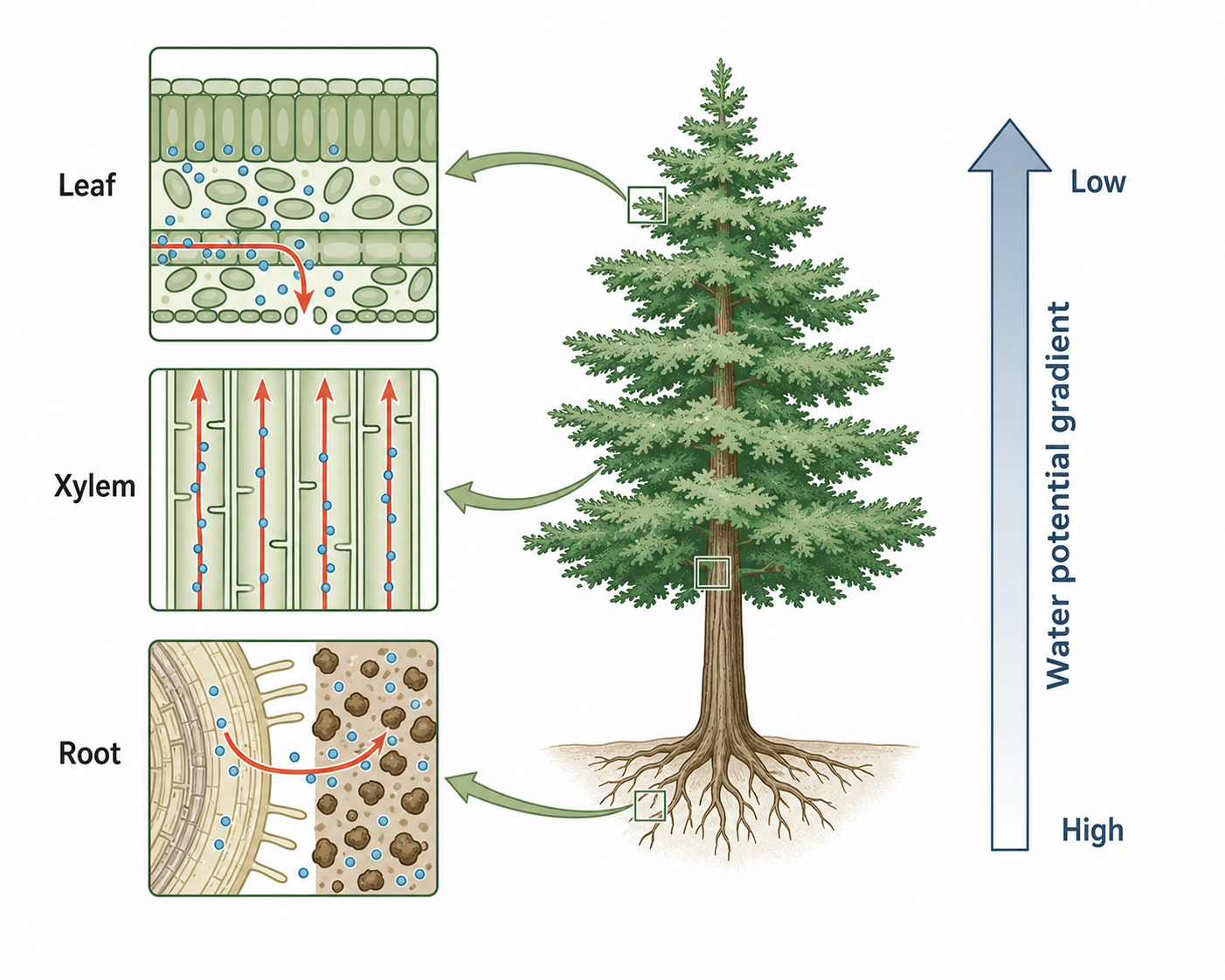
Water rises in xylem mainly because transpiration from leaf mesophyll creates tension in xylem water columns. Cohesion between water molecules transmits that tension from leaves toward roots, while adhesion to xylem walls helps maintain an unbroken transpiration stream.
Read the transpiration stream as a tension pathway from leaf to root.
Match each word in the transpiration stream to its role.
MatchMatch each word in the transpiration stream to its role.
ChooseWhy Xylem Does Not Collapse
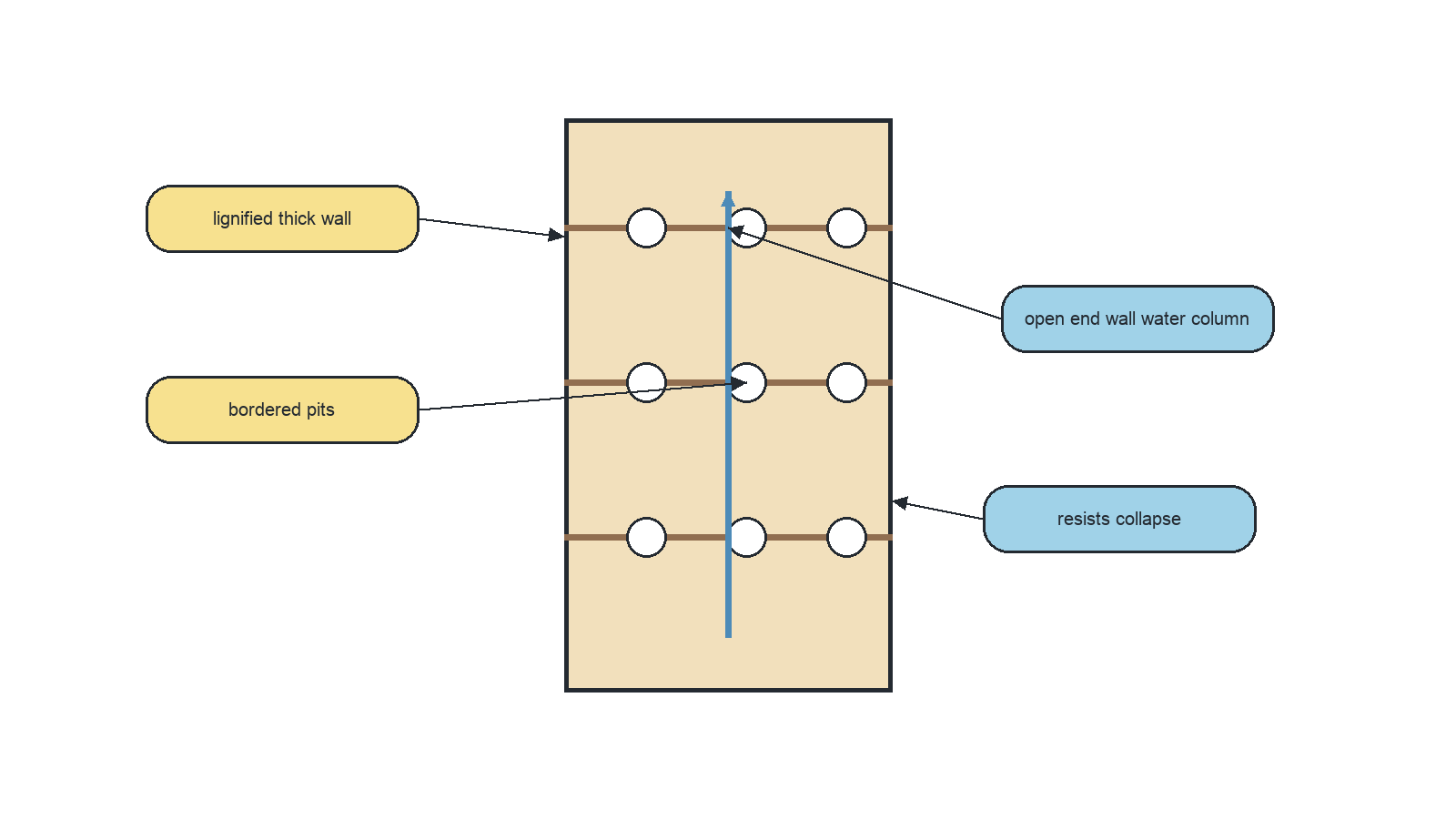
Mature xylem vessels are dead, hollow tubes with absent or perforated end walls, so water can move with little resistance. Lignified walls resist collapse under negative pressure and waterproof the vessel. Pits allow lateral movement of water between vessels and surrounding tissues.
Each feature should be tied to transport efficiency or structural support.
Match xylem structure to transport function.
MatchMatch xylem structure to transport function.
ChooseRead A Dicot Stem Plan
A dicot stem plan diagram shows tissue distribution, not individual cells. Dicot stems have epidermis, cortex, pith, and vascular bundles in a ring. Each vascular bundle contains xylem, phloem, cambium, and supporting fibres. Plan diagrams should use outlines and tissue labels rather than cell detail.
Sort the stem-plan features.
SortRead A Dicot Root Plan
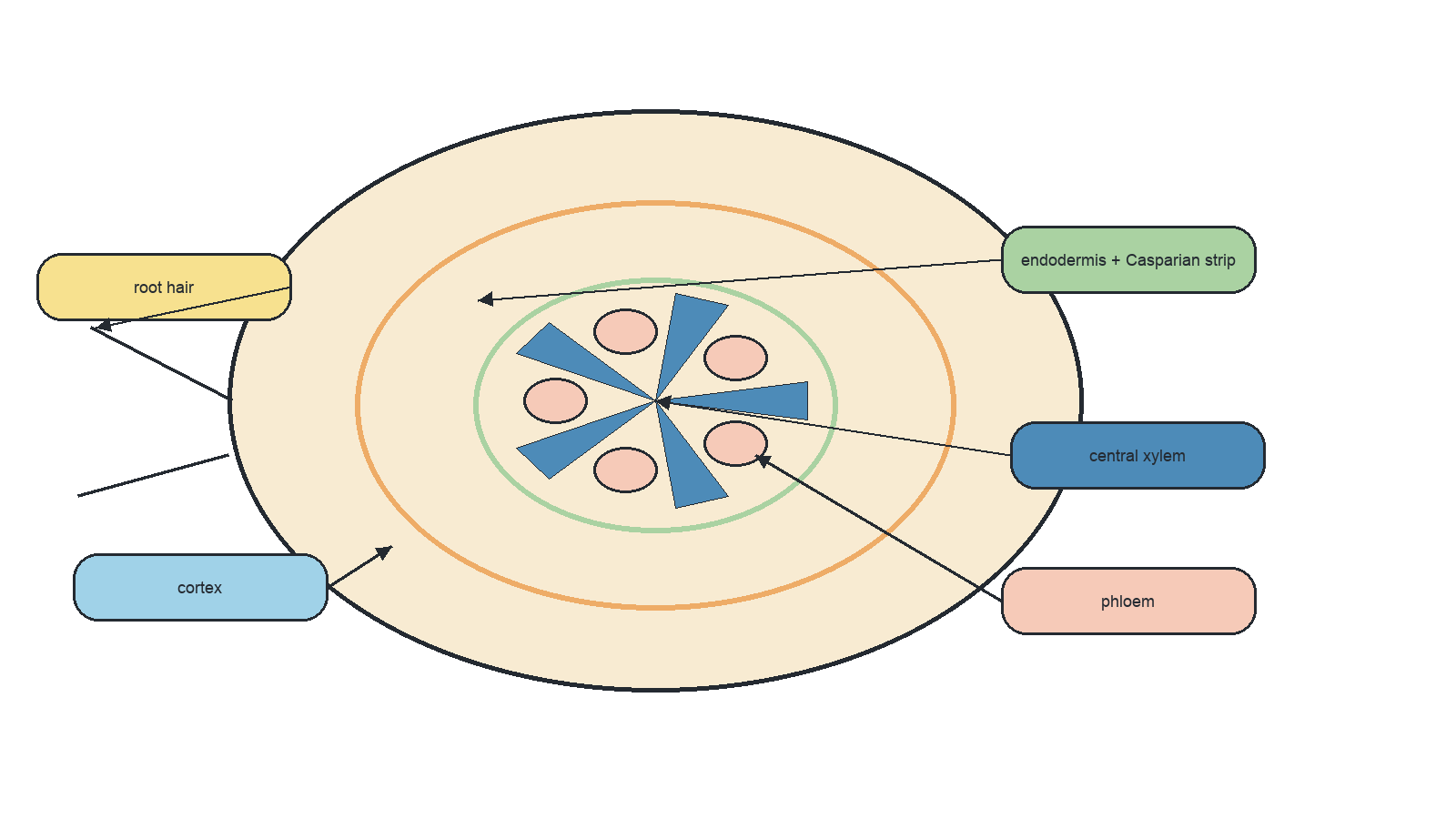
A dicot root has epidermis with root hairs, cortex, endodermis, and central vascular tissue. The xylem forms a central cross with phloem between the arms. The Casparian strip in the endodermis blocks apoplast flow and forces water and ions through selective symplast entry before reaching xylem.
Use tissue position to separate a root plan from a stem plan.
Match each root feature to its role.
MatchMatch each root feature to its role.
ChooseHL: How Tissue Fluid Forms
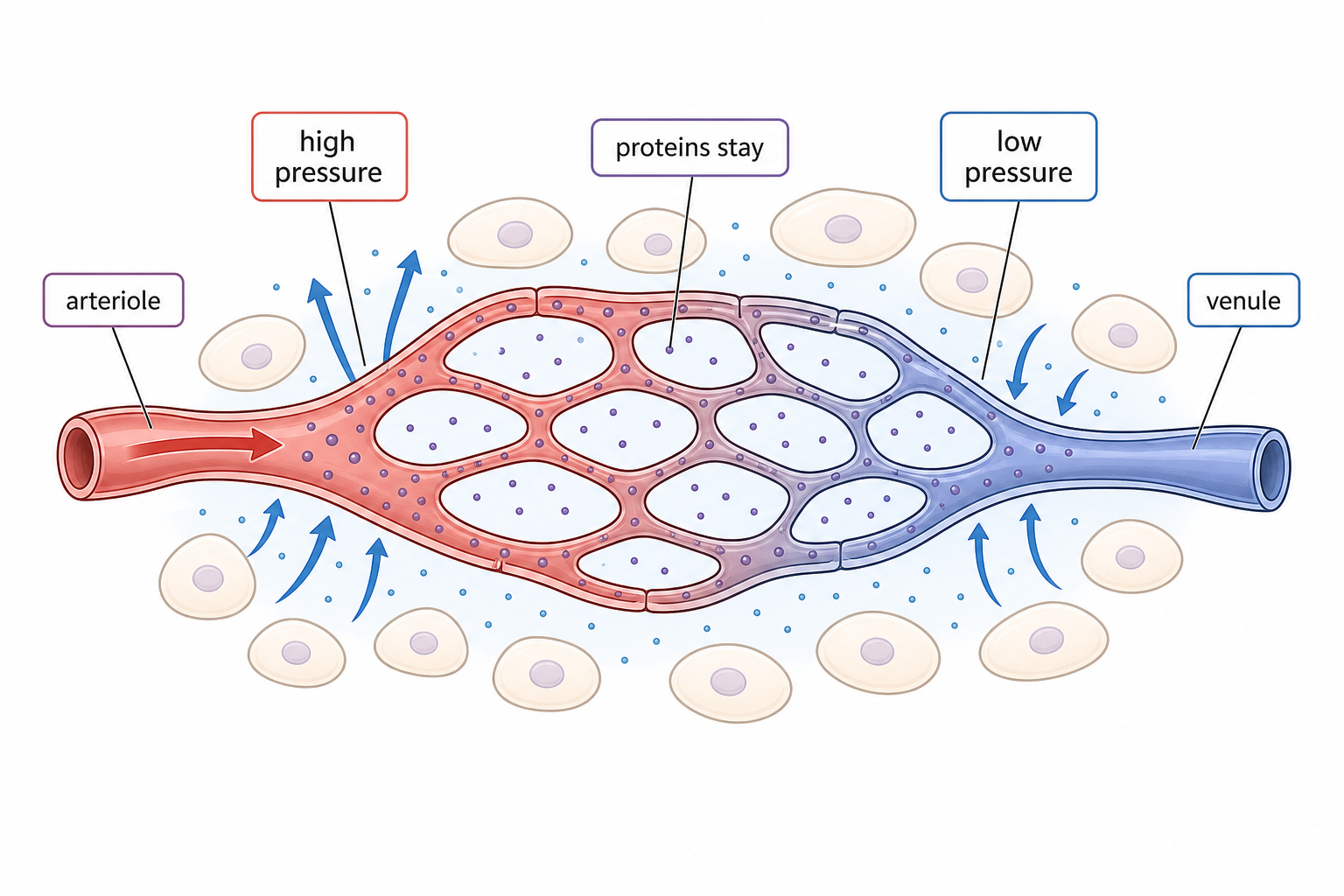
HL adds how tissue fluid forms. At the arteriole end of a capillary, hydrostatic pressure forces plasma fluid out by ultrafiltration. Large plasma proteins remain in the blood and maintain osmotic pull. As pressure falls toward the venule end, about 90% of tissue fluid re-enters capillaries.
Track which force dominates at each end of the capillary.
Order tissue fluid formation and return.
OrderOrder tissue fluid formation and return.
ChooseHL: Exchange In Tissue Fluid
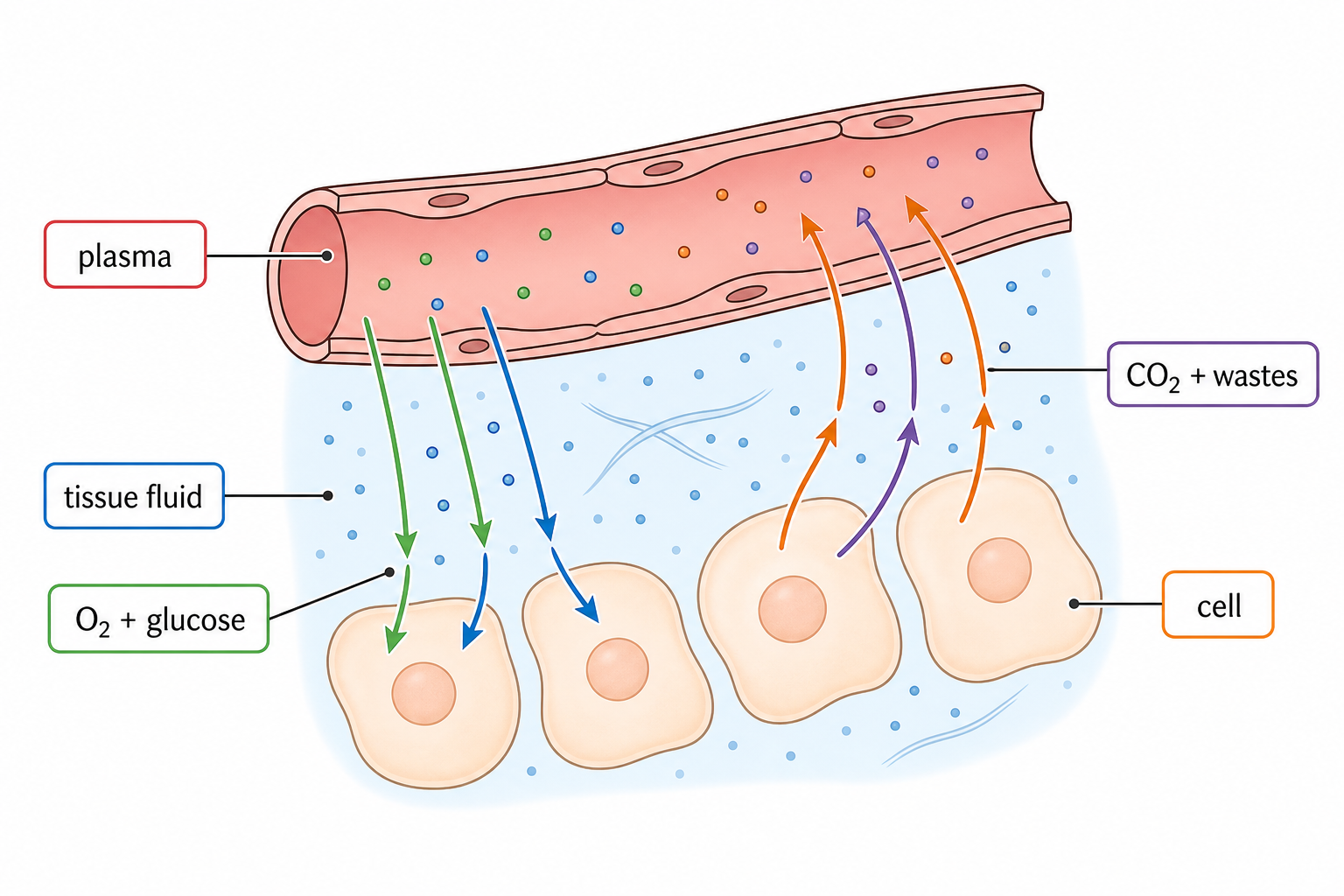
Tissue fluid bathes body cells and mediates exchange between blood and cells. Oxygen, glucose, amino acids, ions, and wastes diffuse between cells and tissue fluid. Compared with blood plasma, tissue fluid has fewer proteins, less oxygen after exchange, and more carbon dioxide from respiring cells.
Compare the compartments by what can cross and what is mostly retained.
Which statement best compares tissue fluid with blood plasma after exchange?
ChooseWhich statement best compares tissue fluid with blood plasma after exchange?
ChooseHL: Why Lymph Returns
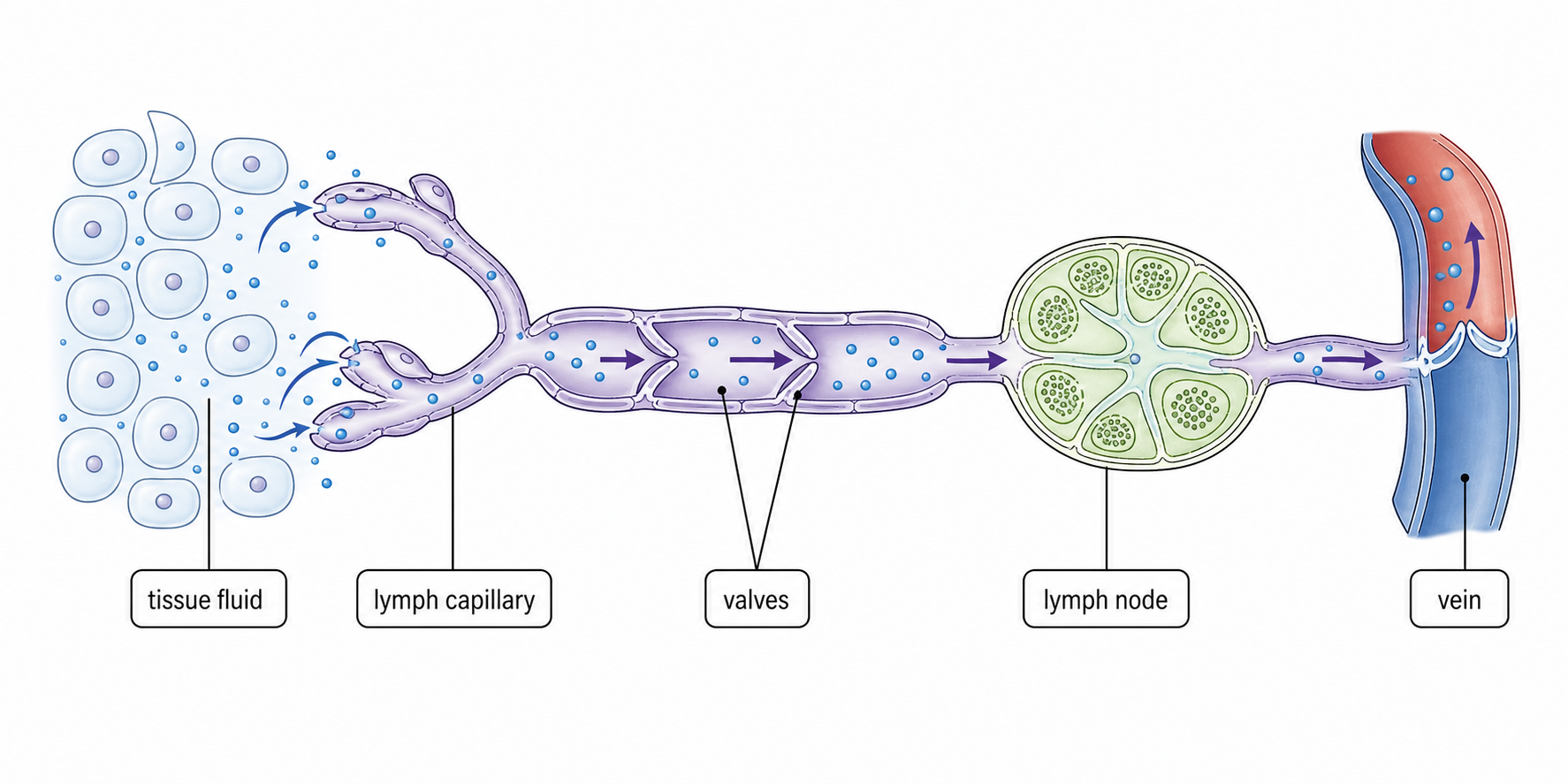
Lymph capillaries drain excess tissue fluid that does not re-enter blood capillaries. Lymphatics use smooth muscle, body movement, and valves to move lymph. Lymph nodes filter debris and contain immune cells before lymph returns to veins.
The route matters because excess tissue fluid must rejoin the blood indirectly.
Order the lymph return route.
OrderOrder the lymph return route.
ChooseHL: Single Vs Double Circulation
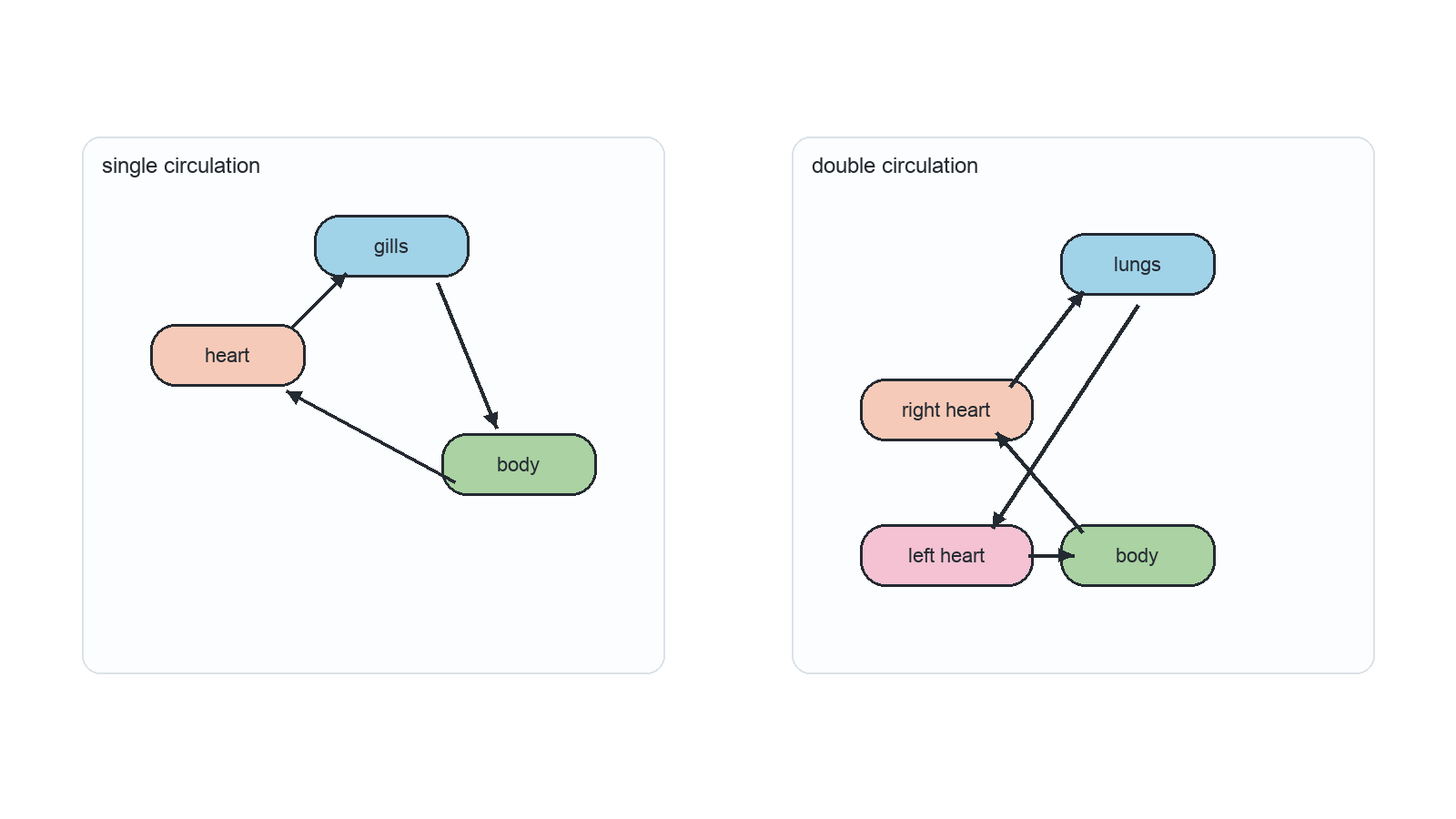
Bony fish have single circulation: heart to gills to body and back to heart. Mammals have double circulation with separate pulmonary and systemic circuits. Double circulation keeps oxygenated and deoxygenated blood separate and maintains high pressure to the body after blood returns from the lungs.
Match the circulation system to its feature.
MatchHL: Why The Mammal Heart Works
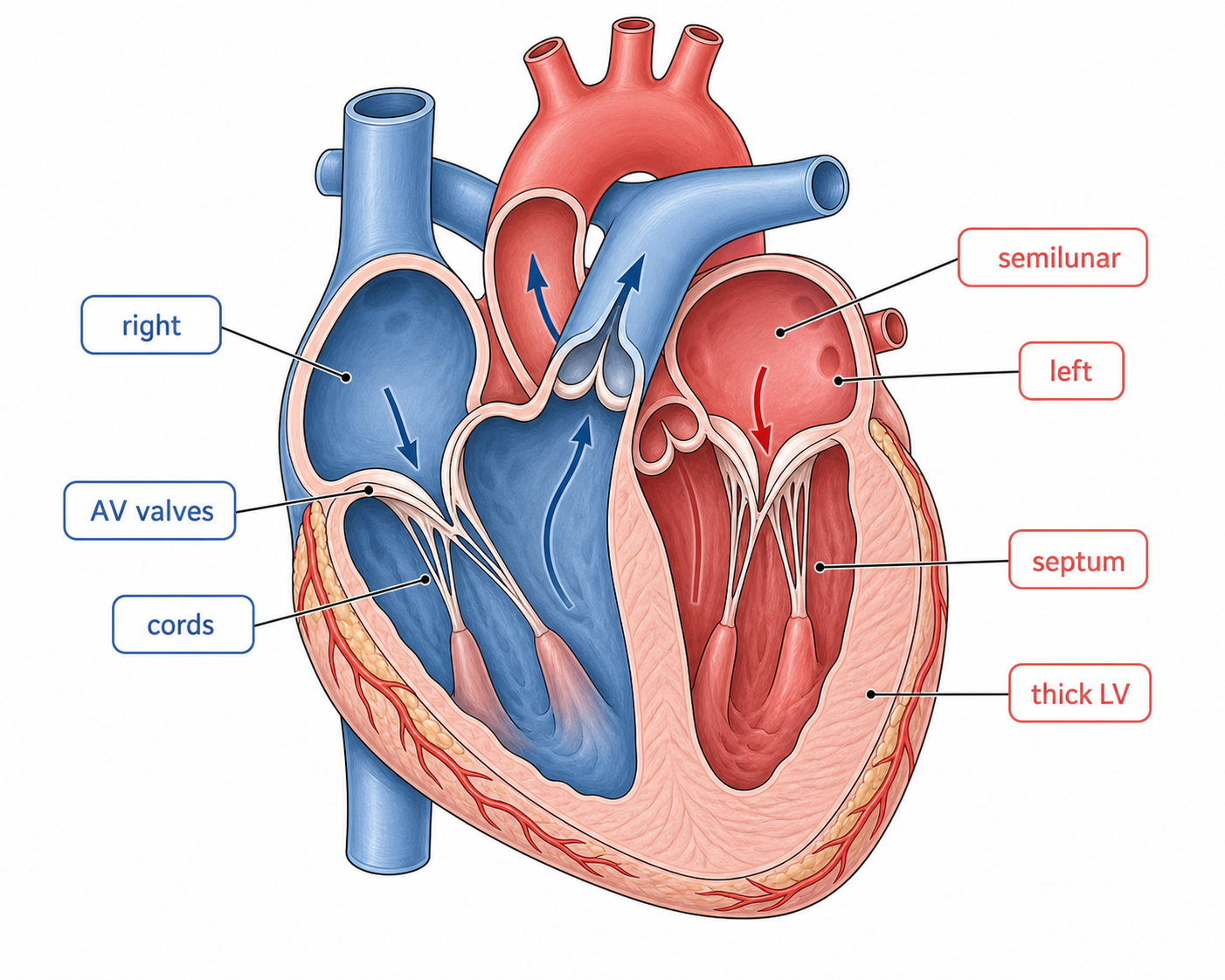
The mammalian heart is adapted for directional, pressurized double circulation. Four chambers and a septum separate right pulmonary and left systemic flow. Valves and tendinous cords ensure one-way movement. The left ventricle has thicker muscle for systemic pressure; coronary arteries supply the heart muscle; cardiac muscle is myogenic.
Relate each labelled feature to keeping flow one way or pressure high enough.
Match heart structure to transport function.
MatchMatch heart structure to transport function.
ChooseHL: Sequence The Cardiac Cycle
PracticeThe cardiac cycle is a sequence of pressure changes and valve states. The sinoatrial node initiates excitation, followed by atrial systole. The atrioventricular node delays conduction so ventricles fill before ventricular systole. Ventricular systole closes AV valves and opens semilunar valves; diastole allows refilling and recovery.
Order the cardiac cycle events.
OrderHL: Root Pressure At Night
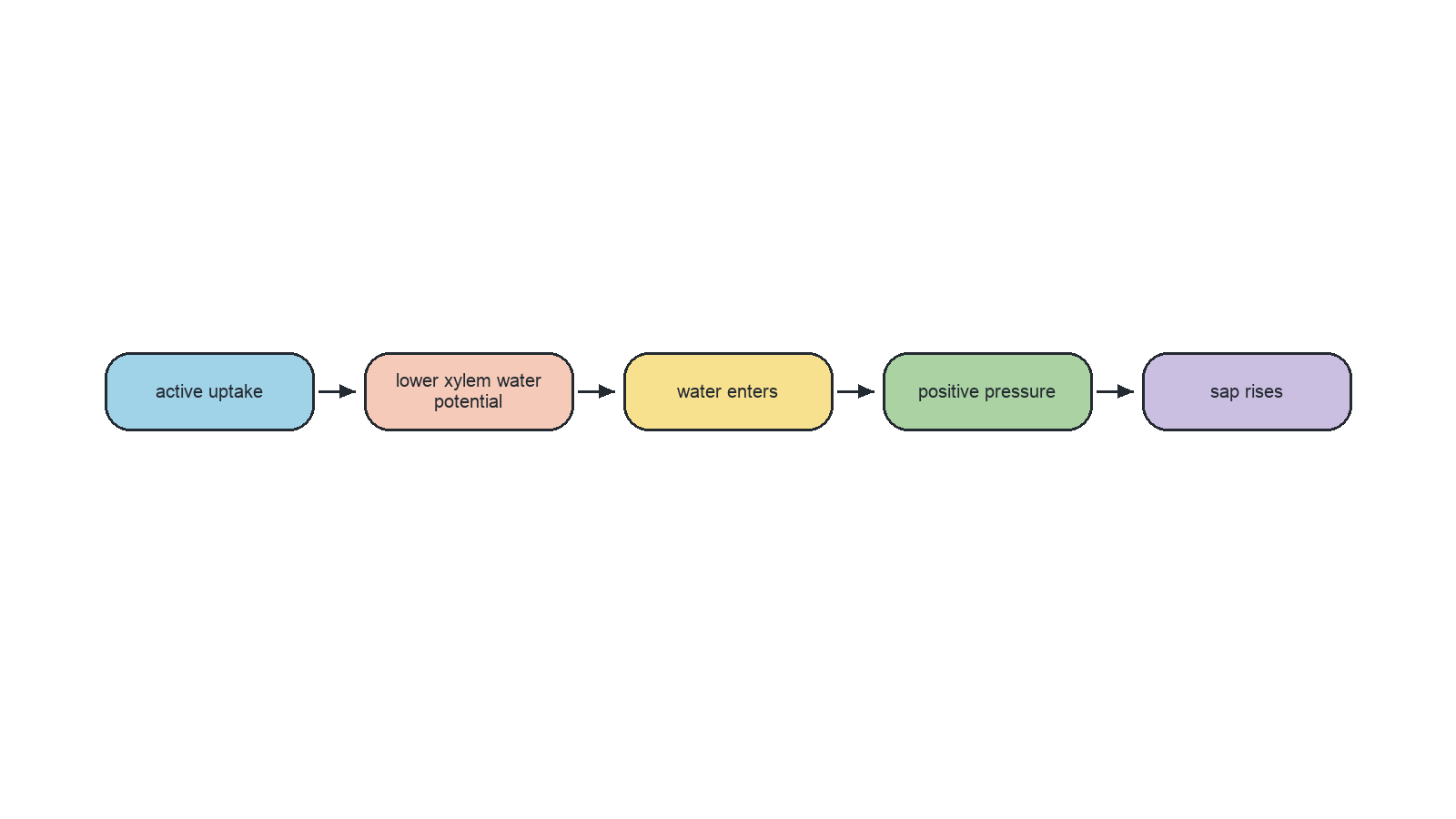
Root pressure is a pushing mechanism generated in roots, especially when transpiration is low. Endodermal cells actively pump mineral ions into xylem, lowering xylem water potential. Water enters xylem by osmosis, creating positive pressure that can push water upward in seedlings or at night.
Order root pressure generation.
OrderHL: How Phloem Translocates
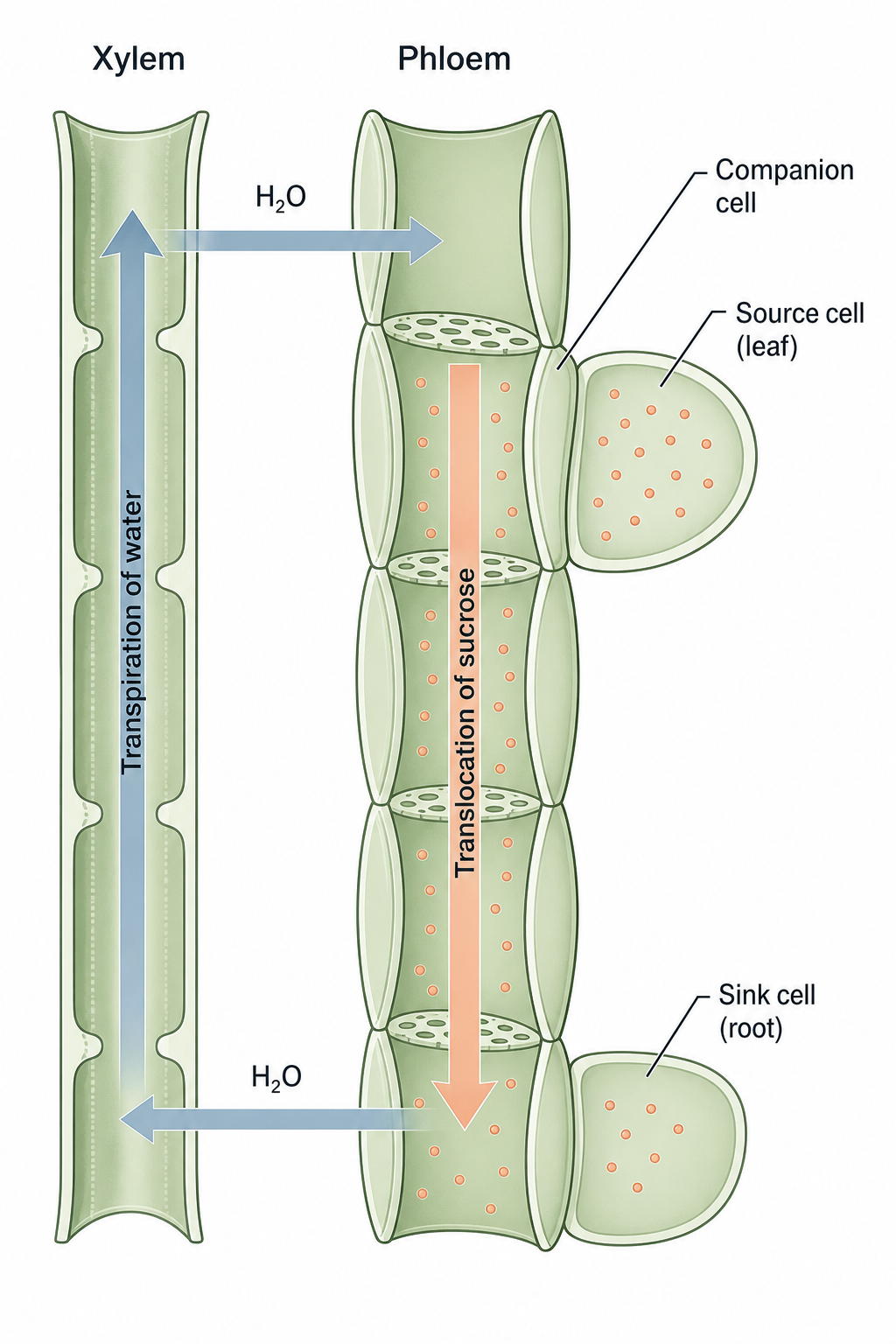
Phloem transports organic compounds such as sucrose and amino acids by pressure-flow translocation. Sieve tube elements are living tubes with sieve plates and reduced organelles. Companion cells have many mitochondria and connect by plasmodesmata. Active loading at sources raises solute concentration, water enters by osmosis, pressure rises, and sap flows toward sinks where solutes are unloaded.
The driving force is the pressure gradient created by loading and unloading.
Order pressure-flow translocation from source to sink.
OrderOrder pressure-flow translocation from source to sink.
ChooseCore Transfer: Link Transport Structure To Function
Exam PracticeAnimal and plant transport answers should link structure to function. In animals, capillaries exchange, arteries maintain high-pressure flow, veins return low-pressure blood, pulse measures arterial pressure waves, and coronary occlusion blocks oxygen delivery to heart muscle. In plants, xylem transports water by transpiration tension and cohesion, while stem and root tissue plans show where xylem and phloem are arranged.
Use this for core questions on blood vessels, pulse, coronary occlusion, xylem, and stem/root tissue distribution.
Use this for core questions on blood vessels, pulse, coronary occlusion, xylem, and stem/root tissue distribution.
Do not list vessel or plant tissue names without linking each to pressure, exchange, flow direction, or tissue position.
HL Transfer: Pressure, Heart, Lymph, And Phloem
Exam PracticeHL transport adds pressure and route systems. Tissue fluid forms by capillary pressure and returns by osmotic pull or lymph. Double circulation separates pulmonary and systemic routes. The heart creates directional pressure with chambers, septum, valves, and cycle timing. Plants add root pressure and phloem pressure-flow translocation.
Match each HL transport clue to the correct mechanism.
MatchUse this for HL questions on tissue fluid, lymph, circulation type, mammalian heart, cardiac cycle, root pressure, and phloem translocation.
Use this for HL questions on tissue fluid, lymph, circulation type, mammalian heart, cardiac cycle, root pressure, and phloem translocation.
Do not merge all plant transport into one answer: xylem tension, root pressure, and phloem pressure flow are different mechanisms.