
From Zygote To Stem Cell Potential
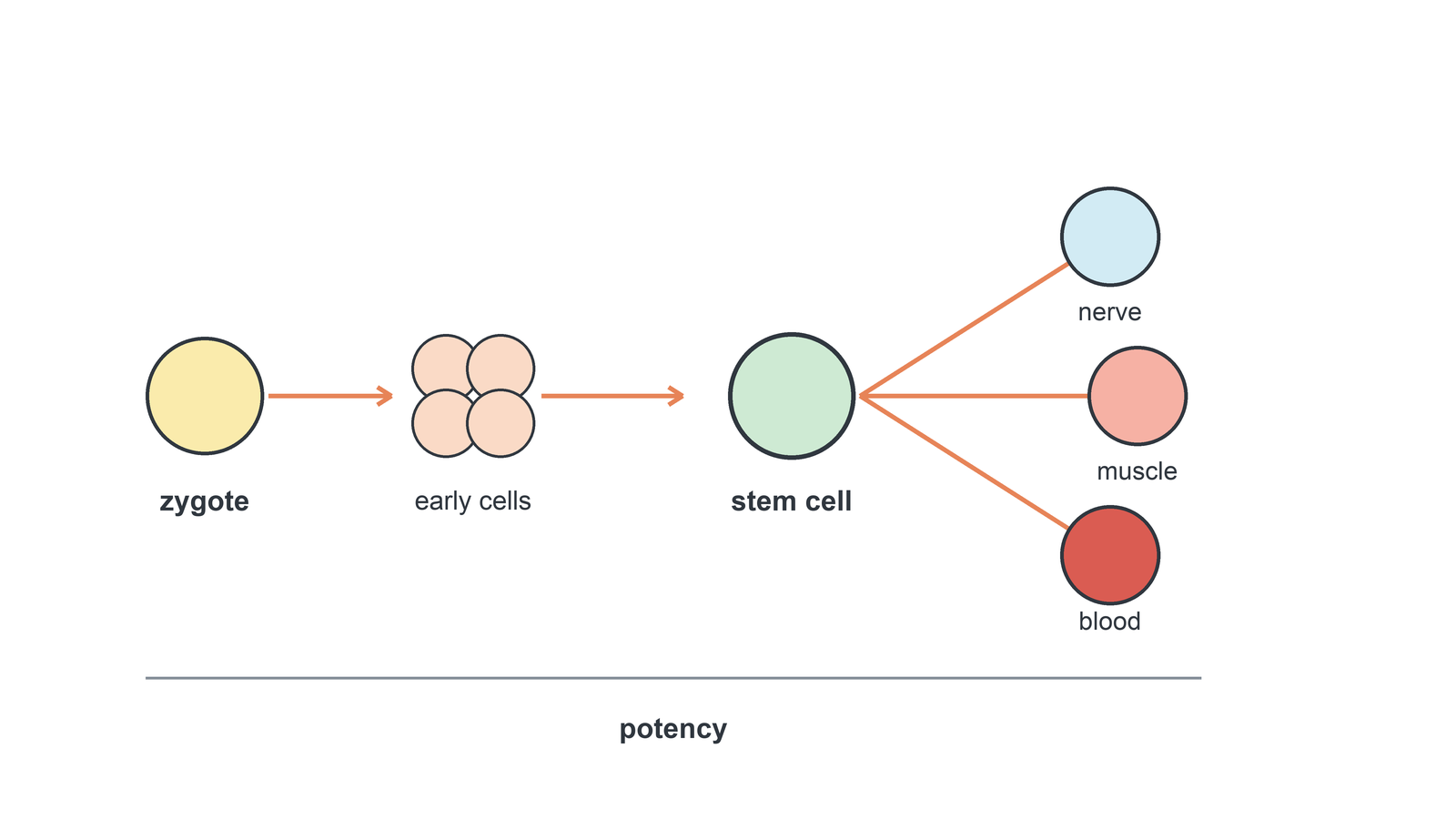
A zygote divides to produce unspecialized cells that later differentiate. The key exam mechanism is differential gene expression: cells usually keep the same genome, but different genes are activated or suppressed, so different proteins are made. Morphogen gradients can control gene expression and body pattern formation during development. Stem cells self-renew by repeated division while remaining undifferentiated, so they can supply new cells before some descendants specialize.
Which explanation best describes differentiation after fertilization?
ChooseCompare Niches And Potency Levels
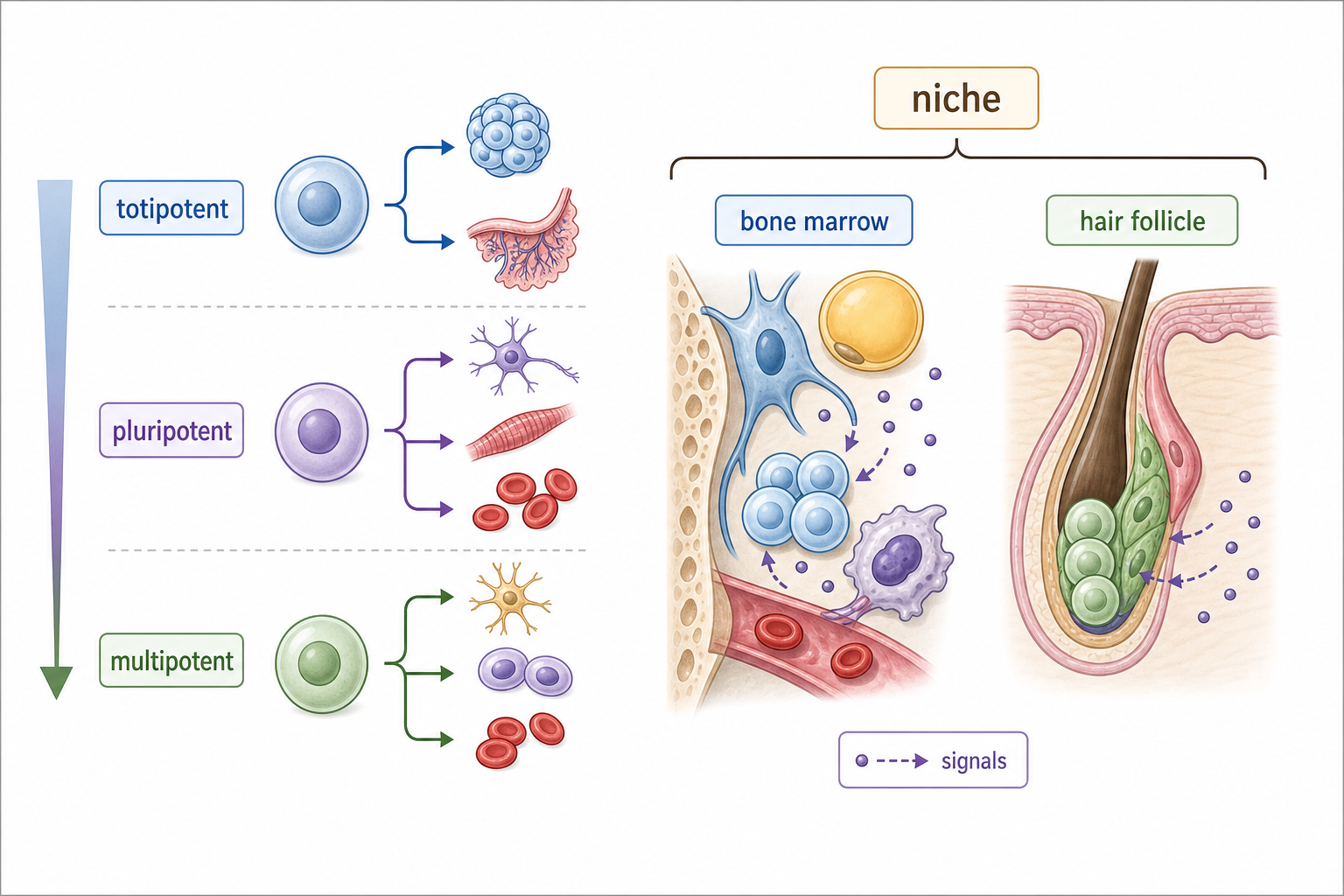
Stem cells are useful because they self-renew by repeated division while remaining undifferentiated, and they have potency: the capacity to differentiate into mature cell types. Adult stem cell niches provide signals that maintain, activate, or differentiate stem cells, such as bone marrow niches for blood cells or hair follicle bulge niches for hair regeneration.
The visual separates potency classes from the adult microenvironments that control stem cells.
Sort the stem-cell terms by their differentiation potential.
SortSort the stem-cell terms by their differentiation potential.
ChooseSize Fits The Cell Job
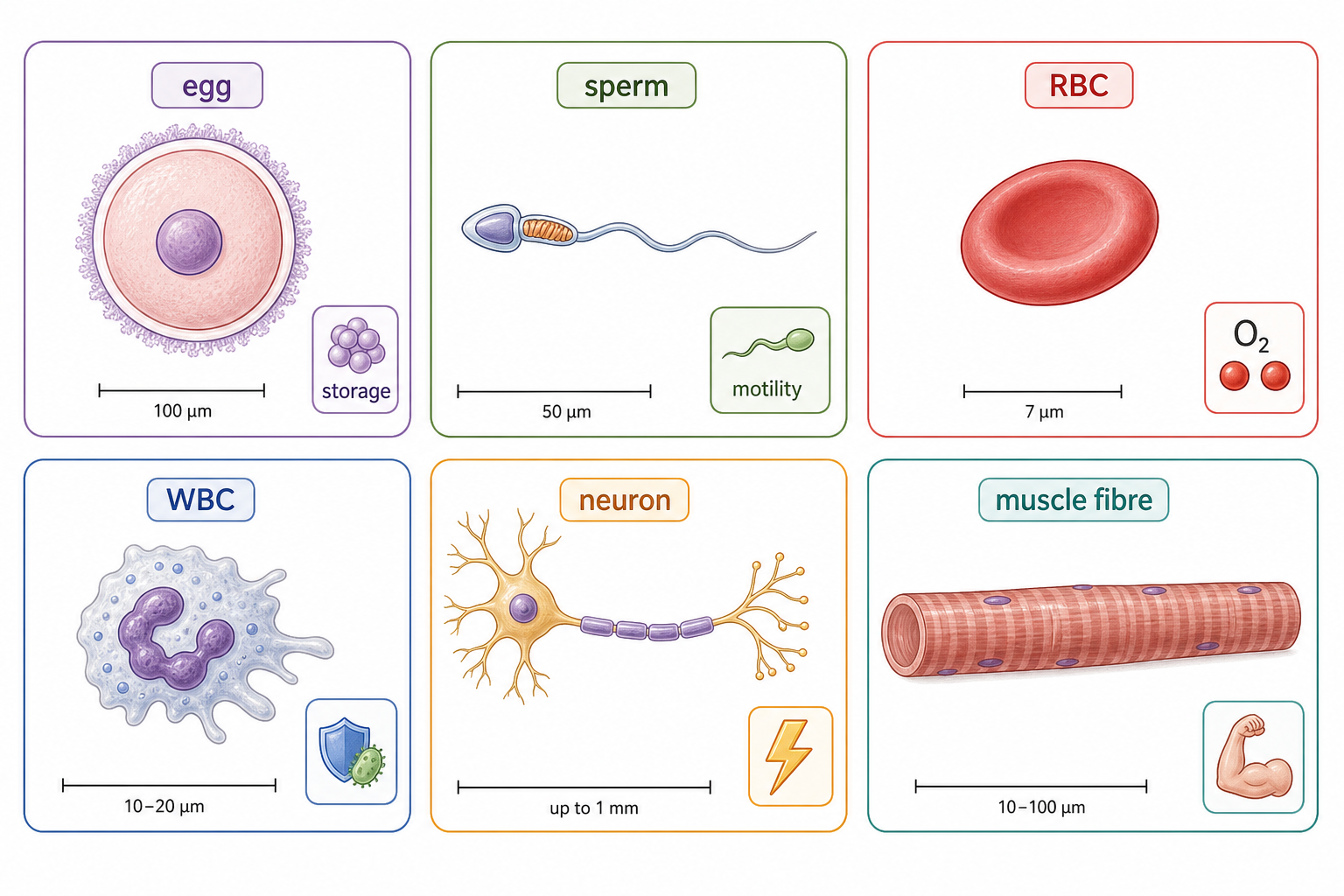
Specialized cells vary widely in size because their structure fits their function. Egg cells are large because they store nutrients; sperm are small and streamlined with a long flagellum; neurons can be very long for communication; striated muscle fibres are extended multinucleate cells for contraction.
Different cell sizes are useful because they solve different biological problems.
Match each specialized cell size/shape to its advantage.
MatchMatch each specialized cell size/shape to its advantage.
ChooseWhy Surface Area Limits Size
PracticeSurface area-to-volume ratio explains why cell size is limited. Surface area controls the rate of exchange across the membrane, while volume controls metabolic demand. As a cell grows, volume increases faster than surface area, so exchange cannot keep up unless the cell divides or develops exchange adaptations.
A roughly spherical cell doubles in diameter. What happens to its surface area-to-volume ratio?
ChooseHL Increase Surface Area For Exchange
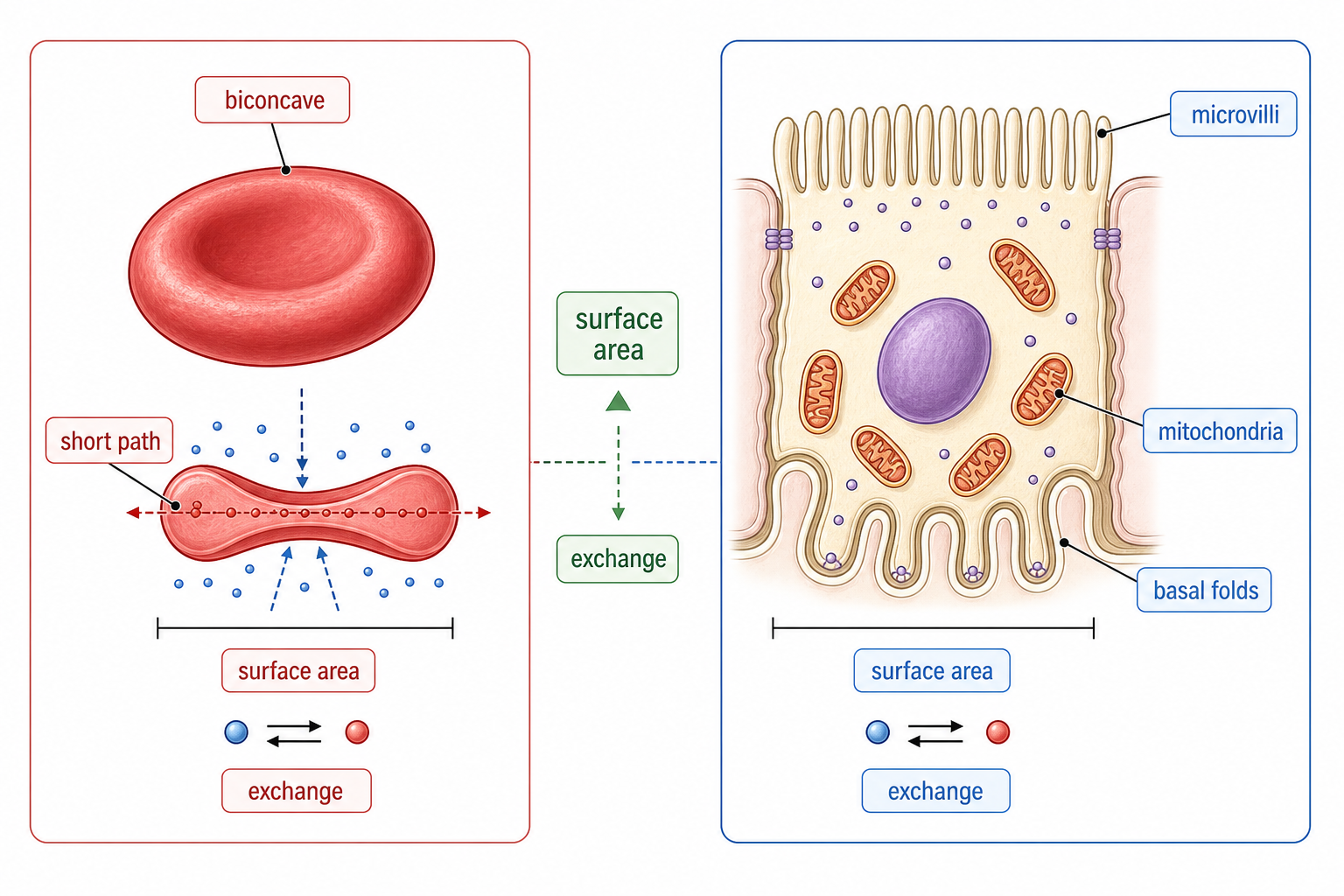
HL asks you to recognize cell adaptations that increase surface area or support high exchange. Erythrocytes are flattened, biconcave, flexible, and lack a nucleus for oxygen exchange. Proximal convoluted tubule cells have apical microvilli and basal invaginations, with many mitochondria to support active transport during reabsorption.
Different structures raise surface area for different exchange tasks.
Match each adaptation to the function it improves.
MatchMatch each adaptation to the function it improves.
ChooseHL Two Pneumocytes Two Jobs
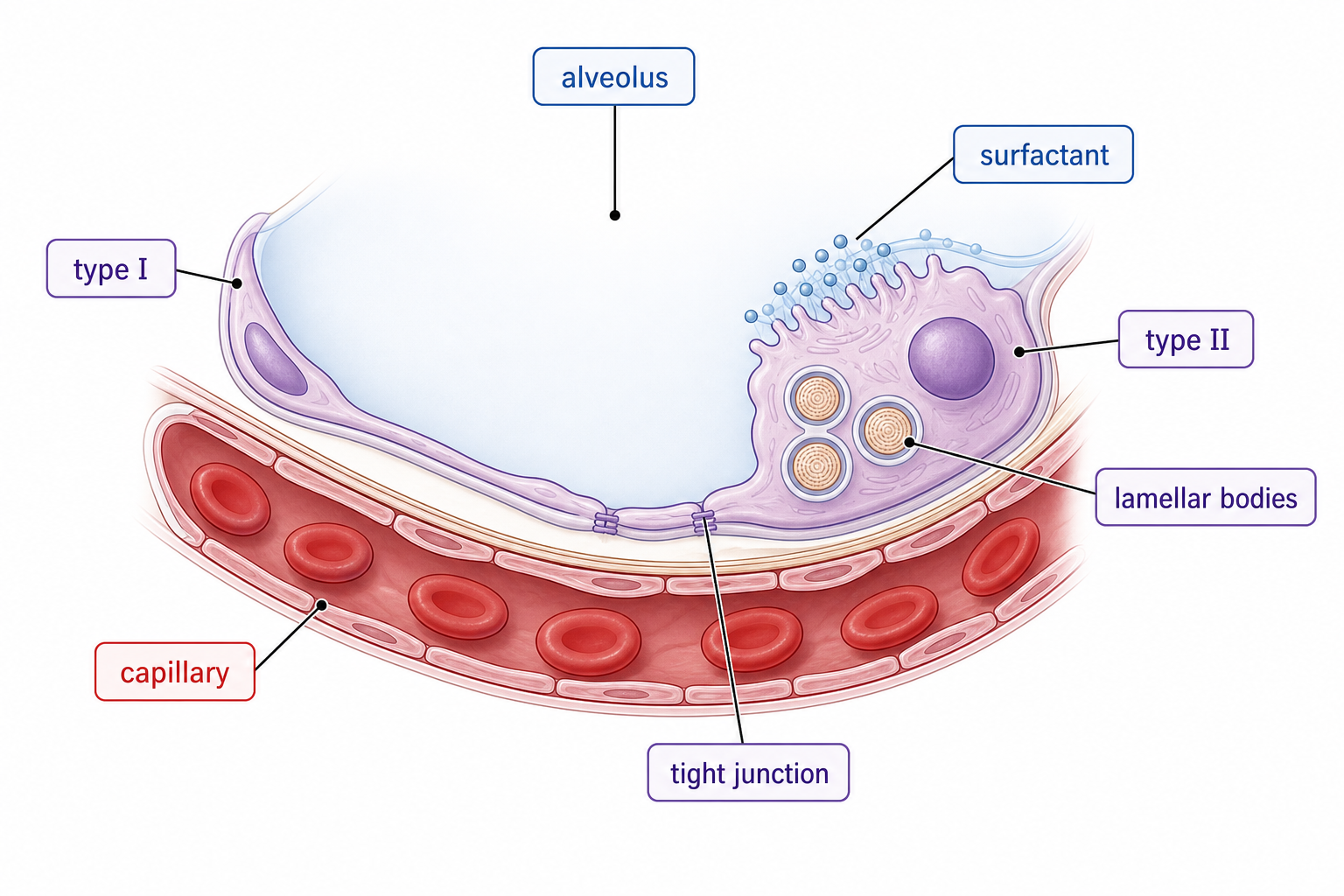
Alveoli use two pneumocyte types with different jobs. Type I pneumocytes are flattened and thin, minimizing diffusion distance for gas exchange. Tight connections reduce leakage of tissue fluid into alveoli. Type II pneumocytes are cuboidal, contain lamellar bodies, and secrete surfactant to reduce surface tension and prevent alveolar collapse.
The alveolar epithelium uses more than one cell type because diffusion and surfactant secretion need different adaptations.
Sort each feature to type I or type II pneumocytes.
SortSort each feature to type I or type II pneumocytes.
ChooseHL Cardiac Versus Skeletal Muscle
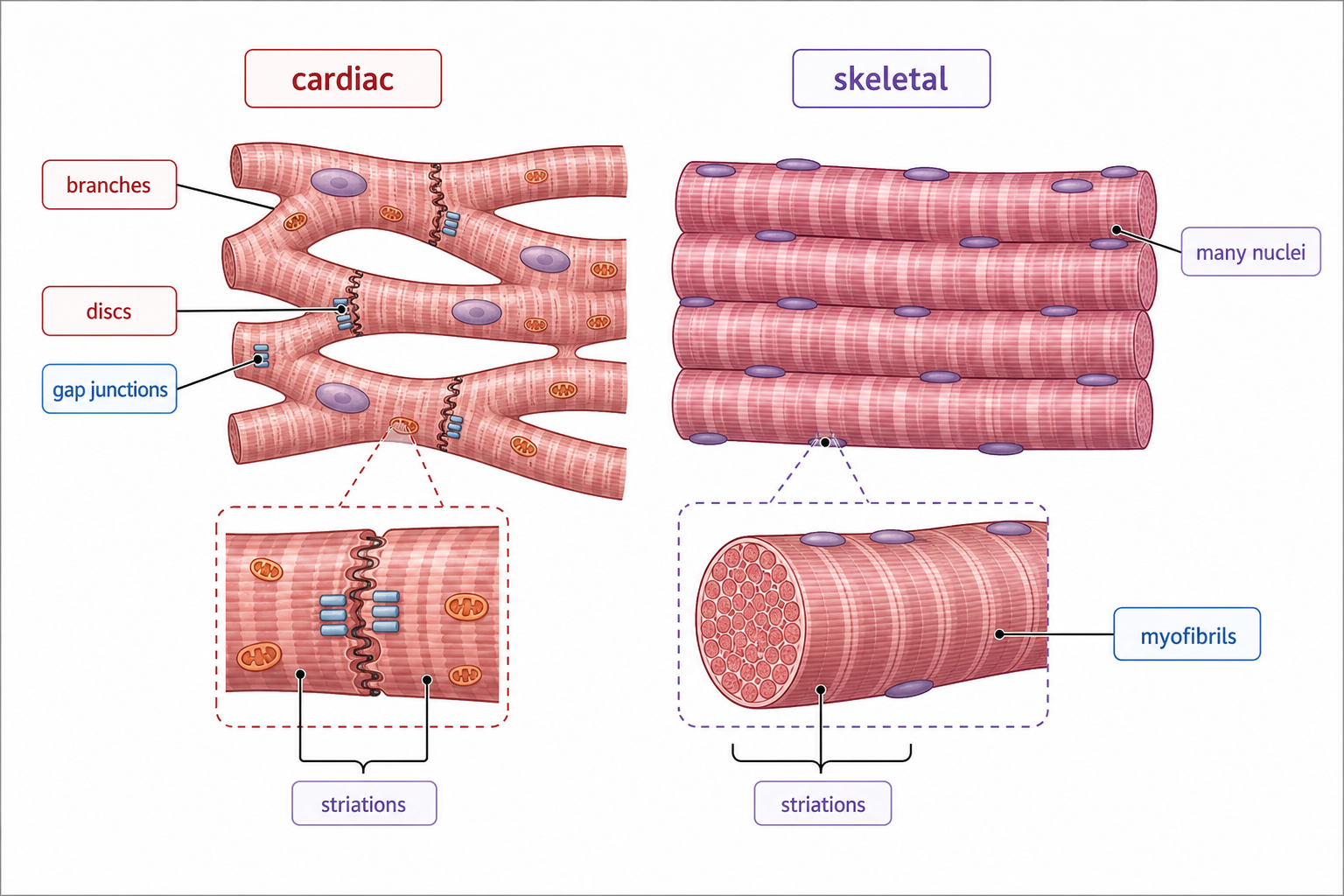
Muscle cells show specialization for contraction. Cardiac muscle is branched, myogenic, striated, and joined by intercalated discs; gap junctions in those discs help synchronized contraction. Skeletal striated muscle fibres are long, multinucleate, striated, and packed with myofibrils and mitochondria.
Both muscle types use striated contractile machinery, but their cell architecture fits different contraction patterns.
Sort the features into cardiac, skeletal, or both.
SortSort the features into cardiac, skeletal, or both.
ChooseHL Gametes Are Specialized Differently
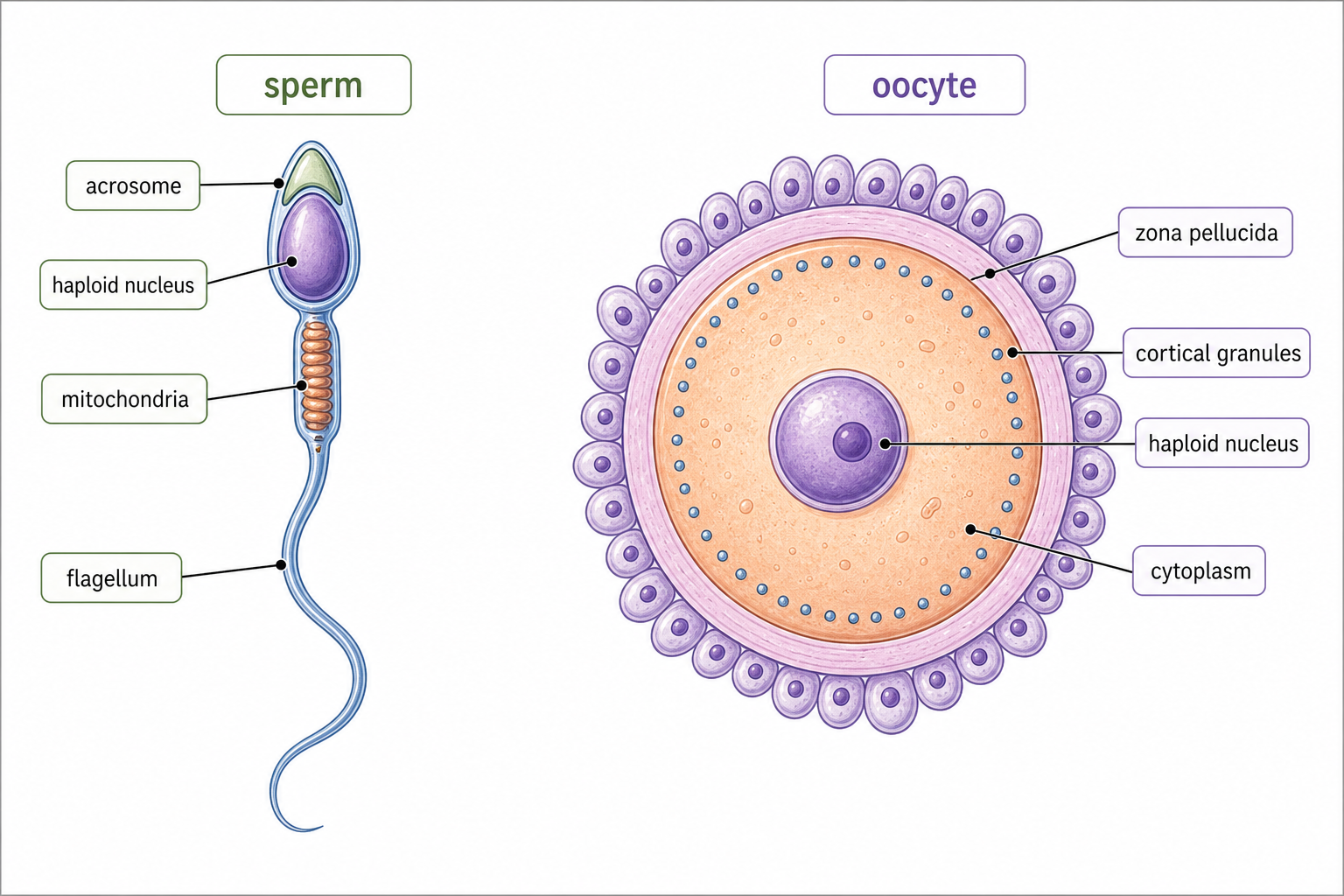
Gametes are specialized in opposite ways for fertilization. Sperm have a haploid nucleus, an acrosome to digest the zona pellucida, a mitochondria-rich middle piece for ATP, and a flagellum for motility. Secondary oocytes have nutrient-rich cytoplasm, a zona pellucida, cortical granules, and surrounding follicle cells.
Sperm and oocytes solve different problems in fertilization, so their structures are specialized differently.
Match each gamete structure to its fertilization role.
MatchMatch each gamete structure to its fertilization role.
ChooseSL Transfer: Explain Specialization And Size Limits
Exam PracticeCell specialization comes from differential gene expression after a zygote divides, stem cells provide self-renewing cells with different potencies, and cell size is constrained by surface area-to-volume ratio because exchange depends on surface area while demand depends on volume.
Use this for core questions on differentiation, stem-cell properties/types/niches, cell size, and surface area-to-volume ratio.
Use this for core questions on differentiation, stem-cell properties/types/niches, cell size, and surface area-to-volume ratio.
Do not list definitions without the cause-effect link, especially gene expression -> protein -> specialized function.
HL Transfer: Link Specialized Cells To Function
Exam PracticeA strong answer identifies the cell, names the structural adaptation, and states the function it improves. Erythrocytes and PCT cells show exchange and transport adaptations; pneumocytes show diffusion versus secretion; muscles show contraction coordination; gametes show fertilization roles.
Match each exam clue to the structure-function link it needs.
MatchUse this for HL questions asking how specialized cells are adapted to their functions.
Use this for HL questions asking how specialized cells are adapted to their functions.
Do not describe a structure without naming the function it improves.