
Classify To Make Diversity Usable
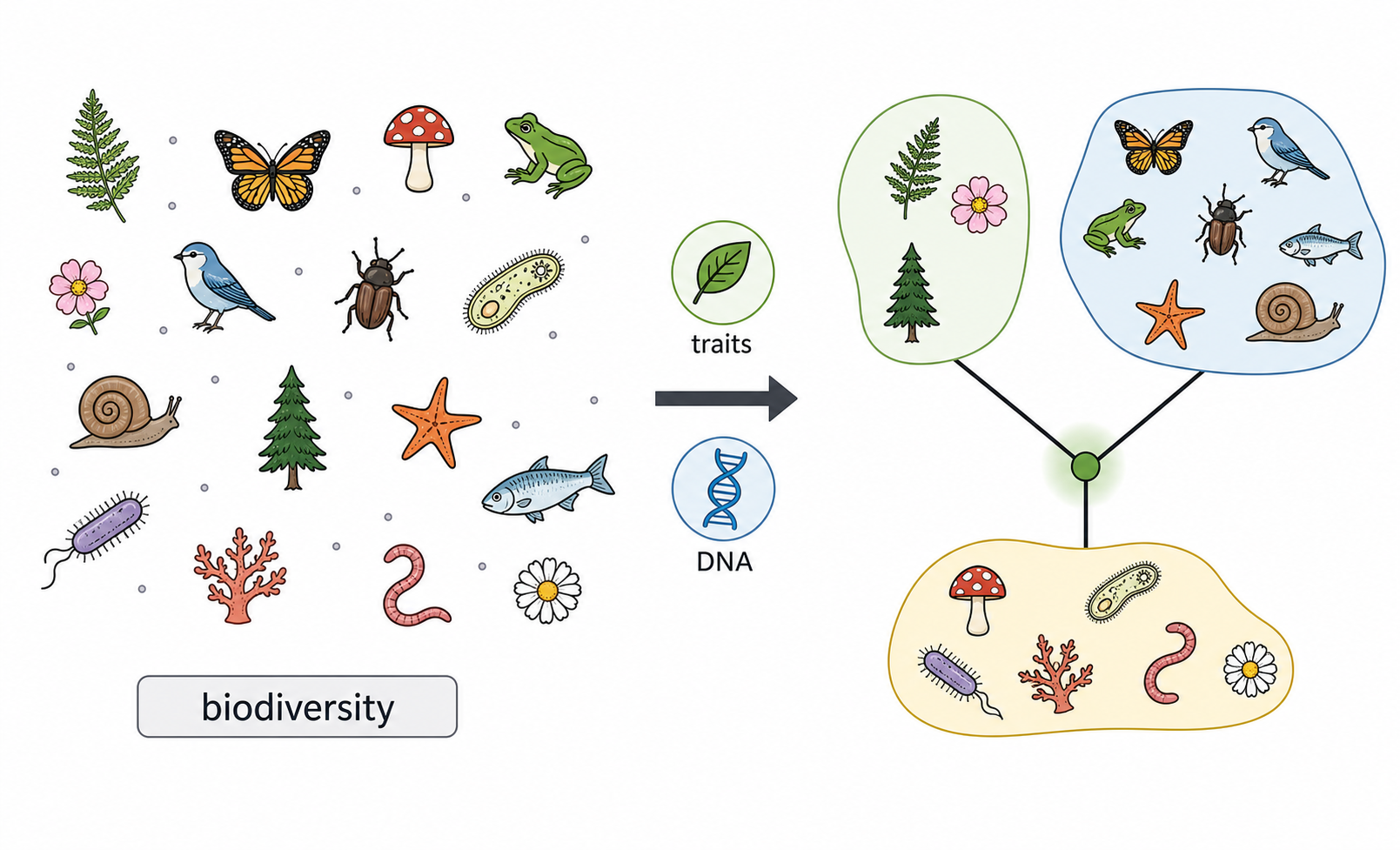
Classification is not just naming things. It organizes biodiversity into groups with shared characteristics so scientists can communicate, identify organisms, compare them, and study them further. A good classification also suggests functional, structural, and evolutionary relationships, so it becomes a prediction tool rather than a filing cabinet.
Classification turns huge biodiversity into groups that can be compared and studied.
Match each classification benefit to what it lets biologists do.
MatchMatch each classification benefit to what it lets biologists do.
ChooseSee Why Fixed Ranks Can Mislead
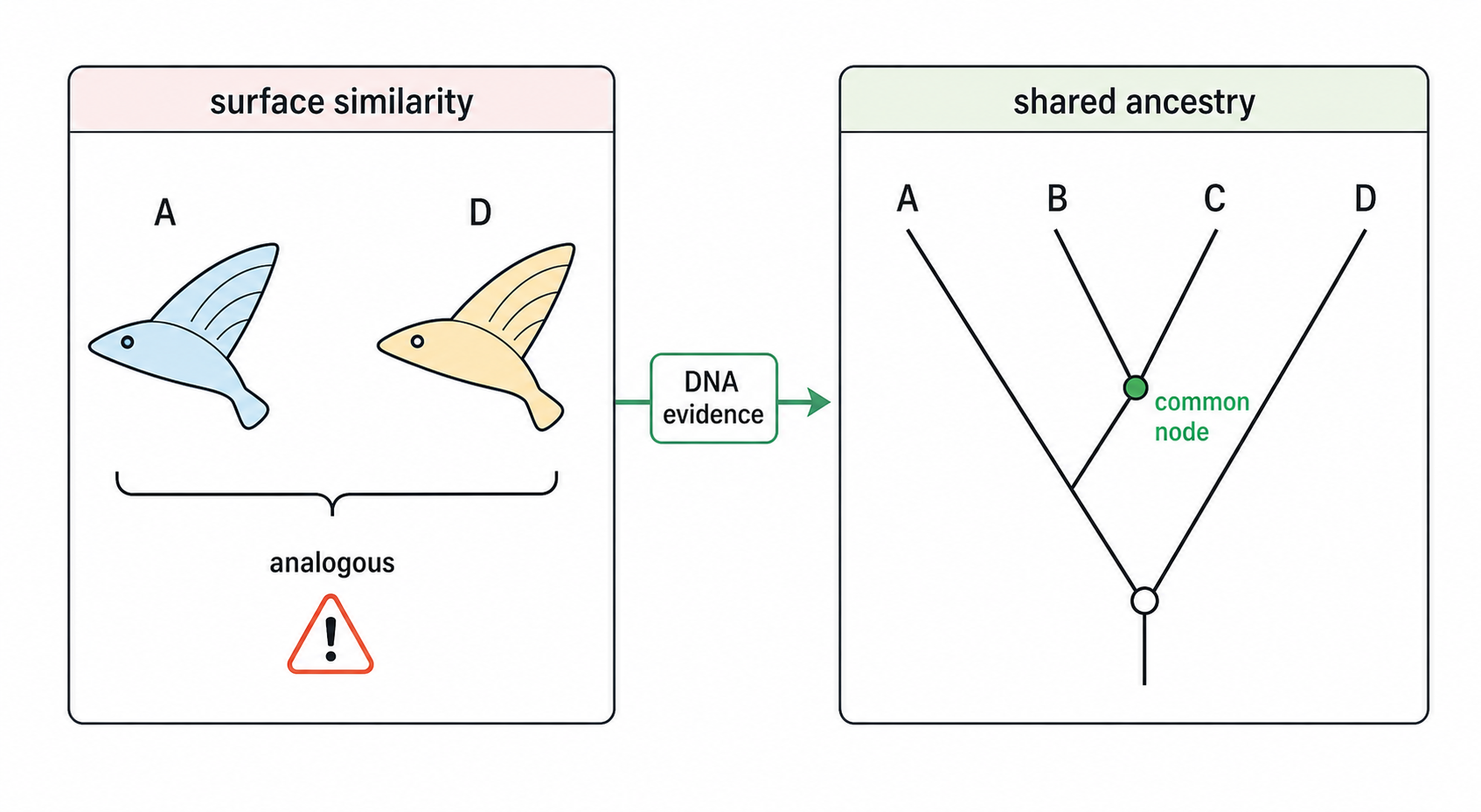
Traditional taxonomy uses fixed ranks: kingdom, phylum, class, order, family, genus, and species. The problem is that evolution does not happen in neat equal steps, so rank spacing can be arbitrary and may not match real divergence. Morphological similarity can also be convergence rather than common ancestry, so organisms can look alike for functional reasons while being less closely related than they appear.
Fixed rank names do not automatically measure evolutionary distance.
Fix the claim: similar appearance proves close relationship.
Spot ErrorsFix the claim: similar appearance proves close relationship.
ChooseMake Classification Match Phylogeny
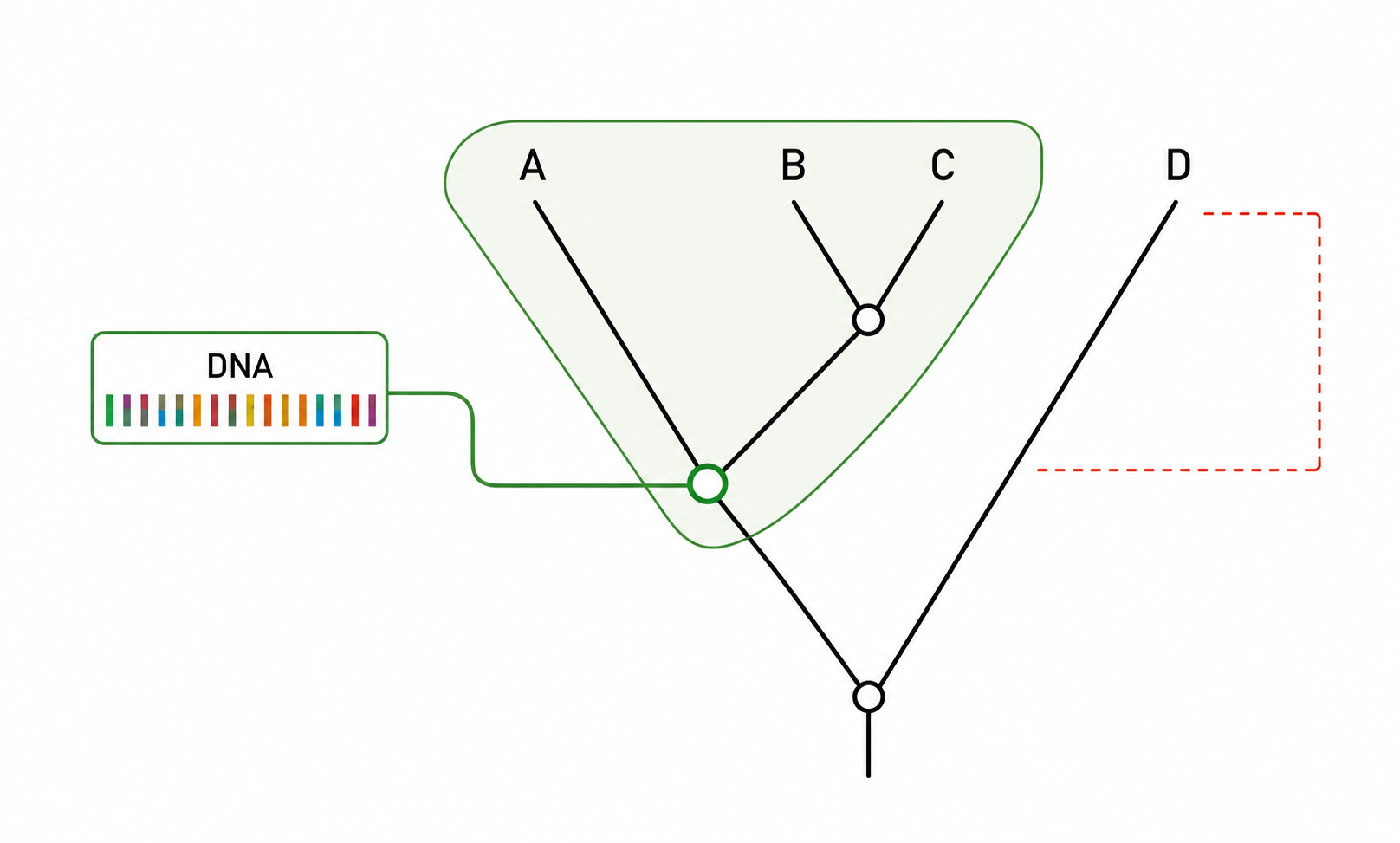
Evolutionary classification aims to match phylogeny: the actual pattern of common ancestry. A natural group is monophyletic, meaning it includes one ancestor and all of that ancestor’s descendants. DNA and protein sequence evidence can correct misleading morphology, so named groups become better predictions of shared traits and evolutionary history.
Evolutionary classification is stronger when the named group matches the tree of common ancestry.
Which grouping is monophyletic?
ChooseWhich grouping is monophyletic?
ChooseUse Synapomorphies To Define Clades
A clade is a lineage group that evolved from a common ancestor. To identify it, look for shared derived characteristics, called synapomorphies. “Derived” matters: a trait that evolved in the common ancestor and is inherited by descendants is stronger evidence than a general similarity. Synapomorphies can be anatomical, behavioural, genetic, or protein-sequence evidence.
Sort each grouping as a true clade or not a true clade.
SortUse Molecular Clocks Carefully
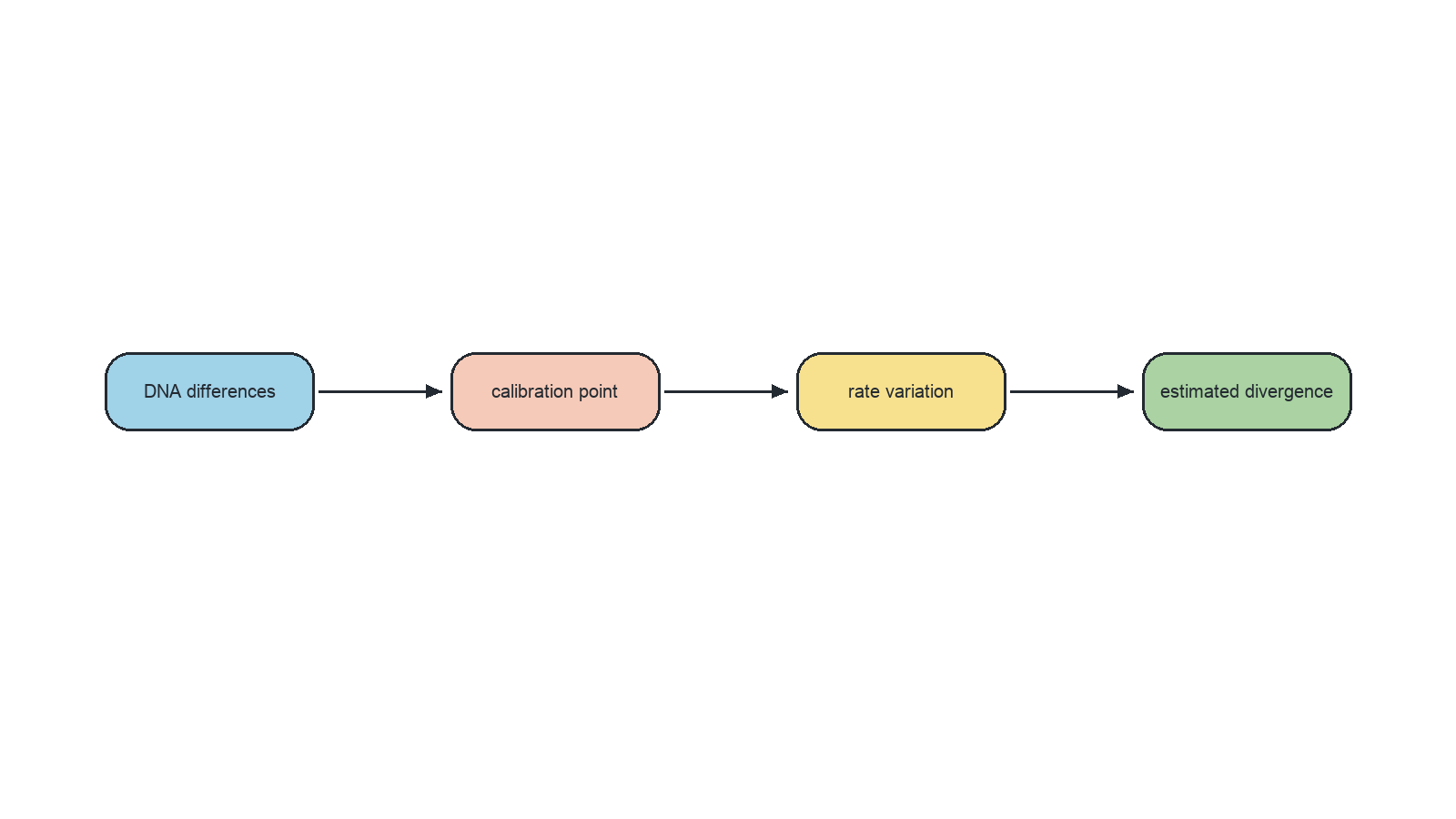
After two clades diverge, DNA or amino acid sequence differences can accumulate. A molecular clock uses those differences to estimate divergence time. The word estimate matters: the rate must be calibrated with known dates, and rates can vary between genes, lineages, generation times, population sizes, and selection pressures. More differences may suggest earlier divergence only when the clock is appropriately calibrated.
A molecular clock is an estimate: the rate assumption must be checked before turning differences into time.
A graph shows Pair X has more substitutions than Pair Y for the same calibrated gene. What can you infer, and what must you check?
GraphPair X has more nucleotide substitutions than Pair Y on the same calibrated gene graph.
A graph shows Pair X has more substitutions than Pair Y for the same calibrated gene. What can you infer, and what must you check?
ChooseBuild The Most Parsimonious Cladogram
Practice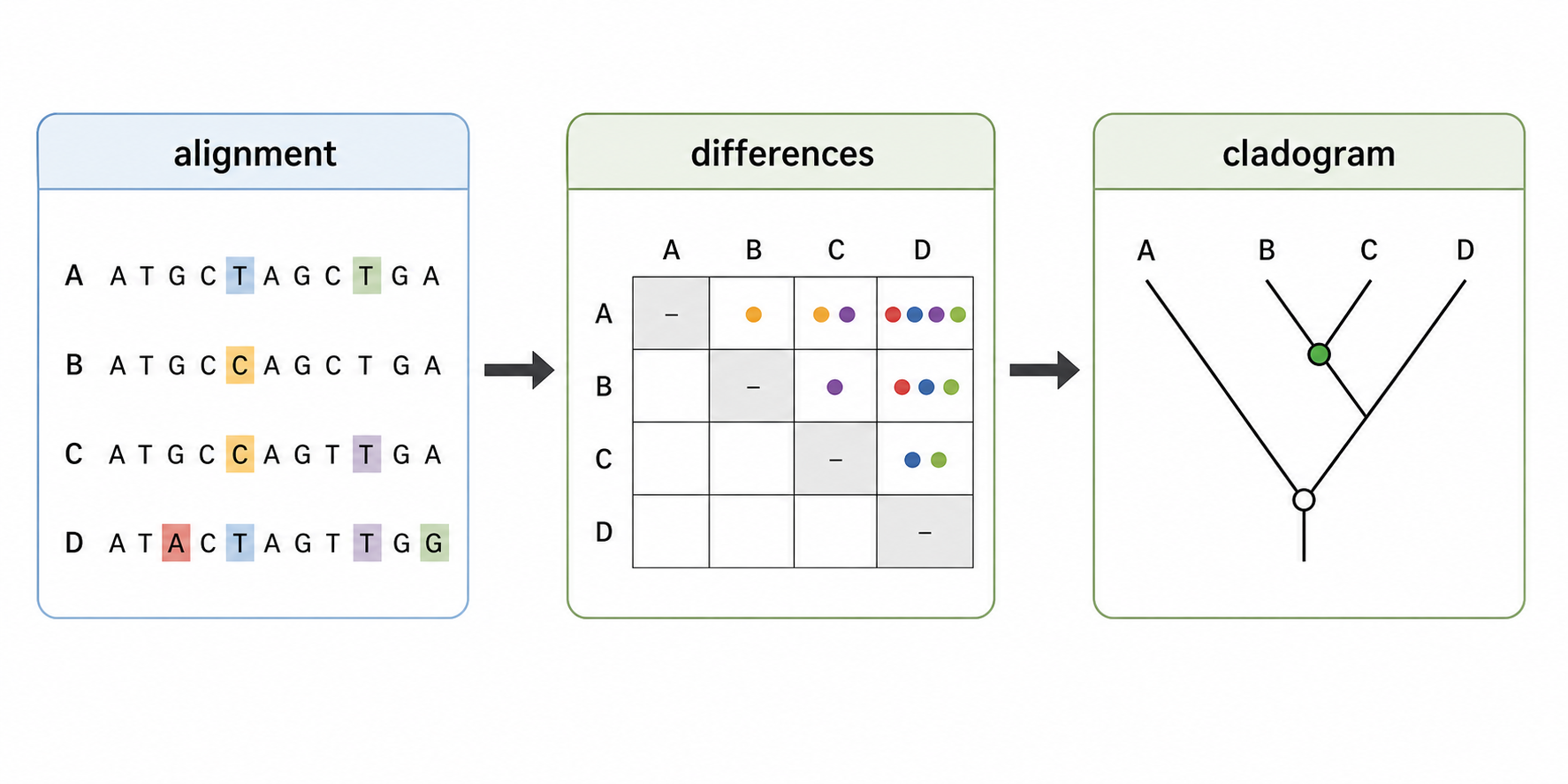
Cladograms can be built by aligning DNA, RNA, or protein sequences and comparing similarities. Computer analysis tests possible trees and infers the tree that best explains the data. Parsimony is one decision rule: prefer the tree requiring the fewest evolutionary changes, as long as it explains the observed sequence pattern.
Two possible cladograms fit the same aligned sequences. Which one is more parsimonious?
CompareRead Cladograms By Nodes
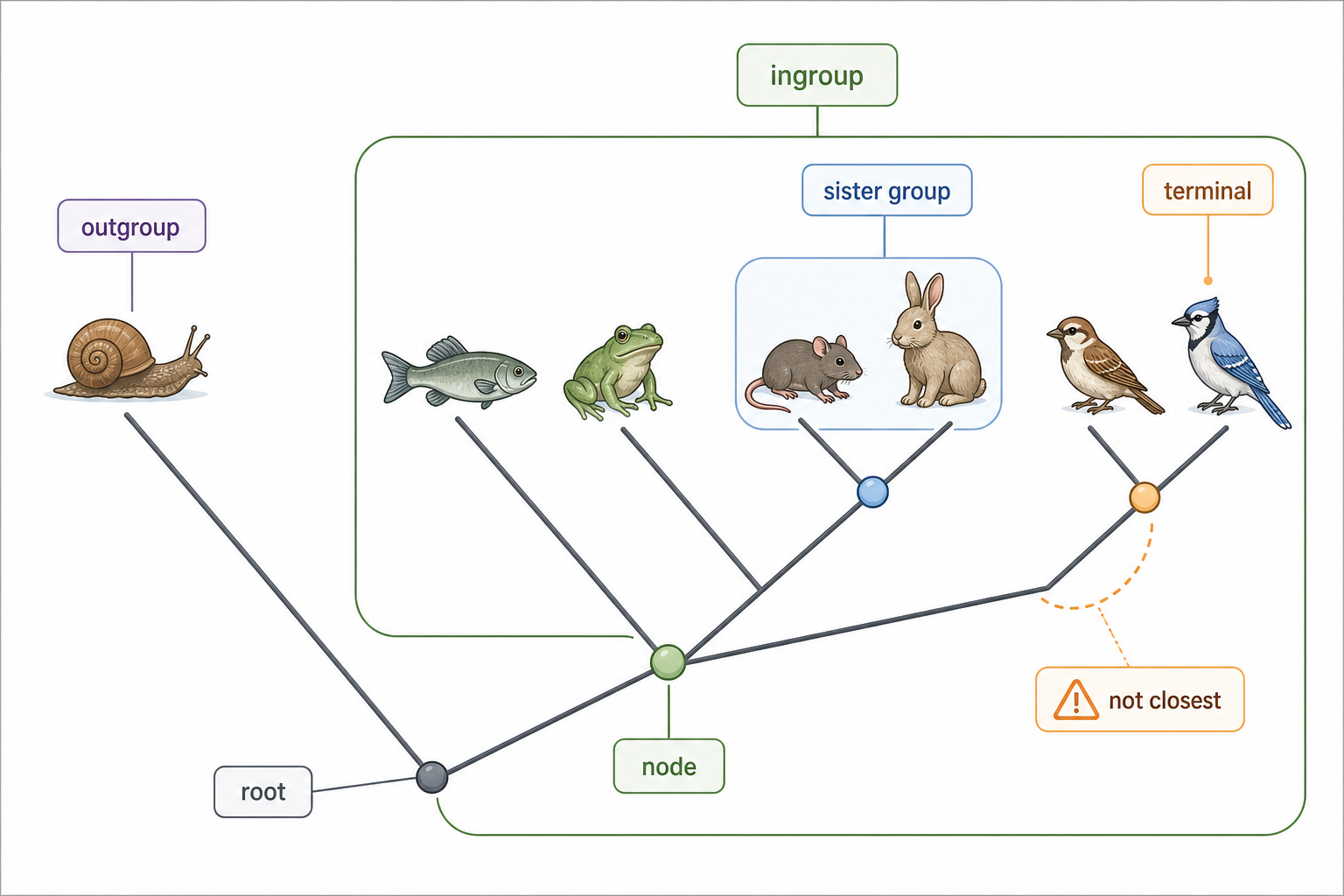
To read a cladogram, ignore how close the tips look on the page. Nodes represent hypothetical common ancestors or speciation events. Branch points show the order of divergence, and the most recent common ancestor determines which taxa are more closely related. Roots, terminal branches, ingroups, outgroups, and sister groups help orient the tree.
Read the tree by tracing back to the most recent common ancestor, not by comparing tip positions.
Two species sit next to each other at the tips, but one shares a more recent common ancestor with a different species. Which rule should you use?
ChooseTwo species sit next to each other at the tips, but one shares a more recent common ancestor with a different species. Which rule should you use?
ChooseUse Cladistics To Test Old Taxonomy
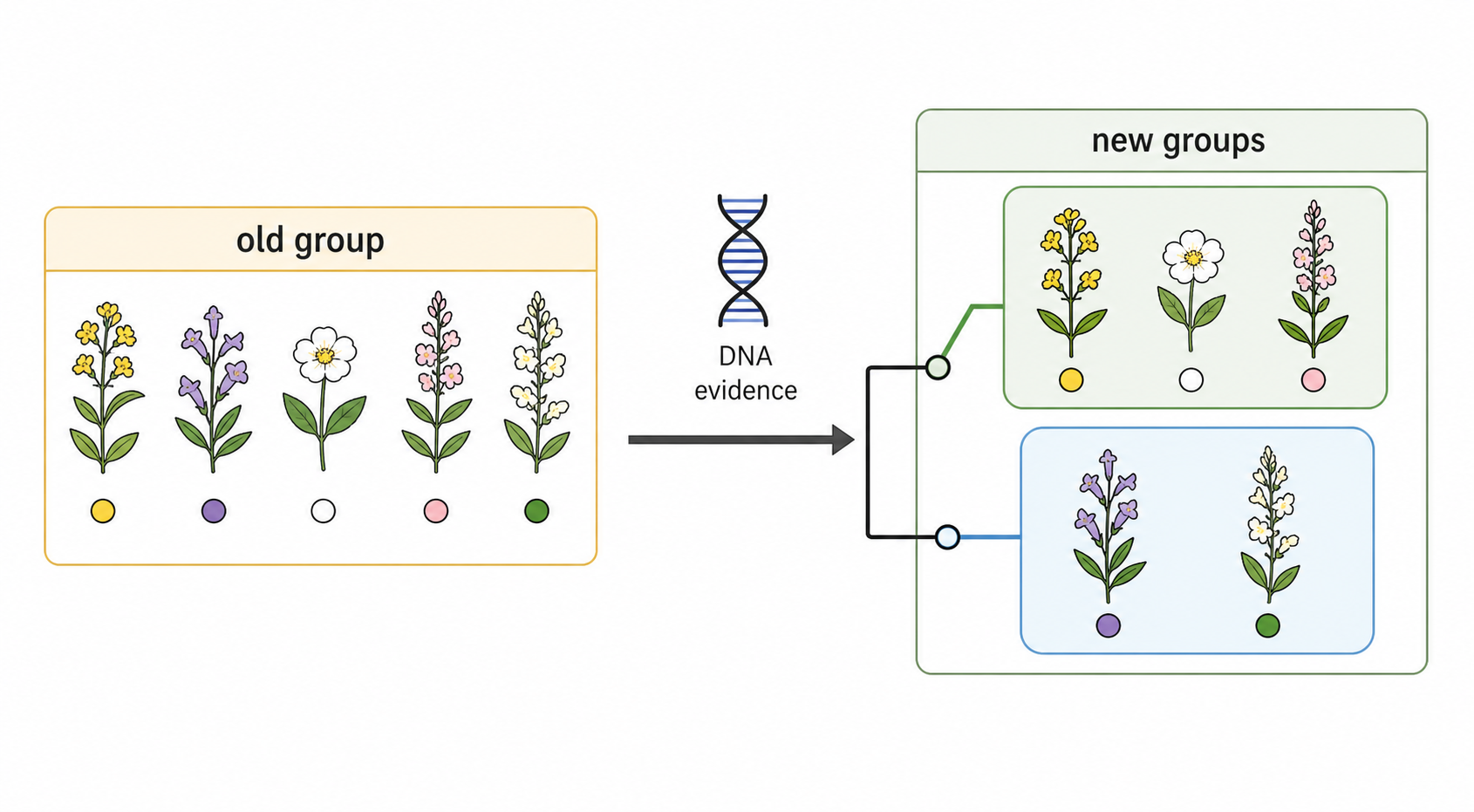
Cladistics can test whether traditional taxa match evolutionary relationships. The figwort family case is the exam example: conserved chloroplast gene sequences showed that the old Scrophulariaceae grouping did not form one clade. Some similar floral traits were convergent, so species such as foxglove and yellow rattle were moved. The lesson is that molecular evidence can falsify a morphology-based group.
Reclassification happens when molecular evidence shows that an old taxon does not match ancestry.
Match each figwort-case detail to its role.
MatchMatch each figwort-case detail to its role.
ChooseSeparate The Three Domains With rRNA
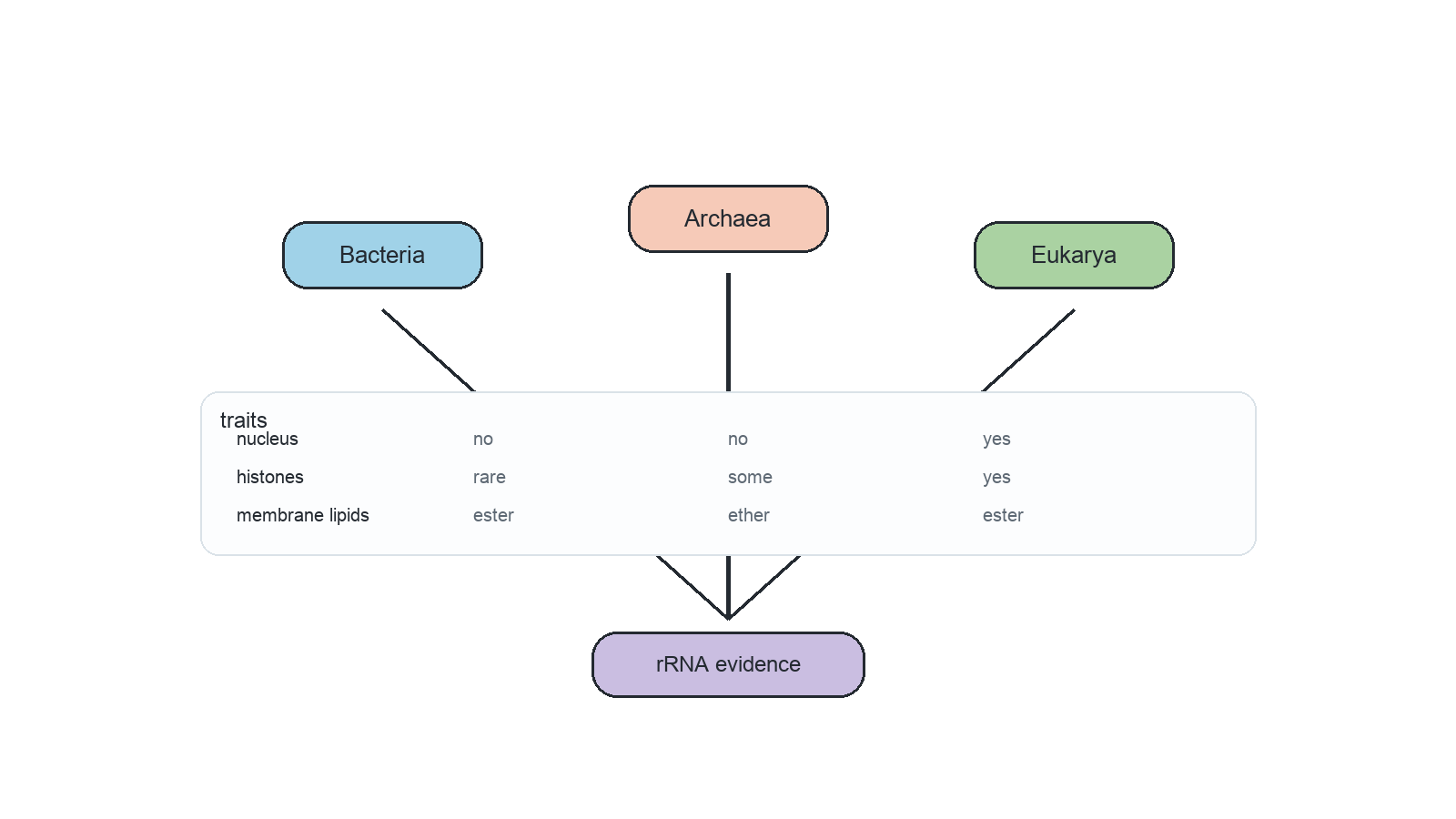
The three-domain system is a molecular-evidence story. rRNA sequence evidence separated prokaryotes into Eubacteria and Archaea, giving three domains: Archaea, Eubacteria, and Eukarya. These domains also differ in chromosome form, histones, introns, cell walls, and membrane lipids. The point is that “prokaryote” was too broad for evolutionary classification because Archaea and Eubacteria are deeply different.
The three-domain model came from molecular evidence, then matched deeper cellular differences.
Match each domain to the most helpful clue.
MatchMatch each domain to the most helpful clue.
ChooseHL Transfer: Read And Defend A Cladogram
Exam PracticeA3.2 exam answers are strongest when they sound like evidence arguments. Classification organizes diversity, but fixed ranks and morphology can mislead. Evolutionary classification should match phylogeny using monophyletic clades supported by synapomorphies. Molecular clocks estimate divergence time from calibrated sequence differences. Cladograms are built from aligned sequence data and interpreted by nodes, not tip positions. Cladistics can reclassify old taxa, and rRNA evidence supports the three-domain system.
Match each exam prompt to the rule you should use.
MatchUse this for combined HL classification and cladistics questions.
Use this for combined HL classification and cladistics questions.
Modern classification aims to reflect evolutionary history, not just rank names or appearance. Fixed ranks can be arbitrary and morphological similarity may result from convergence. Natural groups are monophyletic clades, including an ancestor and all descendants, and can be supported by synapomorphies from anatomical, behavioural, DNA, or protein evidence. Molecular clocks use calibrated sequence differences to estimate divergence time. Cladograms can be built from aligned DNA, RNA, or protein sequences using computer analysis and parsimony, then read by nodes and most recent common ancestors. Cases such as figwort reclassification and rRNA-based three domains show how molecular evidence can correct older taxonomy.
Listing terms without linking them to ancestry evidence or cladogram interpretation.