
Define The Virus Boundary
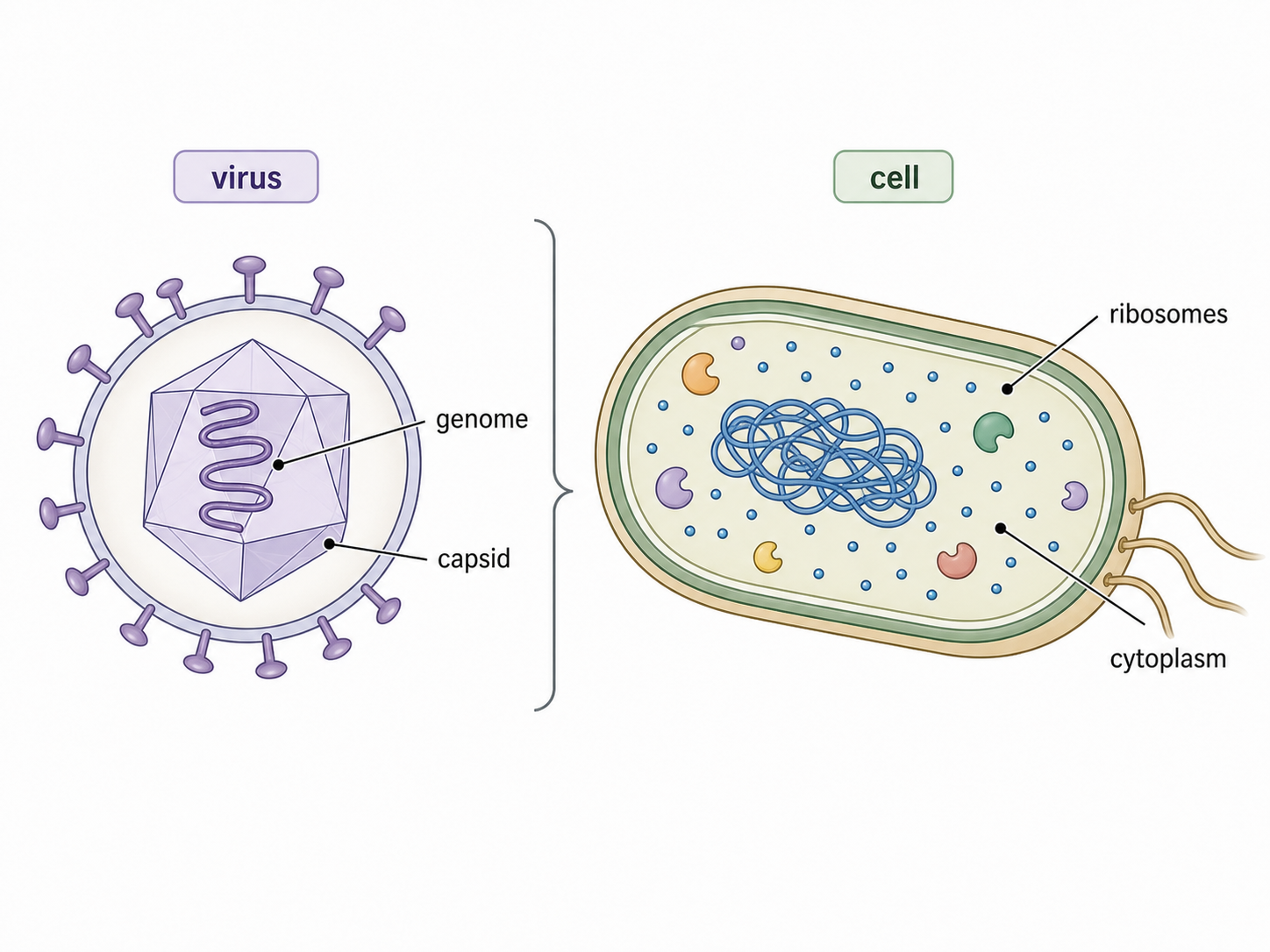
A virus is not a tiny cell. It is a non-cellular obligate parasite: it carries a DNA or RNA genome inside a protein capsid, but it lacks cytoplasm, ribosomes, and most metabolic enzymes. That missing cellular machinery is why viruses must use host cells to make proteins and replicate.
Compare what a virus carries with what a whole cell needs to function independently.
Sort each feature as carried by viruses, missing from viruses, or shared with cells.
SortSort each feature as carried by viruses, missing from viruses, or shared with cells.
ChooseCompare Virus Designs By Axes
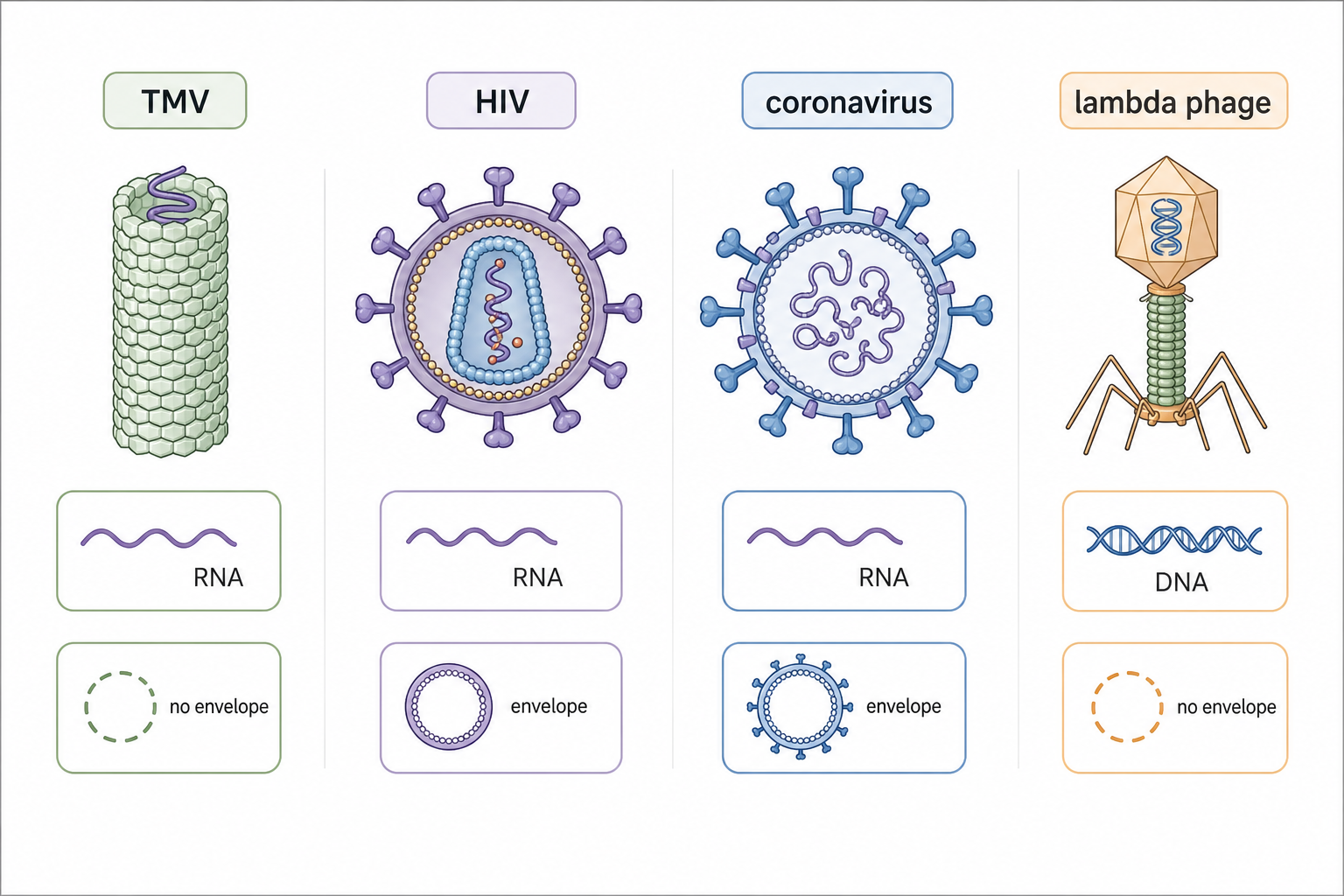
Viruses do not share one body plan. Compare them along separate axes: genome type, genome shape, capsid shape, and envelope status. Genomes may be DNA or RNA, single- or double-stranded, linear, circular, or segmented. Capsids may be helical, polyhedral, conical, or complex. TMV, HIV, coronavirus, and lambda phage are useful because they stop students from using one virus as the template for all viruses.
Compare viruses across separate axes so genome, capsid shape, and envelope status do not get mixed together.
Match each example to its most useful distinguishing feature.
MatchMatch each example to its most useful distinguishing feature.
ChooseRun The Lytic Cycle
PracticeThe lytic cycle is the fast takeover route. Lambda phage attaches to E. coli, injects double-stranded DNA, keeps viral DNA separate from the host chromosome, degrades host DNA, uses host machinery to make viral DNA and capsid proteins, assembles new phages, and releases them by lysis of the host cell.
Place the lytic cycle steps in order.
OrderUse The Lysogenic Switch
PracticeThe lysogenic cycle is the quiet route. Lambda phage DNA integrates into the E. coli chromosome as a prophage. As the bacterium divides by binary fission, the prophage is copied with the host genome. Stress, such as UV damage, can induce prophage excision and switch the virus into the lytic cycle.
Sort each statement into lytic or lysogenic.
CompareEvaluate Virus Origin Hypotheses
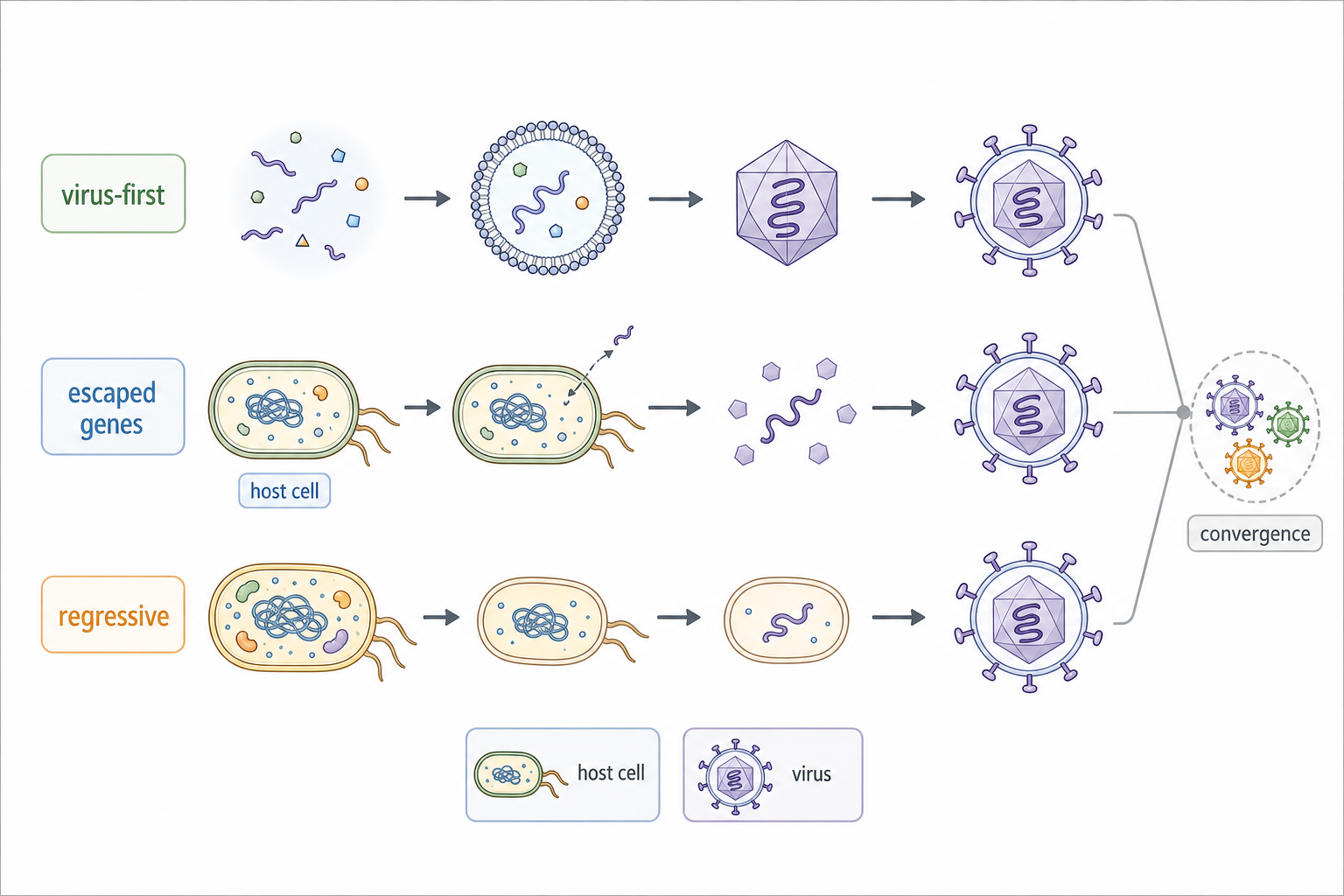
Virus origins should be answered as competing hypotheses, not one settled story. Viruses are likely polyphyletic, meaning different groups may have independent origins. Virus-first suggests pre-cellular replicators; escaped genes or progressive origin suggests mobile genetic elements gained transmission; regressive or reduction origin suggests parasitic cells lost complexity. Shared obligate parasitism may be convergent evolution rather than proof of one common ancestor.
Treat virus origins as competing explanations, not one accepted story.
Match each origin hypothesis to its core claim.
MatchMatch each origin hypothesis to its core claim.
ChooseExplain Why Viruses Evolve Fast
Exam Practice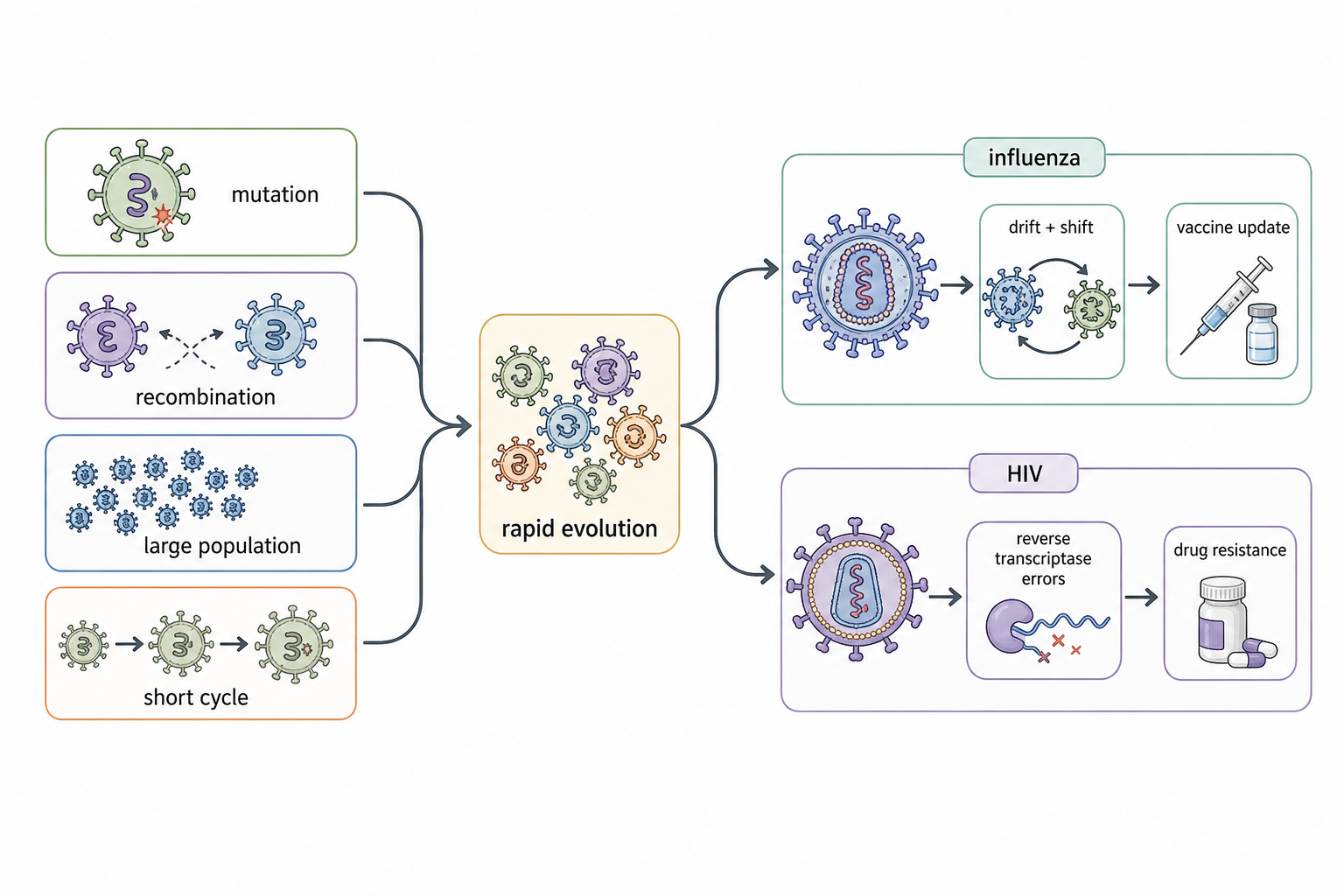
Rapid viral evolution comes from variation plus speed. Mutation, recombination, large population size, and short life cycles generate many variants quickly. RNA viruses often mutate rapidly because replication lacks proofreading. This matters medically: influenza antigenic drift and shift can reduce vaccine match, while HIV reverse transcriptase errors help resistant variants appear during treatment.
Rapid evolution matters because it changes the target that immunity or treatment is trying to hit.
Match each rapid-evolution cause to its consequence.
MatchMatch each rapid-evolution cause to its consequence.
ChooseHL Transfer: Build A Virus Answer
Exam PracticeA strong HL virus answer usually combines two moves: define the boundary, then explain the mechanism or consequence. Viruses have DNA or RNA plus a capsid but lack the machinery for independent metabolism. Their diversity is described by genome, capsid, and envelope. Lambda phage lets you contrast lytic takeover with lysogenic integration. Origin questions require competing hypotheses and polyphyly. Evolution questions require mutation, recombination, short cycles, large populations, and examples such as influenza or HIV.
Match each exam prompt to the evidence or mechanism you should use.
MatchUse this for combined HL virus questions about structure, replication, origins, or rapid evolution.
Use this for combined HL virus questions about structure, replication, origins, or rapid evolution.
Viruses are non-cellular obligate parasites with a DNA or RNA genome inside a protein capsid, but they lack cytoplasm, ribosomes, and most metabolic enzymes, so they depend on host cells. They vary in genome type, capsid shape, and envelope status. Lambda phage shows two contrasting cycles: in the lytic cycle viral DNA remains separate, host machinery makes viral parts, and the cell lyses; in lysogeny viral DNA integrates as a prophage and is copied with the host until stress induces lytic replication. Virus origins are likely polyphyletic, with virus-first, escaped-gene, and regressive hypotheses. Viral evolution is rapid because mutation, recombination, large populations, and short life cycles generate variation quickly, especially in many RNA viruses lacking proofreading; this affects influenza vaccines and HIV treatment.
Writing a fact list without contrasting mechanisms or explaining consequences.