
EduNinja
IB Biology HL/Notes/A1.1 Water

IB Biology HLA1.1 WaterNotes

HLTopic notes4 focus areasSyllabus linked

Water Is The Medium

Learning

Treat water as the working environment for cells, not as background material.

Water matters because it is the medium where life began and where most cell chemistry still happens.

Start with the mark-worthy idea: water is a medium. Medium means substances can dissolve in it, move through it, and react in it. That explains both early life in oceans and modern cell chemistry in cytoplasm and body fluids.

Water remains the medium for most life processes and forms much of cell mass.
Early oceans gave first cells liquid conditions and helped shield them from UV radiation.
In modern organisms, aqueous solution enables transport, diffusion, and metabolism.

Which sentence best explains why water is called a medium for life?

Choose
A. Water is important because organisms need it.

Too vague. It does not say what water allows molecules to do.

B. Water lets substances dissolve, move, and react in aqueous solution.

Yes. This gives the actual mark-worthy meaning of medium.

C. Water is useful only because it protects early life from UV radiation.

UV protection matters for early oceans, but medium means more than protection.

Good. Medium means substances can dissolve, move, and react in aqueous solution.

“Organisms need water” is too vague for a biology answer.

Student can choose the mark-worthy meaning of water as a medium.
Success Criteria
Explain medium as dissolve, move, and react.
Connect early oceans to first cells and UV protection.
Connect modern cells to aqueous cytoplasm, transport, and metabolism.

Bonding Makes The Properties

Learning

A water molecule is polar because of its O-H covalent bonds and V-shape.

Covalent bonds make the water molecule; hydrogen bonds connect neighbouring water molecules.
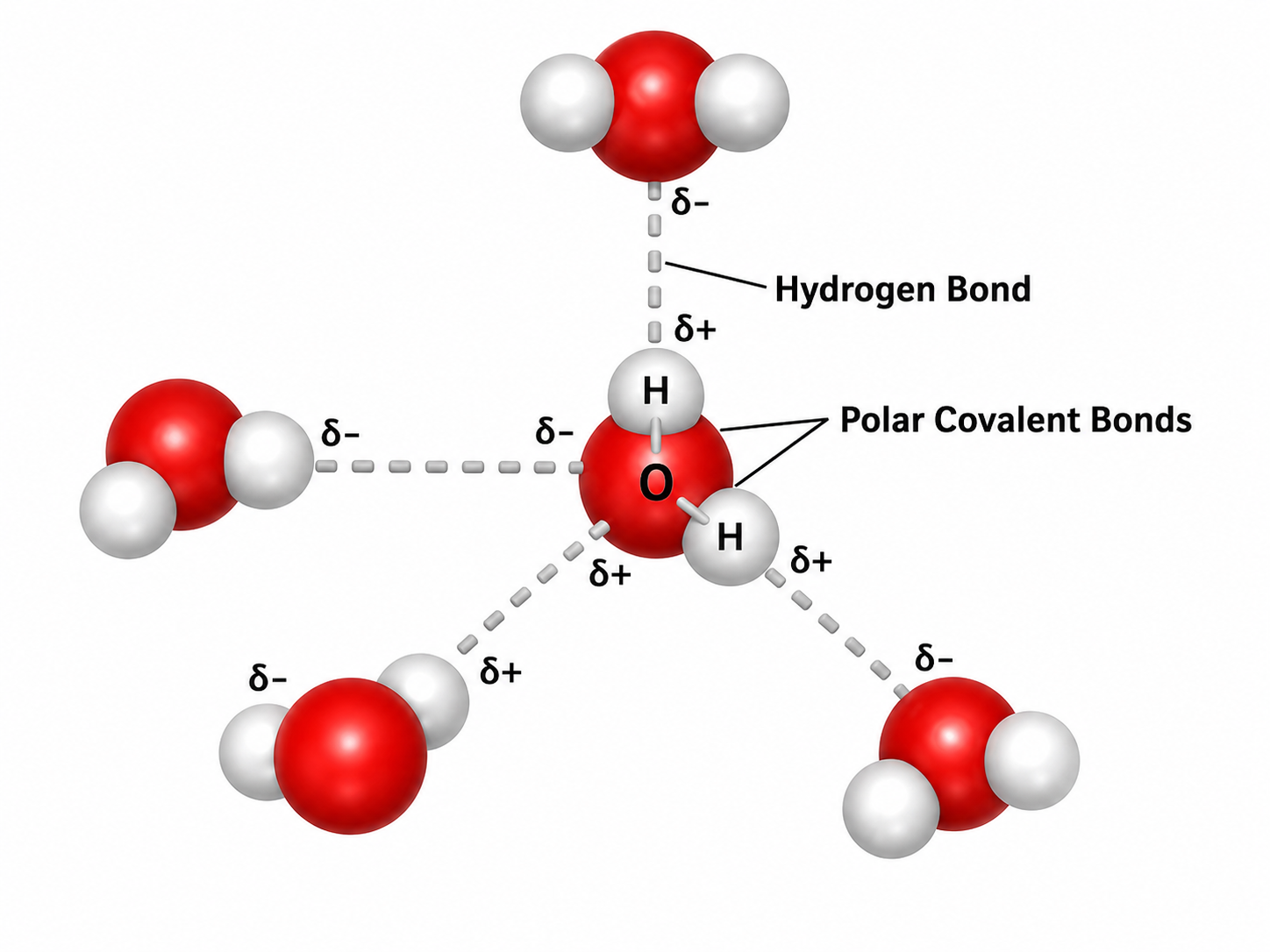
The diagram separates bonds inside a water molecule from attractions between water molecules.

Now zoom in. Inside one water molecule, oxygen and hydrogen are joined by O-H covalent bonds. Because the molecule is polar, neighbouring water molecules attract each other by hydrogen bonds. Those hydrogen bonds explain many unusual water properties.

O-H covalent bonds are inside one water molecule.
Hydrogen bonds form between water molecules, not within one molecule.
Hydrogen bonding explains many unusual water properties, including cohesion and high specific heat capacity.

Label the diagram using the rule: inside one molecule or between molecules?

Label
1. O-H covalent bond inside one molecule
2. hydrogen bond between molecules
3. partially negative oxygen
4. partially positive hydrogen
5. polar V-shaped water molecule

Correct. Covalent bonds are inside each molecule; hydrogen bonds are between neighbouring molecules.

The common mistake is putting “hydrogen bond” on the O-H bond inside one molecule.

Student can use the concept correctly before moving to exam transfer.
Success Criteria
Label O-H covalent bonds inside a water molecule.
Show the V-shape and partial charges that make water polar.
Place hydrogen bonds between water molecules, not within one molecule.

Cohesion Or Adhesion?

Practice

Cohesion is water sticking to water; adhesion is water sticking to another surface.

Cohesion explains a continuous water column and surface tension; adhesion explains attraction to polar or charged surfaces.
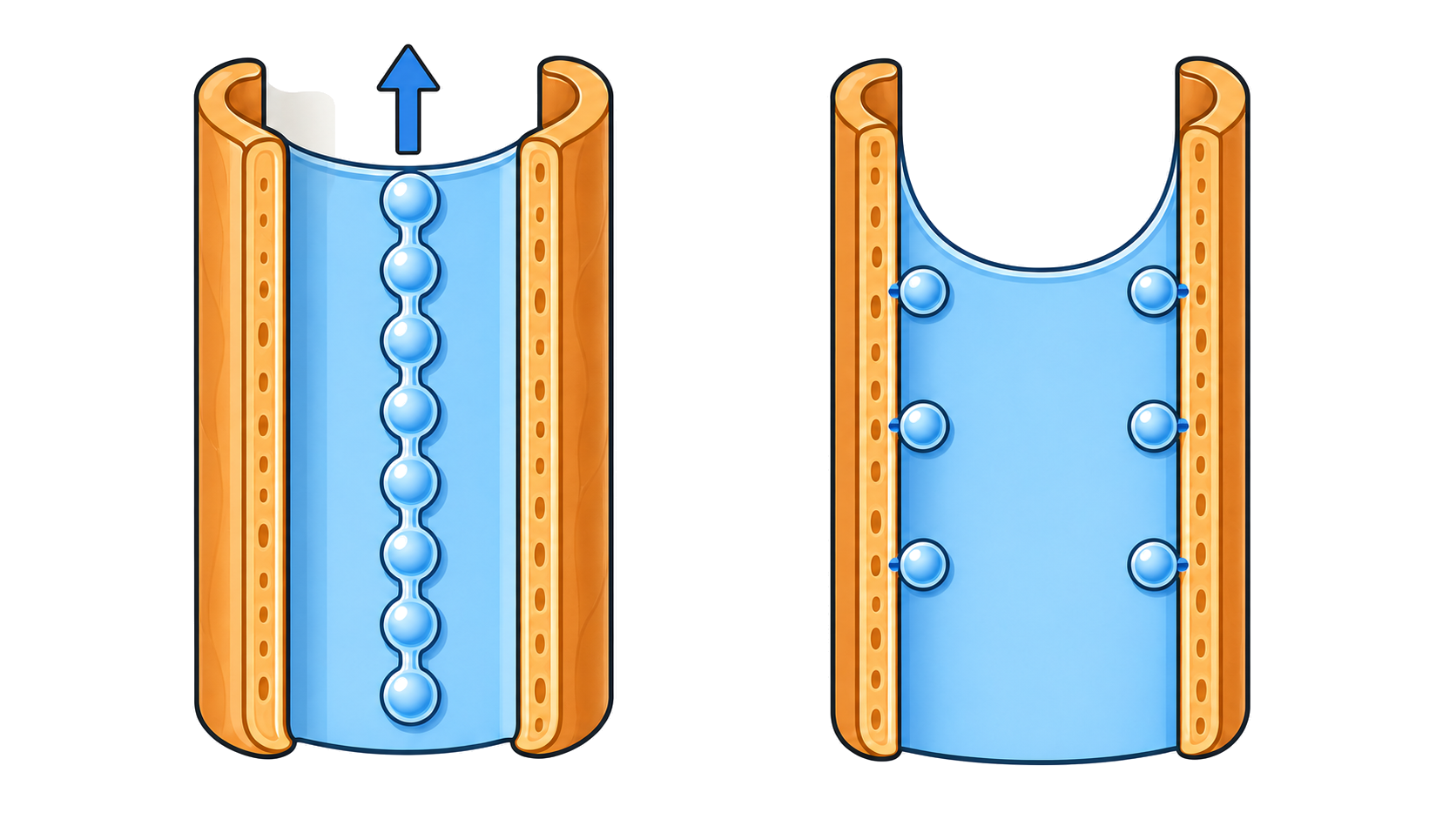
Two or more clear comparison zones for xylem and surface examples, designed so labels or cards can be sorted without overcrowding the base image.

Use one question to choose the word: what is water sticking to? If water sticks to water, it is cohesion. If water sticks to another polar or charged surface, it is adhesion.

Cohesion is attraction between water molecules caused by hydrogen bonding.
Cohesion creates surface tension and helps xylem water columns resist breaking under tension.
Adhesion is attraction between water and polar or charged surfaces, supporting capillary action in narrow spaces.
Surface tension supports droplets and surface-skating insects.
Adhesion supports capillary action in soil channels and cellulose cell walls.
Cohesion is the stronger force in xylem transport; adhesion helps refill vessels.

Sort by asking: water-to-water, or water-to-surface?

Sort
cohesion
Water molecules attract other water molecules by hydrogen bonding.
A water column in xylem resists breaking under tension.
Surface tension supports droplets and surface-skating insects.
adhesion
Water adheres to polar or charged surfaces such as cellulose.
Capillary action occurs in narrow soil channels.

Good. Cohesion is water-to-water; adhesion is water-to-surface.

Xylem transport mentions both ideas, but resisting breakage under tension is cohesion.

Student can use the concept correctly before moving to exam transfer.
Success Criteria
Define cohesion as attraction between water molecules caused by hydrogen bonding.
Define adhesion as water adhering to polar or charged surfaces.
Apply each term to xylem, soil channels, cellulose cell walls, and surface tension.

Solvent: What Dissolves And Why

Learning

Water dissolves substances when its partial charges can interact with them.

Use polarity to decide what water can dissolve and what biological work that allows.
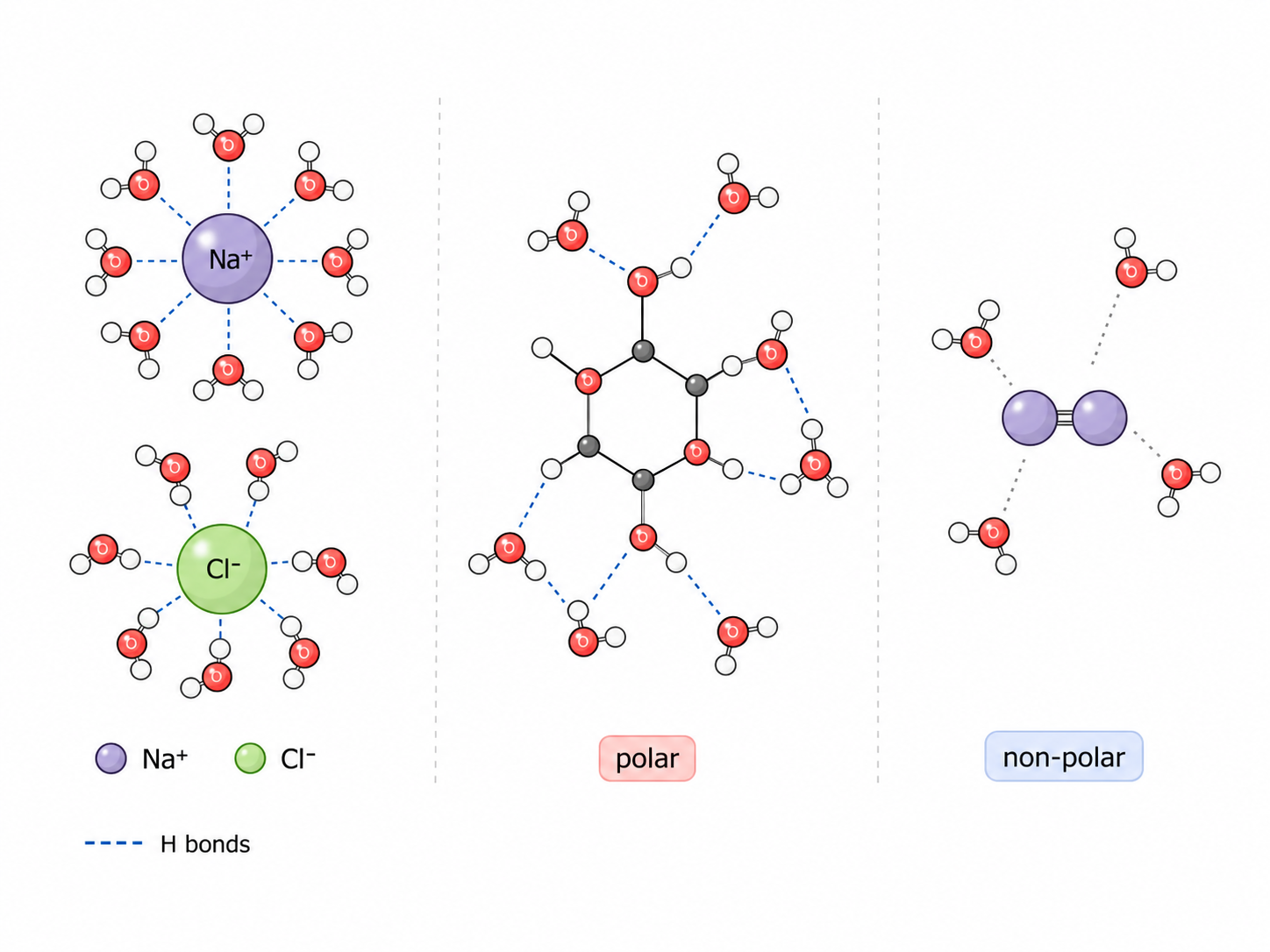
Polarity explains why some solutes dissolve well and non-polar gases dissolve poorly.

Water is a solvent when its partial charges can interact with the solute. Ions are surrounded by hydration shells. Polar molecules can hydrogen-bond with water. Non-polar molecules do not interact strongly, so they are hydrophobic and have low solubility.

Water dissolves ions and polar molecules by hydration and hydrogen bonding.
Aqueous solution enables diffusion, transport, enzyme activity, and metabolism.
Non-polar molecules are hydrophobic; O2 and N2 have low solubility in water.

Match each case to the reason water helps or limits it.

Match
sodium ion in blood plasma->hydration by polar water molecules
glucose in cytoplasm->hydrogen bonding with water
enzyme-catalysed metabolism->reactants move in aqueous solution
oxygen and nitrogen gases->low solubility because they are non-polar

Good. Each match uses charge, polarity, hydrogen bonding, or hydrophobicity.

“Water dissolves everything” is not accurate and loses the non-polar limit.

Student can use the concept correctly before moving to exam transfer.
Success Criteria
Explain hydration of ions using partial charges on water.
Explain hydrogen bonding with polar solutes.
State that aqueous solution enables diffusion, transport, enzyme activity, and metabolism.
State that non-polar molecules are hydrophobic and that O2 and N2 have low solubility in water.

Properties Explain Adaptations

Learning

The same water properties that stabilize habitats also create design problems for aquatic animals.

Compare animals by naming the water property first, then the adaptation it selects for.
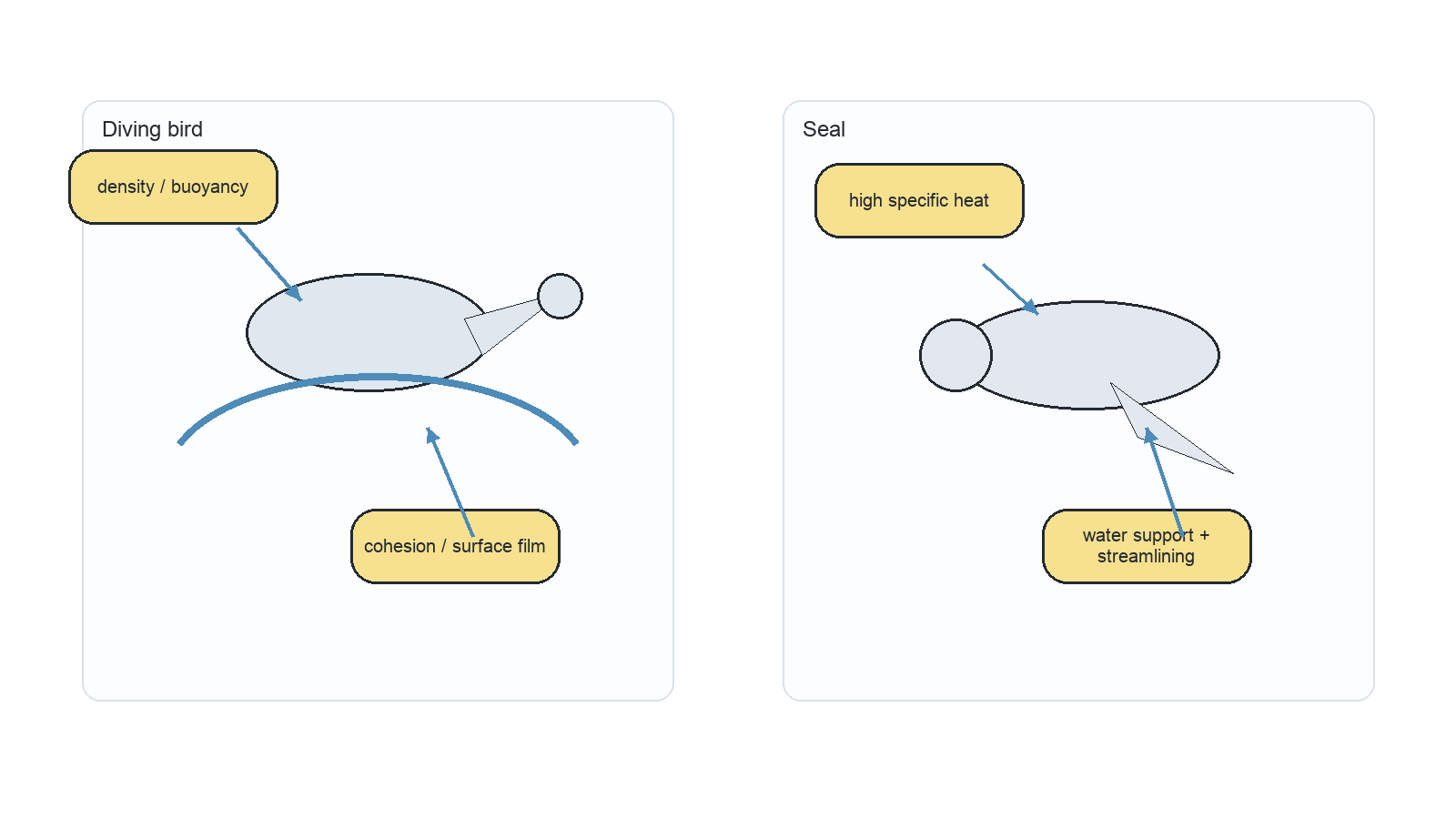
Use named water properties to explain each adaptation rather than listing animal features alone.

For aquatic animals, start with the water property, not the animal feature. High specific heat capacity stabilizes temperature. High thermal conductivity increases heat loss. Buoyancy supports bodies. Viscosity creates drag. Then connect the property to the adaptation.

Specific heat capacity stabilizes aquatic temperatures and body temperature.
Thermal conductivity, buoyancy, and viscosity shape aquatic adaptations.
Compare black-throated loon and ringed seal adaptations for diving, insulation, and movement.

Compare the loon and the seal using this sentence frame: Because water has ____, the animal needs _____.

Compare
Models
black-throated loonringed seal
Compare By
divinginsulationmovement
Because water is buoyant, diving animals must manage floating and sinking.
Because water conducts heat quickly, seals need insulation such as blubber.
Because water is viscous, both animals benefit from streamlined bodies.

Good. The comparison is strong because each adaptation is caused by a named water property.

A feature such as blubber is not a full answer unless you explain the water property it solves.

Student can use the concept correctly before moving to exam transfer.
Success Criteria
Explain why high specific heat capacity stabilizes aquatic temperatures and body temperature.
Connect thermal conductivity, buoyancy, and viscosity to aquatic adaptations.
Compare black-throated loon and ringed seal adaptations for diving, insulation, and movement.

HL: Earth Water Evidence

Learning

For HL, separate where Earth water may have come from from why it stayed.

Asteroid delivery explains a possible source; cooler temperatures and gravity explain retention.
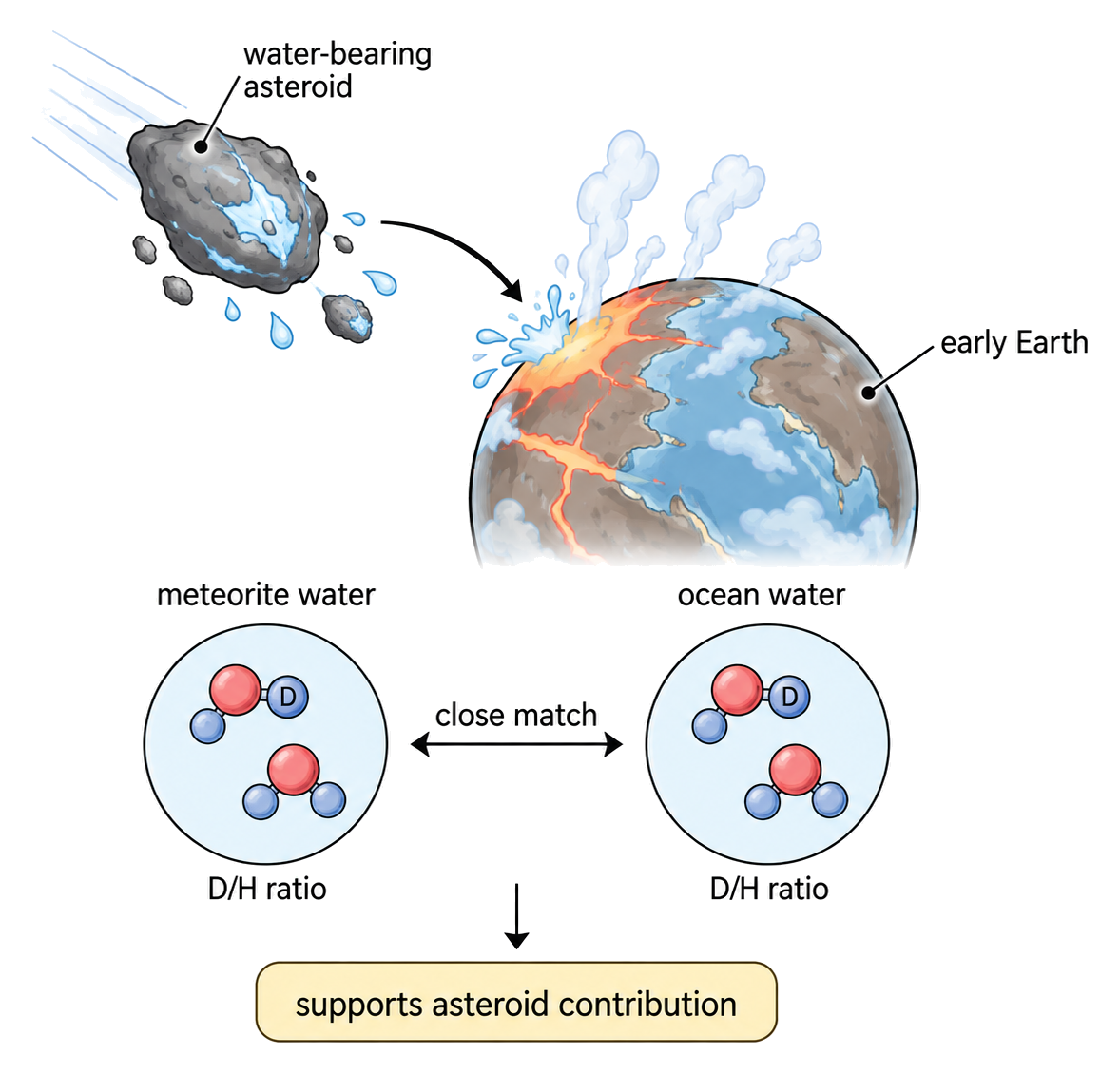
A strong answer separates source evidence from retention conditions.

For HL, keep two claims separate. Source claim: Earth water may have been delivered by asteroids, supported by isotope comparisons with carbonaceous chondrites and Vesta meteorites. Retention claim: cooler temperatures allowed water vapour to condense and gravity helped Earth keep it.

Asteroid delivery is the syllabus hypothesis for Earth’s water origin.
Carbonaceous chondrites and Vesta meteorites provide isotope evidence.
Gravity and cooler temperatures allowed water vapour to condense and be retained.

Sort each statement as source evidence or retention condition.

Sort
source evidence
Asteroid delivery is the hypothesis for Earth water origin.
Carbonaceous chondrites have isotope ratios compared with Earth water.
retention condition
Cooler temperatures allowed water vapour to condense.
Gravity helped Earth keep water instead of losing it to space.

Good. You separated evidence for origin from conditions for retention.

Do not use meteorite evidence to explain why water stayed on Earth; it supports the source claim.

Student can use the concept correctly before moving to exam transfer.
Success Criteria
State asteroid delivery as the syllabus hypothesis for Earth water origin.
Use carbonaceous chondrites and Vesta meteorites as isotope evidence.
Explain that gravity and cooler temperatures allowed water vapour to condense and be retained.

HL: Water Guides Life Search

Learning

Liquid water guides searches for extraterrestrial life because known life uses water as its medium.

A promising exoplanet is in the right temperature zone and shows evidence for water, but water alone does not prove life.
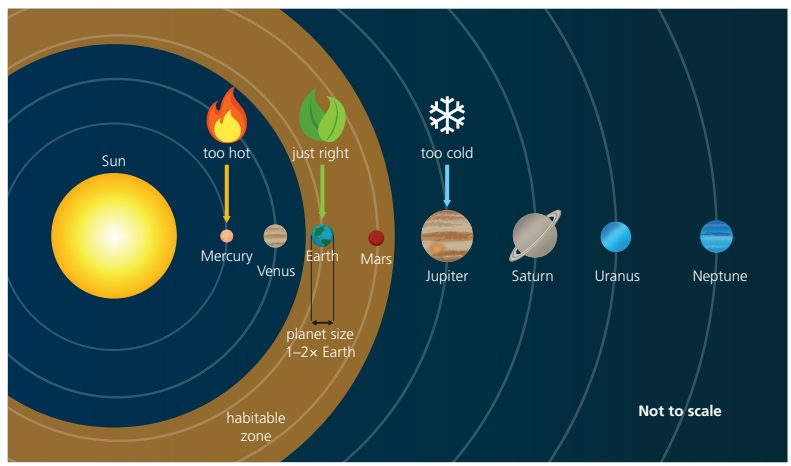
Distance can suggest liquid-water conditions; spectroscopy can provide atmospheric water evidence.

Liquid water is a filter for where to search, not proof that life exists. Goldilocks zones identify where surface liquid water could exist. Transit spectroscopy can then look for water signatures in exoplanet atmospheres.

Liquid water guides searches for extraterrestrial life.
Goldilocks zones mark where surface liquid water could exist.
Transit spectroscopy can detect water signatures in exoplanet atmospheres.

Which claim is safest?

Choose
A. Water in an atmosphere proves life is present.

Too strong. Water is not proof of life.

B. Liquid water makes a planet a better target for further investigation.

Yes. This is cautious and evidence-based.

C. Any planet in space can support life if it has sunlight.

Too broad and ignores liquid water conditions.

Good. The safe claim is that water guides further investigation.

Do not overclaim. Water evidence supports searching, not proving life.

Student can use the concept correctly before moving to exam transfer.
Success Criteria
Explain why liquid water guides searches for extraterrestrial life.
Define Goldilocks zones as regions where surface liquid water could exist.
Explain that transit spectroscopy can detect water signatures in exoplanet atmospheres.

Remember The SL Water Chain

Review

Exam answers about water need property plus biological importance.

Do not list water properties alone; turn each property into a cause-and-use sentence.

Before the exam answer, retrieve the chain. Water’s polar structure leads to hydrogen bonding. Hydrogen bonding and polarity create properties. Properties explain biological uses: transport, metabolism, temperature stability, xylem, and aquatic adaptations.

Structure: polar V-shaped water molecules form hydrogen bonds.
Properties: cohesion, adhesion, solvent ability, specific heat capacity, thermal conductivity, buoyancy, and viscosity.
Uses: xylem transport, aqueous metabolism, stable habitats, and aquatic animal adaptations.
Surface tension supports droplets and surface-skating insects.
Adhesion supports capillary action in soil channels and cellulose cell walls.
Cohesion is the stronger force in xylem transport; adhesion helps refill vessels.

Match each water idea to the biological consequence it supports.

Match
hydrogen bonding between water molecules->cohesion and surface tension
cohesion->continuous water column in xylem
polar solvent->transport and metabolism in aqueous solution
high specific heat capacity->stable aquatic temperatures
viscosity->streamlined movement adaptations

Good. You can retrieve the chain from structure to use.

Matching only by keyword is not enough; the exam needs the cause-effect link.

Student can use the concept correctly before moving to exam transfer.
Success Criteria
Retrieve structure -> property -> biological use.
Use exact property terms.
Explain consequences rather than listing facts.

Build The SL Exam Answer

Exam Practice

Core retrieval for SL students: recall only the ideas required before HL extensions.

For SL, link water structure to biological properties: medium for life, hydrogen bonding, cohesion, adhesion, solvent behaviour, and aquatic animal adaptations.

Use this after retrieval when a question asks why water is important to organisms or how water properties support life. Short-answer writing belongs in the practice/question-bank flow; this card gives the answer framework.

Start from molecular cause: water is polar and forms hydrogen bonds.
Choose relevant properties: cohesion, solvent ability, specific heat capacity, thermal conductivity, buoyancy, or viscosity.
Link each property to a biological consequence such as xylem transport, metabolism, temperature stability, or aquatic adaptation.

Use this after retrieval when a question asks why water is important to organisms or how water properties support life. Short-answer writing belongs in the practice/question-bank flow; this card gives the answer framework.

Water is polar and forms hydrogen bonds, giving it properties useful to living organisms. Cohesion helps maintain continuous water columns in xylem, while water’s solvent properties allow ions and polar molecules to dissolve so they can be transported and used in metabolism. High specific heat capacity also helps aquatic environments remain temperature-stable.

The common mark loss is listing properties without explaining what they allow organisms to do. Use cause -> property -> consequence.

Success Criteria
Use cause -> property -> consequence.
Include exact property terms.
Avoid vague “water is important” answers.

HL: Retrieve And Transfer

Review

HL retrieval: add only the extension ideas after the core content is secure.

For HL, add the evidence chains for Earth water origin and the search for extraterrestrial liquid water.

For HL, retrieve two separate chains. Earth-water origin uses asteroid delivery and isotope comparisons. Life-search questions use liquid water, Goldilocks zones, and spectroscopy as evidence filters.

Origin: asteroid delivery plus isotope evidence from carbonaceous chondrites and Vesta meteorites.
Retention: cooler temperatures and gravity allowed water to condense and remain.
Life search: liquid water guides investigation, but does not prove life.

Match each HL evidence idea to the claim it supports.

Match
carbonaceous chondrite isotope ratios->evidence for possible asteroid delivery of Earth water
cooler early Earth temperatures->water vapour could condense
Earth gravity->water could be retained
Goldilocks zone->surface liquid water could exist
transit spectroscopy->water signatures may be detected in an atmosphere

Good. You kept origin, retention, and life-search claims separate.

Do not treat every water fact as evidence for life.

Student can use the concept correctly before moving to exam transfer.

Use this for HL questions about Earth water origin, retention, or using water in the search for life.

For Earth origin, state asteroid delivery and support it with isotope evidence from meteorites.
For retention, state cooler temperatures allowed condensation and gravity helped retain water.
For life search, state liquid water guides investigation, but does not prove life; use Goldilocks zones and spectroscopy as evidence tools.

Use this for HL questions about Earth water origin, retention, or using water in the search for life.

Earth water may have an extraplanetary origin because asteroid delivery is supported by isotope comparisons with meteorites such as carbonaceous chondrites and Vesta meteorites. Water was retained because cooler temperatures allowed vapour to condense and Earth gravity helped keep it. In the search for extraterrestrial life, liquid water is used as a filter for promising targets, with Goldilocks zones and transit spectroscopy helping identify where water may exist.

Do not overclaim that water proves life, and do not mix origin evidence with retention conditions.

Success Criteria
Retrieve the main water properties without mixing cohesion and adhesion.
Connect each property to a named biological consequence.
Recall the two HL applications: origin evidence and search for extraterrestrial life.