EduNinja
Question rangeD2.2.5 (HL)—Genome, transcriptome, proteome
[Maximum number: 10]

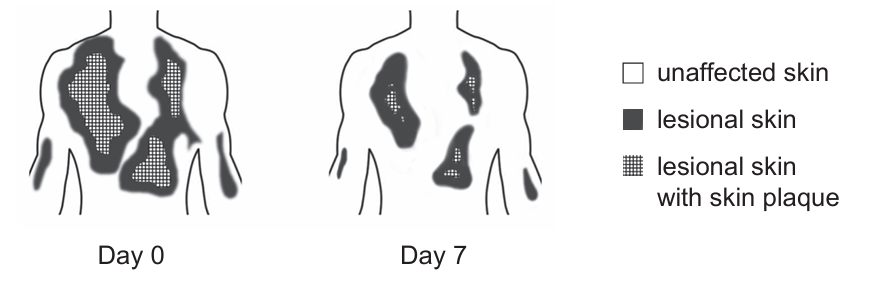
Psoriasis is a disorder characterized by inflammation of the skin. It causes the formation of red patches (lesional skin), which often have flaky, silver-white surfaces (skin plaques).

Some drugs are available to treat psoriasis. During treatment, the changes in psoriasis severity can be measured by taking daily photographs of the affected region(s) of the body.

In one study, five males of a similar age and with similar psoriasis severity were provided with the same dose of a medicinal drug for seven days. The skin maps show the change in psoriasis severity on the back of one of the males during this study.
Question image
(a)

Distinguish between the appearance of the skin of this male on Day 0 and Day 7 of treatment.

[ 2 ]
(b)

Explain how quantitative data could be obtained from all males to assess the success of the treatment.

[ 2 ]
(c)

Comment on the reliability of this investigation.

[ 1 ]
(d)

One drug commonly used to treat psoriasis is called guselkumab. It reduces inflammation in affected regions of skin.

Tissue samples of lesional skin were taken from people with psoriasis before treatment with guselkumab (Day 0) and after one week of treatment (Day 7). Tissue samples of unaffected skin were also taken from these people before treatment with guselkumab. The numbers of samples were different for the three groups.

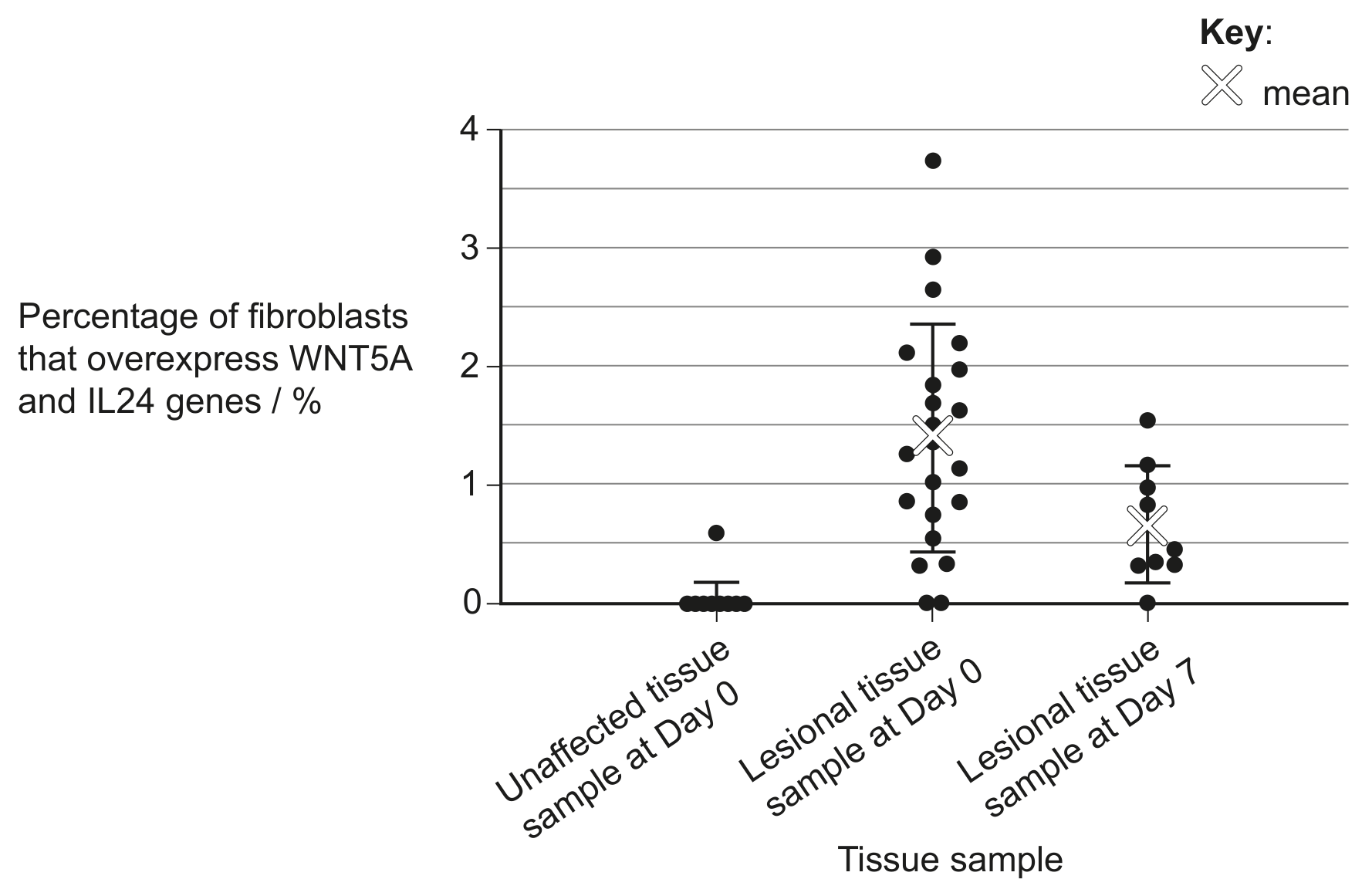
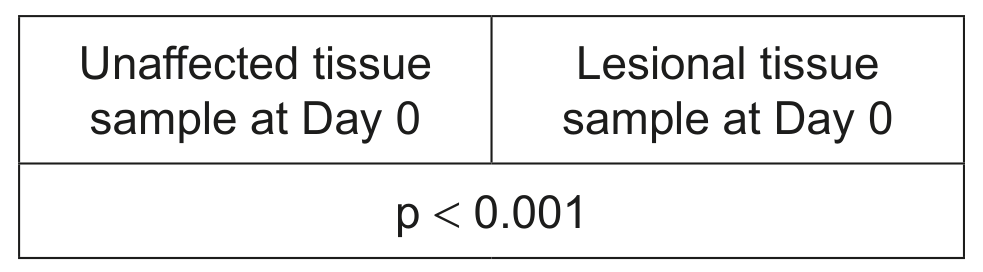
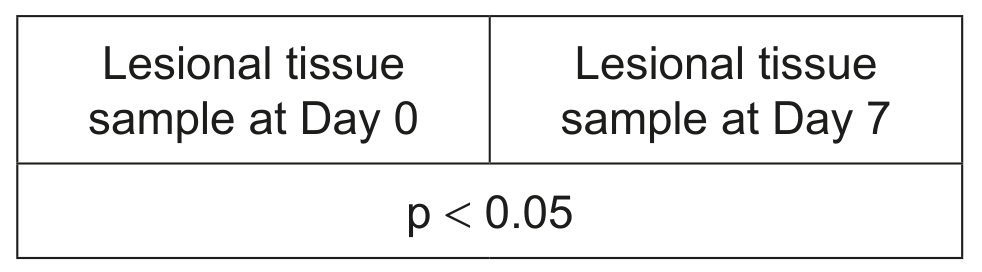
Skin cells called fibroblasts were extracted from all tissue samples. The scientists measured the expression of two genes that are known to cause inflammation, WNT5A and IL24. They calculated the percentage of fibroblasts that overexpress (express more than normal) both the WNT5A and IL24 genes. The graph shows the data. The crosses on the graph represent mean percentages.
Statistical significance levels
Statistical significance levels

Table
Statistical significance levels

Statistical significance levels

State the highest percentage of fibroblasts that overexpress WNT5A and IL24 in the lesional tissue sample at Day 0.

[ 1 ]
(e)

Calculate the decrease in the mean percentage of fibroblasts in lesional tissue that overexpress WNT5A and IL24 after treatment with guselkumab.

[ 1 ]
(f)

Suggest the reason for including unaffected tissue samples in this investigation.

[ 1 ]
(g)

Explain the conclusions that can be drawn from the data in the graph.
[ 2 ]
[Maximum number: 1]

What is a proteome?

A

The genes that code for all the proteins in the ribosome

B

The group of proteins that generate a proton gradient in mitochondria

C

The entire genome of a prokaryote

D

The entire set of proteins expressed by an organism at a certain time

[Maximum number: 1]

Which statement correctly describes genome and proteome?

A

Only the genome but not the proteome can be analysed using gel electrophoresis.

B

The genome and the proteome are the same in all tissues in an organism.

C

In cells of different tissues, the genome is the same while the proteome varies.

D

Only mutations in the proteome but not in the genome cause any variability.

[Maximum number: 1]

What is the proteome of an individual?

A

The amino acids unique to an individual making up the proteins in cells

B

The way in which an individual's polypeptides are folded into a three-dimensional structure

C

The proteins synthesized as an expression of an individual's genes

D

All possible combinations of amino acids an individual contains

[Maximum number: 9]

Honey bees (Apis mellifera) live in colonies where some workers exhibit scouting behaviour. The scouts communicate information on new food sources to the non-scouting workers of the colony.

(a)

Outline how the scouts communicate the location of new food sources to the non-scouts.

[ 2 ]
(b)

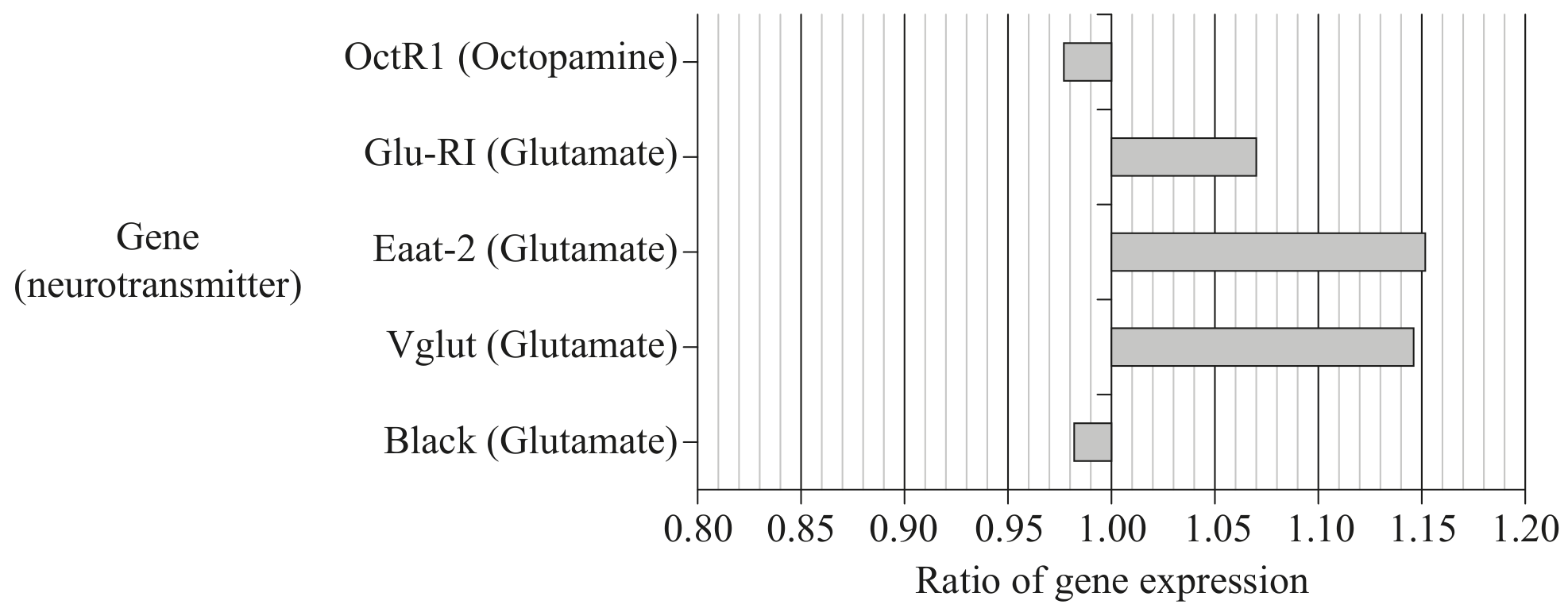
Biologists compared food scouts to non-scouts to see if the gene expression for neurotransmitter signalling differs in their brain cells. Several genes for neurotransmitters were investigated by the scientists, including one gene for octopamine and four genes for glutamate.

 Ratio of gene expression = the gene expression in the scouts  the gene expression in the non-scouts \text { Ratio of gene expression }=\frac{\text { the gene expression in the scouts }}{\text { the gene expression in the non-scouts }}

The ratio of gene expression was calculated and the results are shown on the graph.

Question image

State what the ratio of 1.00 means.

[ 1 ]
(c)

State which gene shows the highest expression in the scouts compared to the non-scouts.

[ 1 ]
(d)

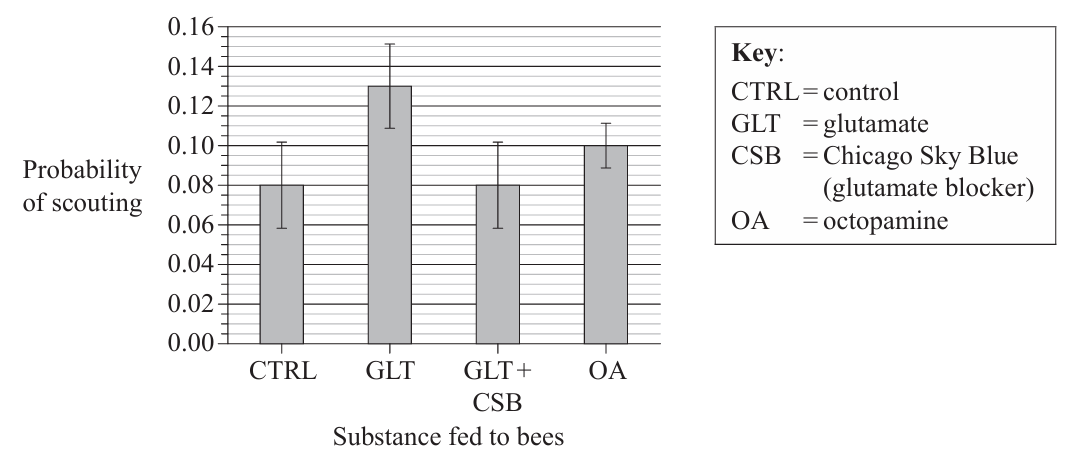
The biologists then fed non-scout bees various substances to see if they would promote scouting behaviour. The graph shows the effect of these substances.

Question image

Calculate the increase in the probability of scouting behaviour of non-scouts fed with GLT (glutamate) and OA (octopamine).
GLT:
OA:

[ 2 ]
(e)

Explain how natural selection could have affected the evolution of scouting behaviour in honey bees.

[ 3 ]
0