Mice (Mus musculus) have various defence systems against predators such as foxes (Vulpus vulpus) or stoats (Mustela erminea). The mice release specific alarm compounds when under threat that serve as danger signals for other mice. Predators also release scents that the mice can detect.
In one study, mice were exposed to paper soaked in compounds taken from other mice, foxes or stoats in a test chamber. The scientists then measured the reaction of three different groups of neurons used in smelling: G1, G2 and G3, as shown in the diagram.
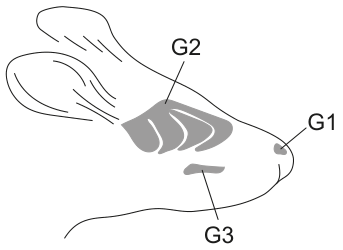
The percentage of G1, G2 and G3 neurons responding to the mouse, fox and stoat compounds, as well as a control compound, are shown in the chart.
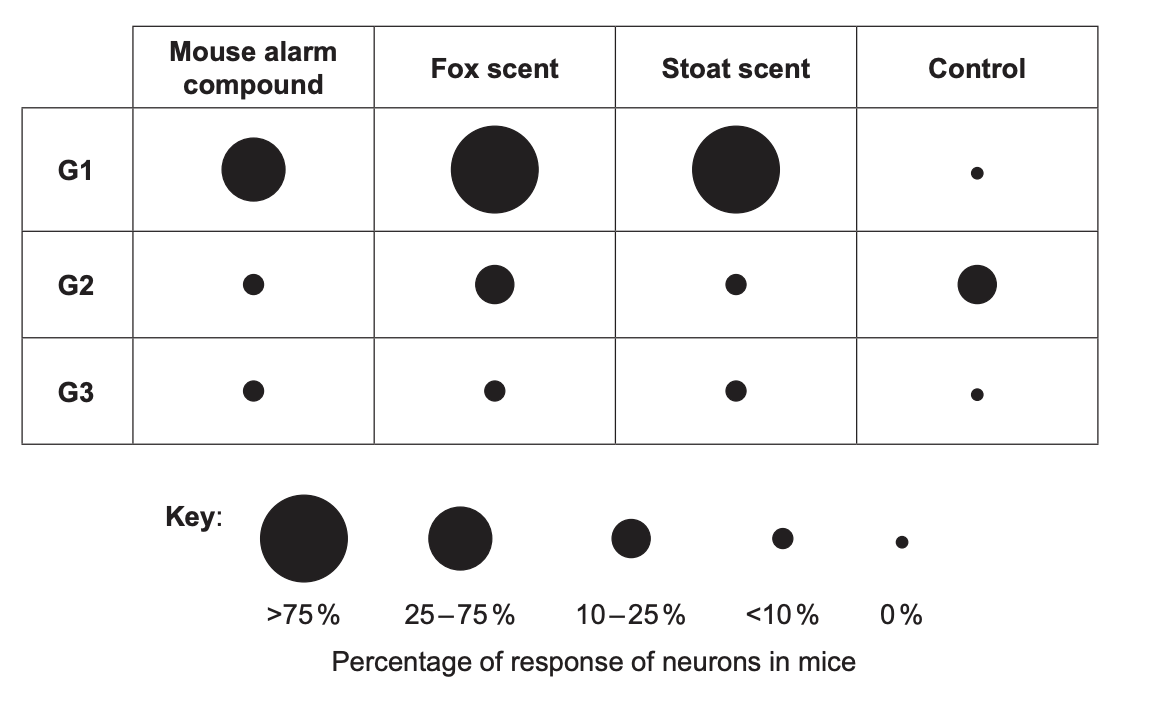
State the percentage of G2 neurons in the mice that respond to the fox scent.
Using evidence from the chart, identify, giving a reason, which group of neurons responded most to the chemicals.
The scientists recorded the neural traces (action and resting potentials) of six G1 neurons exposed to the compounds from the different animals. The horizontal bar beneath each trace corresponds to the time of exposure to the test compound.
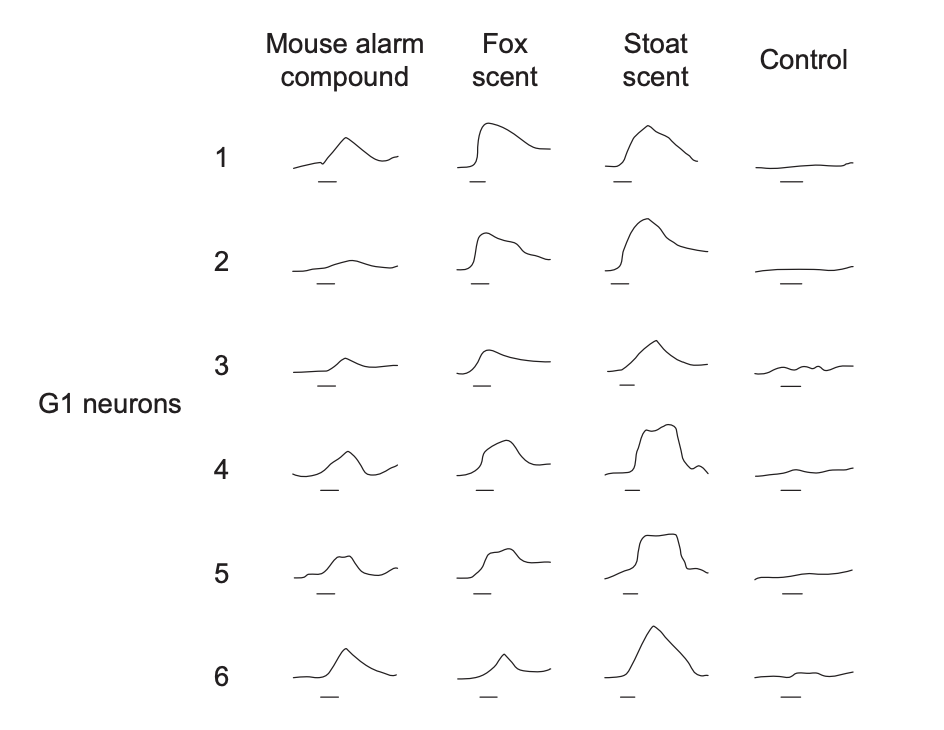
State the name of the instrument used to make these traces.
Distinguish between the effects of the mouse alarm compound and the effects of the control compound on the G1 neurons.
Compare and contrast the effects of the mouse alarm compound and stoat scent on the G1 neurons.
Deduce whether there is a correlation between the neural traces and the percentage of responding G1 neurons.
The molecular structures of the mouse alarm compound and fox scent are very similar.
Suggest an evolutionary advantage for this chemical similarity.
Another study was carried out on the defence systems in aphids (Myzus persicae) which feed on thale cress plants (Arabidopsis thaliana). Individual aphids release an alarm compound containing the chemical (E)- -farnesene (EBF) when attacked by a predator. Other aphids are repelled and leave the thale cress plant or hide.
The gene for EBF was inserted to produce transgenic (T) thale cress plants to test aphid reaction to EBF over several generations. Aphids were raised on wild type (W) thale cress and then allowed to feed for three generations on either W or T thale cress. Aphids were tested in each generation for their reaction when EBF was added to a choice chamber. The percentages of aphids attracted to or repelled by EBF and those which made no choice were recorded.
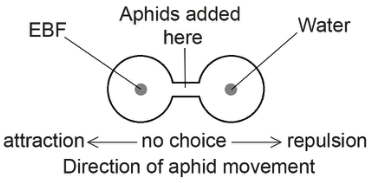
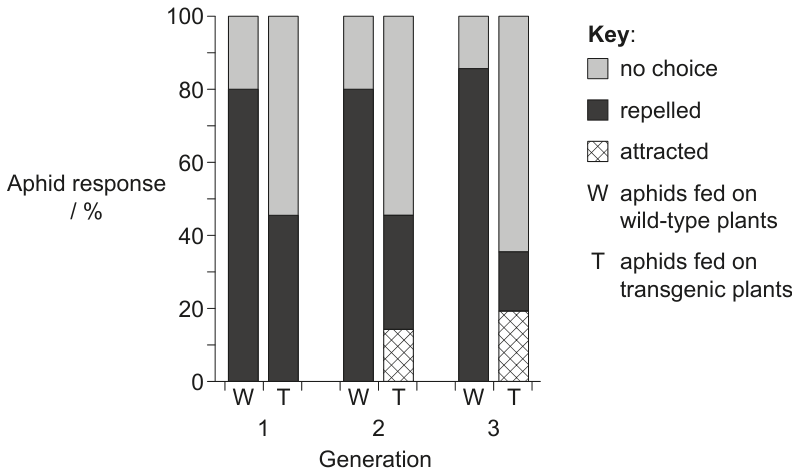
Identify, with a reason, the aphids that were most strongly repelled by EBF.
Outline the conclusions that can be drawn from the data in the graph for the group of aphids fed for three generations on transgenic thale cress plants (T).
Discuss whether natural selection would favour the transgenic EBF-producing thale cress plants if they were released into the wild.