EduNinja
Question rangeB2.3.6—Surface area-to-volume ratios
[Maximum number: 1]

How would surface area, volume and surface area to volume ratio of a cell change as the cell becomes bigger, if the cell does not change shape?

Surface area

Volume

Surface area : volume

Increase

Increase

Increase

Increase

Increase

Decrease

Increase

Decrease

Decrease

Decrease

Increase

Increase

[Maximum number: 12]

There is growing evidence of a decrease in bee populations. This decrease is a serious problem because of their valuable role as pollinators in the ecosystems where they live. Neonicotinoid pesticides have been implicated in this decrease because they have been found at trace levels in the nectar and pollen of crop plants and in the bee colonies.
Scientists placed colonies of a species of bumblebee, Bombus terrestris, in the laboratory to test the effects of different levels of a neonicotinoid on their development. They divided the colonies into three groups:
- The control colonies were given a solution of water and sugar that resembled nectar produced by flowers.
- A second group of colonies was given the same sugar solution containing a neonicotinoid dissolved in it at low concentrations, similar to those found in nature.
- A third group of colonies was given the same sugar solution containing a neonicotinoid dissolved in it at high concentrations, similar to those found in nature.

After two weeks, all colonies were placed in the field to allow the bumblebees to feed naturally.

[Maximum number: 1]

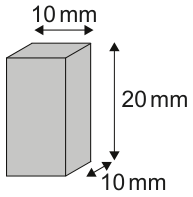
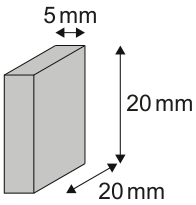
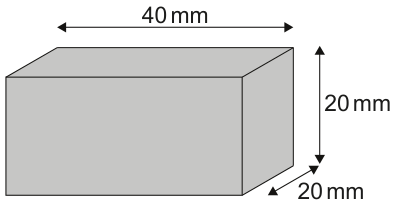
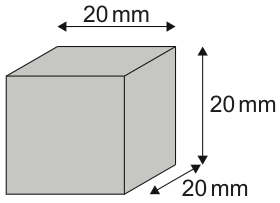
The diagrams represent cells with the same concentration of dissolved substances in their cytoplasm. If all the cells were placed in the same hypertonic sucrose solution, which cell would show the greatest rate of change in the concentration of its cytoplasm?

A
Question image
B
Question image
C
Question image
D
Question image
[Maximum number: 1]

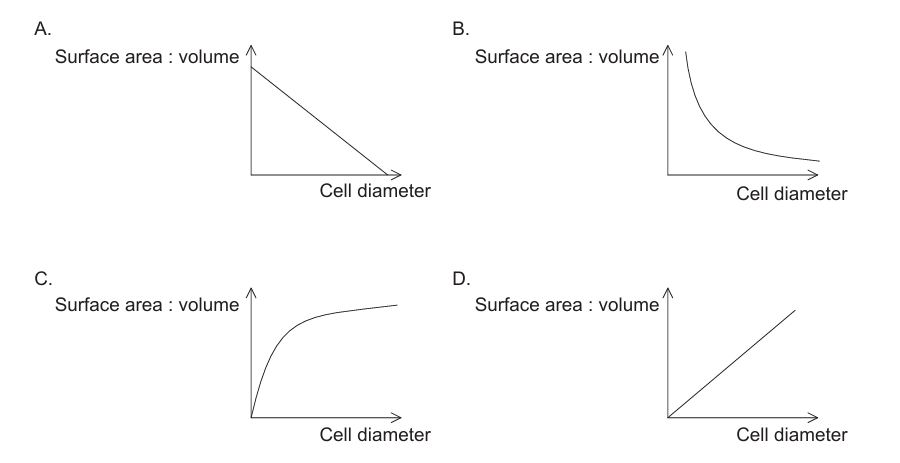
Which graph represents the change in cell surface area to volume ratio with increasing cell diameter?

Question image
[Maximum number: 1]

What happens to the cell surface area to volume ratio as a cell grows?

A

It decreases, so production of waste material is reduced.

B

It increases, so mineral ion absorption is increased.

C

It increases, so osmosis is reduced.

D

It decreases, so rate of gas exchange is too low.

[Maximum number: 1]

In a cell, what is the effect of a large surface area to volume ratio?

A

Slower rate of exchange of waste materials

B

Faster heat loss

C

Faster rate of mitosis

D

Slower intake of food

[Maximum number: 1]

During which stage does the cell surface area to volume ratio decrease?

A

Interphase

B

Metaphase

C

Telophase

D

Cytokinesis

[Maximum number: 1]

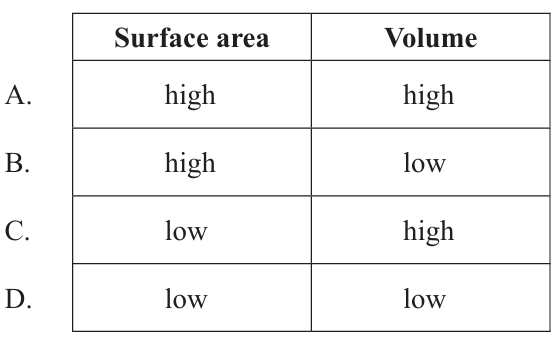
What features of a cell favour efficient removal of waste products?

Question image
[Maximum number: 1]

What happens to the surface area to volume ratio as a cell grows?

A

It decreases.

B

It increases.

C

It doubles.

D

It does not change.

[Maximum number: 1]

What is proportional to a cell's surface area?

A

Rate of exchange of materials

B

Rate of heat production

C

Rate of waste production

D

Rate of oxygen consumption

0