EduNinja
Question rangeB2.1.12 (HL)—Cholesterol and fluidity
[Maximum number: 1]

More than 90 % of cellular cholesterol is located in the cell's plasma membrane. What is the main role of cholesterol in the plasma membranes of mammalian cells?

A

To regulate membrane fluidity

B

To increase membrane solubility

C

To increase membrane permeability

D

To regulate membrane temperature
[Maximum number: 1]

What is a function of cholesterol in the cell membrane?

A

To regulate fluidity

B

To store energy

C

To provide a channel for transport

D

To hold adjacent cells together

[Maximum number: 1]

What is a role of cholesterol in animal cells?

A

It increases body fat.

B

It controls membrane fluidity.

C

It lines the inner wall of capillaries.

D

It is a constituent of bile.

[Maximum number: 1]

Which molecule regulates the fluidity of cell membranes?

A

Phospholipid

B

Cholesterol

C

Glycoprotein

D

Peripheral protein

[Maximum number: 1]

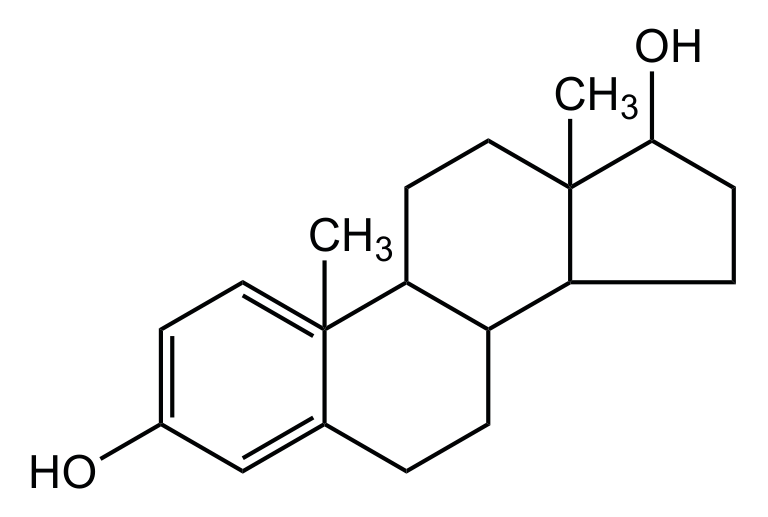
Oestradiol is a steroid hormone.

Question image

How does oestradiol cross plasma membranes?

A

It can move between phospholipids because it is non-polar.

B

It can pass either between phospholipids or through channel proteins because it is amphipathic.

C

It can only pass through hydrophilic pores as its polar ends can form H bonds.

D

It must pass through channel proteins due to its large size.

[Maximum number: 1]

Which statement applies to cholesterol?

A

It is hydrophobic and found on the outside of the phospholipid bilayer.

B

It is hydrophilic and found inside the phospholipid bilayer.

C

It impacts membrane fluidity.

D

It is transported in association with glucose in the blood.

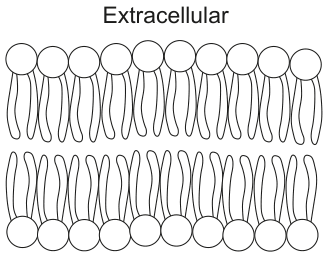
The image shows a phospholipid bilayer that is a component of the cell membrane.

Intracellular

Intracellular

[Maximum number: 7]

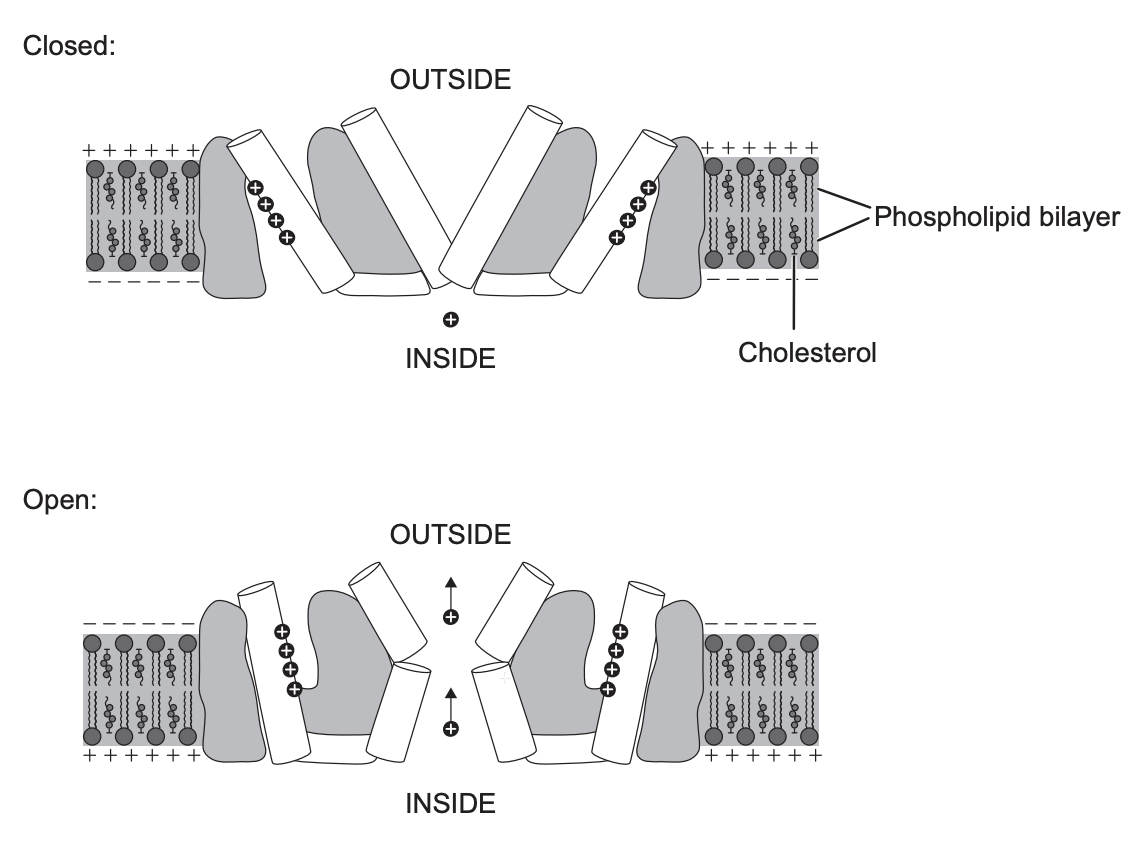
Voltage-gated ion channels are proteins that are embedded in the phospholipid bilayer of plasma membranes. They conduct ions at high rates, regulated by the voltage across the membrane. The diagram shows a typical voltage-gated potassium ( K+\mathrm{K}^{+}) channel when it is closed and when it is open.

Question image
0